

Parveen Shakir poetry is the voice of a woman speaking about love, pride and loss in her own words, and that is why it still fills WhatsApp statuses more than 30 years after her death. On this page you will find 17 of her best known sher, each checked against her published work, with a simple Explanation of what it means and when people share it. You will also find her books in order and a short guide to spotting the fake lines that are shared in her name.
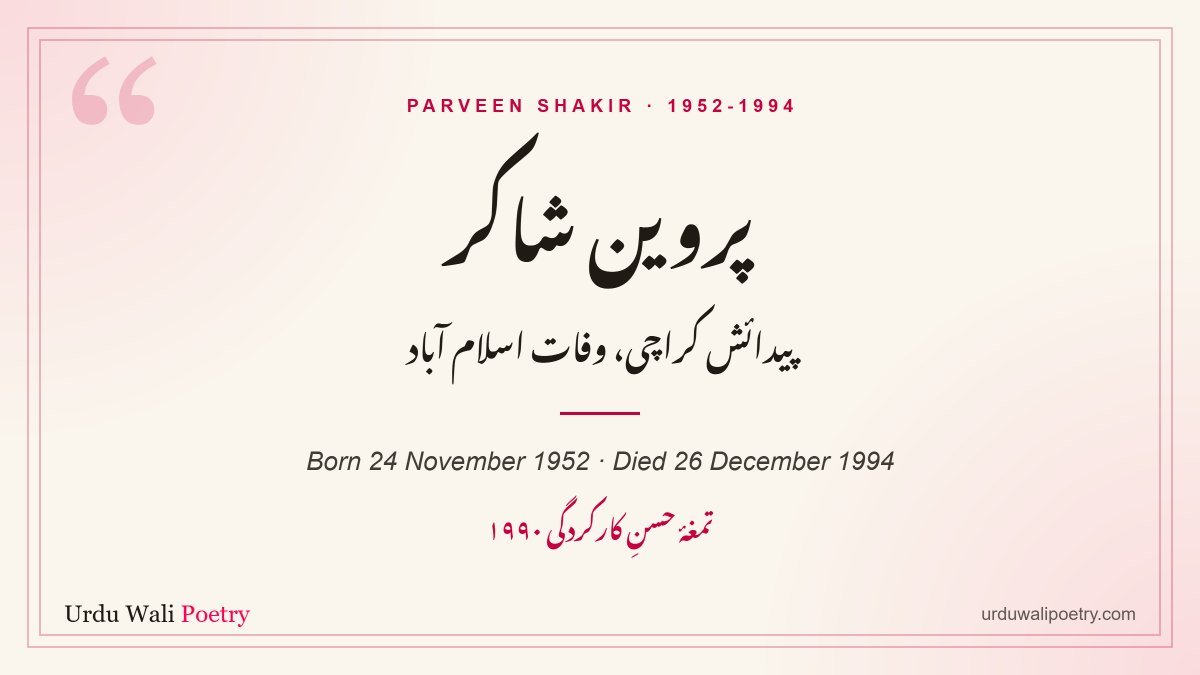
Parveen Shakir (1952 to 1994) was a Pakistani Urdu poet from Karachi. Her first book, Khushbu (1976), won the Adamjee Literary Award, and she received the Pride of Performance in 1990. Her poetry is known for simple words, images like khushbu (fragrance) and kajal, and a woman’s point of view on love and separation.
Table of Contents
- Parveen Shakir at a Glance
- Elegance and Emotion in Her Verses
- Parveen Shakir Sad Poetry on Hijr and Judai
- Feminine Perspective and Lasting Impact
- Parveen Shakir Poetry on Justice and Society
- Parveen Shakir 2 Line Poetry for WhatsApp Status
- Parveen Shakir Books in Order
- Fake Sher Shared in Parveen Shakir’s Name
- Have a Sher in Your Own Voice?
- Conclusion
- FAQs
Parveen Shakir at a Glance
Parveen Shakir was born on 24 November 1952 in Karachi and died in a road accident in Islamabad on 26 December 1994, at the age of 42. In her short life she published five books of poetry and became one of the most read poets of her generation.
Before joining the civil service, she worked as a teacher for nine years. In 1986 she was posted to Islamabad as second secretary of the Central Board of Revenue, so for most of her life poetry was written alongside a full time government job.
Her mentor was Ahmad Nadeem Qasmi, one of the senior names of Urdu literature. Since her death, the Parveen Shakir Urdu Literature Festival has been held in Islamabad in her memory. You can read her short profile on Parveen Shakir’s poet page.
Elegance and Emotion in Her Verses
The love poetry of Parveen Shakir is soft on the surface and sharp underneath. She writes about being loved, being left and being talked about, often in the same ghazal. The four sher below show that mix of tenderness and quiet hurt.
کو بہ کو پھیل گئی بات شناسائی کی
اس نے خوشبو کی طرح میری پذیرائی کی
Koo ba koo phail gayi baat shanasai ki
Us ne khushboo ki tarah meri pazeerai ki
Parveen Shakir
Explanation: Shanasai means acquaintance and pazirai means welcome. The beloved welcomed her the way fragrance is welcomed, and fragrance cannot be hidden, so the news of their closeness spread from lane to lane. The second line is the reason the first one happened. Mehdi Hassan’s singing of this ghazal made it one of her best known pieces.
وہ کہیں بھی گیا لوٹا تو مرے پاس آیا
بس یہی بات ہے اچھی مرے ہرجائی کی
Woh kahin bhi gaya lauta to mere paas aaya
Bas yahi baat hai achhi mere harjai ki
Parveen Shakir
Explanation: A harjai is someone whose heart wanders. She does not pretend he was faithful; she admits it openly, then finds the one good thing in him: wherever he went, he came back to her. The smile in this sher is bitter, and that honesty is what makes it feel real.
وہ تو خوش بو ہے ہواؤں میں بکھر جائے گا
مسئلہ پھول کا ہے پھول کدھر جائے گا
Woh to khushboo hai hawaon mein bikhar jayega
Masla phool ka hai phool kidhar jayega
Parveen Shakir
Book: Khushbu
Explanation: He is the fragrance, free to scatter in any wind. The real question is about the flower: where can a flower go? It stays rooted where it grew. Many readers see this as the difference between a man’s freedom and a woman’s place in society, which fits the title of her very first book.
گلاب ہاتھ میں ہو آنکھ میں ستارہ ہو
کوئی وجود محبت کا استعارہ ہو
Gulab hath mein ho aankh mein sitara ho
Koi wajood mohabbat ka isteara ho
Parveen Shakir
Explanation: A rose in the hand and a star in the eye: in one line she paints the most hopeful moment of love. The ghazal goes on to wish for someone who could be an istiara (metaphor) of love itself. It is a gentle sher, often shared on birthdays and anniversaries.
Parveen Shakir Sad Poetry on Hijr and Judai
Parveen Shakir’s sad poetry is rarely loud. Instead of crying out, she shows small physical signs of grief: eyes, palm lines, kajal. If you like this mood, you will also enjoy our wider collection of sad poetry in Urdu.
پاس جب تک وہ رہے درد تھما رہتا ہے
پھیلتا جاتا ہے پھر آنکھ کے کاجل کی طرح
Paas jab tak woh rahe dard thama rehta hai
Phailta jata hai phir aankh ke kajal ki tarah
Parveen Shakir
Explanation: While he is near, the pain stays still. The moment he leaves, it spreads like kajal running from a wet eye. Only a woman who has seen her own kajal spread after crying could write this image, and that personal detail is what makes the sher unforgettable.
تو بدلتا ہے تو بے ساختہ میری آنکھیں
اپنے ہاتھوں کی لکیروں سے الجھ جاتی ہیں
Tu badalta hai to be-sakhta meri aankhen
Apne hathon ki lakeeron se ulajh jati hain
Parveen Shakir
Explanation: Be-sakhta means without wanting to. When he changes, her eyes go on their own to the lines of her palm, as if she is checking her fate. She never says “I am hurt”; the reader sees it in one small movement of the eyes.
ہم تو سمجھے تھے کہ اک زخم ہے بھر جائے گا
کیا خبر تھی کہ رگ جاں میں اتر جائے گا
Hum to samjhe the ke ik zakhm hai bhar jayega
Kya khabar thi ke rag-e-jaan mein utar jayega
Parveen Shakir
Explanation: She thought it was a wound that would heal with time. She did not know it would reach the rag-e-jaan, the vein of life itself. This is the sher people share when a breakup they thought was small turns out to be the deepest one.
کیسے کہہ دوں کہ مجھے چھوڑ دیا ہے اس نے
بات تو سچ ہے مگر بات ہے رسوائی کی
Kaise keh doon ke mujhe chhor diya hai us ne
Baat to sach hai magar baat hai ruswai ki
Parveen Shakir
Explanation: Being left is painful, but saying it out loud is harder, because people will talk. Ruswai means public disgrace. In two lines she shows how a woman’s heartbreak becomes a matter of family and society, not only of the heart.
Feminine Perspective and Lasting Impact
What changed Urdu poetry with Parveen Shakir was simple: the woman in the ghazal finally spoke for herself. In classical poetry the beloved is silent and the lover speaks; in her poetry the woman has her own pride, her own doubts and her own rebellion.
میں سچ کہوں گی مگر پھر بھی ہار جاؤں گی
وہ جھوٹ بولے گا اور لا جواب کر دے گا
Main sach kahungi magar phir bhi haar jaungi
Woh jhoot bolega aur la-jawab kar dega
Parveen Shakir
Explanation: She will tell the truth and still lose; he will lie and leave her with no answer. La-jawab means speechless. Anyone who has lost an argument to a smoother talker understands this sher at once, which is why it is one of her most shared lines.
تجھے مناؤں کہ اپنی انا کی بات سنوں
الجھ رہا ہے مرے فیصلوں کا ریشم پھر
Tujhe manaun ke apni ana ki baat sunun
Ulajh raha hai mere faislon ka resham phir
Parveen Shakir
Explanation: Should she make up with him, or listen to her own ana (self respect)? She compares her decisions to resham, silk thread, which tangles at the slightest pull. The word “phir” at the end tells us this is not the first time she is stuck in this knot.
لڑکیوں کے دکھ عجب ہوتے ہیں سکھ اس سے عجیب
ہنس رہی ہیں اور کاجل بھیگتا ہے ساتھ ساتھ
Larkiyon ke dukh ajab hote hain sukh us se ajeeb
Hans rahi hain aur kajal bheegta hai saath saath
Parveen Shakir
Explanation: A girl laughs while her kajal is getting wet: happiness and tears at the same moment. She says girls’ sorrows are strange and their joys even stranger. It is shared a lot by daughters on wedding days, when leaving home is both a joy and a grief.
کچھ تو ترے موسم ہی مجھے راس کم آئے
اور کچھ مری مٹی میں بغاوت بھی بہت تھی
Kuch to tere mausam hi mujhe raas kam aaye
Aur kuch meri mitti mein baghawat bhi bohat thi
Parveen Shakir
Explanation: Here she does not blame only the other person. His seasons did not suit her, she admits, but her own soil also had a lot of baghawat (rebellion) in it. Few love poets are this fair to both sides.
Parveen Shakir Poetry on Justice and Society
Not all Parveen Shakir poetry is about love. In some ghazals she writes about a city where people cannot speak freely and justice cannot be trusted. These sher show a side of her that romantic collections usually skip.
پا بہ گل سب ہیں رہائی کی کرے تدبیر کون
دست بستہ شہر میں کھولے مری زنجیر کون
Pa-ba-gil sab hain rihai ki kare tadbeer kaun
Dast-basta shehar mein khole meri zanjeer kaun
Parveen Shakir
Explanation: Pa-ba-gil means feet stuck in clay. When everyone in the city is stuck and their hands are tied (dast-basta), who is left to open her chains? The ghazal goes on to question the judge and the court, so the sher is about a whole society, not one person.
دشمنوں کے ساتھ میرے دوست بھی آزاد ہیں
دیکھنا ہے کھینچتا ہے مجھ پہ پہلا تیر کون
Dushmanon ke saath mere dost bhi azaad hain
Dekhna hai kheenchta hai mujh pe pehla teer kaun
Parveen Shakir
Explanation: Her enemies are free, and so are her friends. Now she only waits to see who shoots the first arrow. The fear is not of the enemy; it is the doubt that the first wound may come from a friend.
Parveen Shakir 2 Line Poetry for WhatsApp Status
These short, clear sher work well as WhatsApp status because each one tells a full story in two lines. For more of this kind, read our heart touching 2 line poetry from the classic poets.
بس یہ ہوا کہ اس نے تکلف سے بات کی
اور ہم نے روتے روتے دوپٹے بھگو لیے
Bas ye hua ke us ne takalluf se baat ki
Aur hum ne rote rote dupatte bhigo liye
Parveen Shakir
Explanation: Nothing dramatic happened. He only spoke to her with takalluf, the polite formality we use with strangers, and she cried until her dupatta was wet. Anyone who has heard “aap” from someone who used to say “tum” knows how much that small change hurts.
ممکنہ فیصلوں میں ایک ہجر کا فیصلہ بھی تھا
ہم نے تو ایک بات کی اس نے کمال کر دیا
Mumkina faislon mein ek hijr ka faisla bhi tha
Hum ne to ek baat ki us ne kamal kar diya
Parveen Shakir
Explanation: Separation was one of the possible decisions. She only raised a point, and he “did wonders” by choosing exactly that. The phrase “kamal kar diya” is pure sarcasm, which makes this a favourite status after a sudden breakup.
وہ شخص آ کے مرے شہر سے چلا بھی گیا
میں پھول چنتی رہی اور مجھے خبر نہ ہوئی
Woh shakhs aa ke mere shehar se chala bhi gaya
Main phool chunti rahi aur mujhe khabar na hui
Parveen Shakir
Explanation: He came to her city and left again, and she kept picking flowers without knowing. The sadness is in the missed chance, not in a fight. It suits the moments when you learn too late that someone you wanted to see was close by.
Parveen Shakir Books in Order
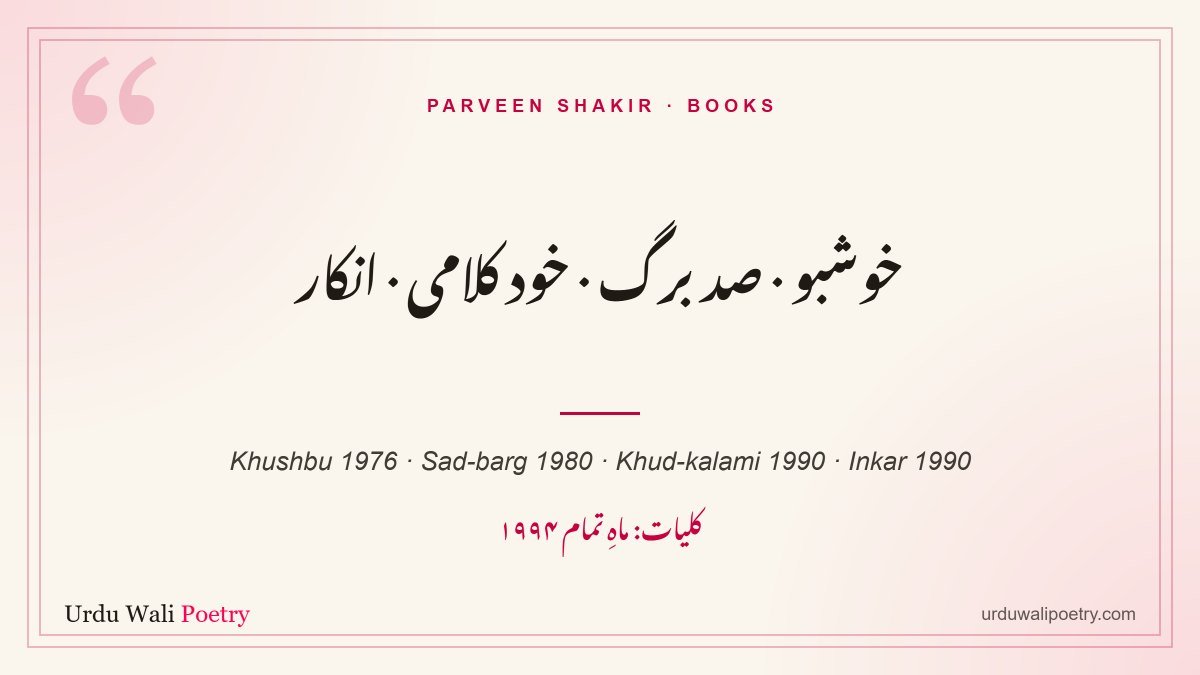
Parveen Shakir published four books of poetry in her lifetime, and in 1994 they were collected in one volume called Mah-e-Tamam. Here is the order, with the year each appeared:
1. Khushbu (1976), her first book, which won the Adamjee Literary Award.
2. Sad-barg (1980).
3. Khud-kalami (1990).
4. Inkar (1990).
5. Mah-e-Tamam (1994), the kulliyat (collected works) of the four books above.
Kaf-e-Aina was published after her death. If you want to check any sher you read online, Mah-e-Tamam is the best single book to look in, because almost all her ghazals are inside it.
Fake Sher Shared in Parveen Shakir’s Name
Many lines shared online with Parveen Shakir’s name are not hers. A common pattern is that the first line is real and the second line has been changed or made up, so the sher no longer rhymes or loses its meaning. We found and removed several such lines from this page while updating it.
Here is a quick way to check a sher before you share it:
1. Read both lines aloud. In her ghazals the second line always ends with the same radeef (repeated end word) and qafia (rhyme) as the rest of the ghazal. If the rhyme breaks, the line has probably been changed.
2. Look for her images. Her real poetry uses khushbu, kajal, chand, barish and resham again and again, in very simple words.
3. Check it in Mah-e-Tamam or another printed collection of her work. If you cannot find it there, do not attach her name to it.
Have a Sher in Your Own Voice?
Parveen Shakir wrote about love and pride exactly the way she felt them, without borrowing anyone’s voice. If you write poetry in that spirit, share it with our readers in Urdu or Roman Urdu under your own name. Every post is checked before it goes live. Post your own shayari here.
Conclusion
Parveen Shakir poetry lasts because it is honest. She wrote about love without hiding the hurt, about pride without apology, and about society without shouting. The 17 sher on this page are a good start, but the real pleasure is reading the full ghazals in her books.
If you enjoyed her voice, explore more love poetry in Urdu, read Faiz Ahmad Faiz poetry, or try the restless lines of Jaun Elia poetry.
FAQs
Who was Parveen Shakir?
Parveen Shakir was a Pakistani Urdu poet, teacher and civil servant, born in Karachi on 24 November 1952. She is best known for her romantic ghazals written from a woman’s point of view. She died in a road accident in Islamabad on 26 December 1994.
What is Parveen Shakir’s most famous sher?
Two of her most quoted sher are the one beginning “Main sach kahungi magar phir bhi haar jaungi” and the one beginning “Ko-ba-ko phail gayi baat shanasai ki”. Both are in the collection above with their meaning.
What was Parveen Shakir’s first book?
Her first book of poetry was Khushbu, published in 1976. It won the Adamjee Literary Award and brought her wide recognition.
When is Parveen Shakir’s birthday and death anniversary?
Her birth anniversary is on 24 November and her death anniversary is on 26 December. Literary events and TV programmes in Pakistan remember her on both dates.
Which singer sang Parveen Shakir’s ghazal?
Mehdi Hassan sang her well known ghazal “Ko-ba-ko phail gayi baat shanasai ki”, and many other singers have also performed her poetry.
How can I tell if a sher is really by Parveen Shakir?
Check whether both lines rhyme with the rest of the ghazal, and look for the sher in her collected works, Mah-e-Tamam. Many lines online carry her name but have a changed or made up second line.
Comments0
No comments yet. Be the first to share your thoughts.