


Looking for sad poetry in Urdu that is real and not copied from random status pages? Here you will read 17 classic sad sher in Urdu text and Roman Urdu, on zindagi, judai, tanhai, bewafai and tears, each with the poet’s name and a short explanation of what it really means. Every line has been checked against the poet’s own ghazal.
Sad poetry in Urdu is poetry of gham (grief), dard (pain), judai (separation) and tanhai (loneliness), usually written as a sher of two lines inside a ghazal. The most quoted sad sher come from classic masters like Mirza Ghalib, Mir Taqi Mir, Fani Badayuni and Dagh Dehlvi, whose lines are still shared as WhatsApp status today.
Table of Contents
- What Is Sad Poetry in Urdu?
- Very Sad Poetry About Life
- Heart Touching Sad Poetry About Love and Judai
- Sad Poetry in Urdu Text on Tanhai
- Bewafai and Intezar Shayari
- Sad Lines in Urdu Text About Tears and Sighs
- A Famous Ghalib Sher That Is Often Misquoted
- How to Share Sad Poetry on WhatsApp Status
- Write sad poetry of your own?
- Conclusion
- FAQs
What Is Sad Poetry in Urdu?
Sad poetry in Urdu is any sher, ghazal or nazm whose main feeling is grief. In Urdu it is often called dard bhari shayari or gham ki shayari.
Most sad poetry comes as a sher: two lines (misre) that complete one thought. A ghazal is a chain of such sher that share the same radeef (the repeated ending word) and qafia (rhyme), but each sher can be read and shared on its own.
Urdu has a whole vocabulary for sadness: hijr (separation from the beloved), intezar (waiting), bewafai (unfaithfulness), udaasi (low mood) and tanhai (loneliness). The sections below follow these moods, so you can jump to the one you feel today.
If you want longer pieces, read our 4 line sad poetry in Urdu text, and for short lines see deep sad poetry in Urdu 2 lines.
Very Sad Poetry About Life
The saddest Urdu poetry about life is not about one heartbreak but about living itself: grief that never ends and a life that feels like a prison. These four sher come from two poets who knew that feeling well.
1. Mirza Ghalib: Qaid e Hayat o Band e Gham
قید حیات و بند غم اصل میں دونوں ایک ہیں
موت سے پہلے آدمی غم سے نجات پائے کیوں
Qaid-e-hayat o band-e-gham asl mein donon ek hain
Maut se pehle aadmi gham se najat paaye kyun
Mirza Ghalib
Explanation: Qaid-e-hayat is the prison of life and band-e-gham is the chain of grief. Ghalib says they are really one and the same thing, so why should anyone expect to be free of grief while still alive? It sounds dark, but it is also strangely calming: sadness is not a failure, it is part of being alive.
2. Mirza Ghalib: Ranj Se Khugar Hua Insan
رنج سے خوگر ہوا انساں تو مٹ جاتا ہے رنج
مشکلیں مجھ پر پڑیں اتنی کہ آساں ہو گئیں
Ranj se khugar hua insan to mit jata hai ranj
Mushkilen mujh par padin itni ke aasan ho gayin
Mirza Ghalib
Explanation: Khugar means used to something. When a person gets used to sorrow, the sorrow stops hurting. Ghalib had so many troubles that they became easy. Many readers share this one after a long bad phase, because it is sad and brave at the same time.
3. Fani Badayuni: Zindagi Jabr Hai
زندگی جبر ہے اور جبر کے آثار نہیں
ہائے اس قید کو زنجیر بھی درکار نہیں
Zindagi jabr hai aur jabr ke aasaar nahin
Haaye is qaid ko zanjeer bhi darkaar nahin
Fani Badayuni
Explanation: Jabr means force, something you did not choose. Fani says life is forced on us, yet you cannot see any sign of the force. The second line is the painful one: this prison does not even need a chain, because you cannot walk out of it anyway.

4. Mirza Ghalib: Gham e Hasti Ka Asad
غم ہستی کا اسدؔ کس سے ہو جز مرگ علاج
شمع ہر رنگ میں جلتی ہے سحر ہوتے تک
Gham-e-hasti ka Asad kis se ho juz marg ilaj
Shama har rang mein jalti hai sahar hote tak
Mirza Ghalib
Explanation: Asad was Ghalib’s first takhallus (pen name). He says the grief of existence (gham-e-hasti) has no cure. Then he gives the picture of a candle (shama): whatever happens around it, it keeps burning until morning (sahar). A person, too, keeps going through every kind of night until his time is complete.
Heart Touching Sad Poetry About Love and Judai
Heart touching sad poetry about love is mostly about one thing: you cannot stop loving the person who hurts you. These four sher show that from four different sides.
5. Mirza Ghalib: Mohabbat Mein Nahin Hai Farq
محبت میں نہیں ہے فرق جینے اور مرنے کا
اسی کو دیکھ کر جیتے ہیں جس کافر پہ دم نکلے
Mohabbat mein nahin hai farq jeene aur marne ka
Usi ko dekh kar jeete hain jis kafir pe dam nikle
Mirza Ghalib
Explanation: In love, living and dying become the same. The lover lives only by looking at the very person (called kafir, the cruel one) who is taking his life away. This sher is from the same ghazal as “Hazaron khwahishen aisi”, yet far fewer people know it.

6. Mir Taqi Mir: Yaad Us Ki Itni Khoob Nahin
یاد اس کی اتنی خوب نہیں میرؔ باز آ
نادان پھر وہ جی سے بھلایا نہ جائے گا
Yaad us ki itni khoob nahin Mir baaz aa
Nadan phir wo jee se bhulaya na jayega
Mir Taqi Mir
Explanation: Mir is talking to himself here. Stop thinking about her so much, Mir; it is not good for you. Then the warning: foolish one (nadan), if you keep remembering, you will never be able to forget. Anyone who has kept checking an old chat at 2 am knows this feeling.
7. Mirza Ghalib: Hui Muddat Ke Ghalib Mar Gaya
ہوئی مدت کہ غالبؔ مر گیا پر یاد آتا ہے
وہ ہر اک بات پر کہنا کہ یوں ہوتا تو کیا ہوتا
Hui muddat ke Ghalib mar gaya par yaad aata hai
Wo har ik baat par kehna ke yun hota to kya hota
Mirza Ghalib
Explanation: Ghalib imagines people remembering him after his death. It has been ages since Ghalib died, they say, but we still remember his habit of asking about everything, “what if it had happened this way?” It is a gentle, sad line about the people we miss for their small habits.
8. Mir Taqi Mir: Kya Kahun Tum Se Main Ke Kya Hai Ishq
کیا کہوں تم سے میں کہ کیا ہے عشق
جان کا روگ ہے بلا ہے عشق
Kya kahun tum se main ke kya hai ishq
Jaan ka rog hai bala hai ishq
Mir Taqi Mir
Explanation: Someone asks Mir what love is, and he has no sweet answer. Rog means a disease and bala means a disaster. Ishq, for Mir, is an illness that stays with you for life. It is short enough for a status and says more than a long post.
Sad Poetry in Urdu Text on Tanhai
Tanhai (loneliness) poetry is about the quiet kind of sadness: the empty evening, the house that feels like a desert, the feeling of being far from home.
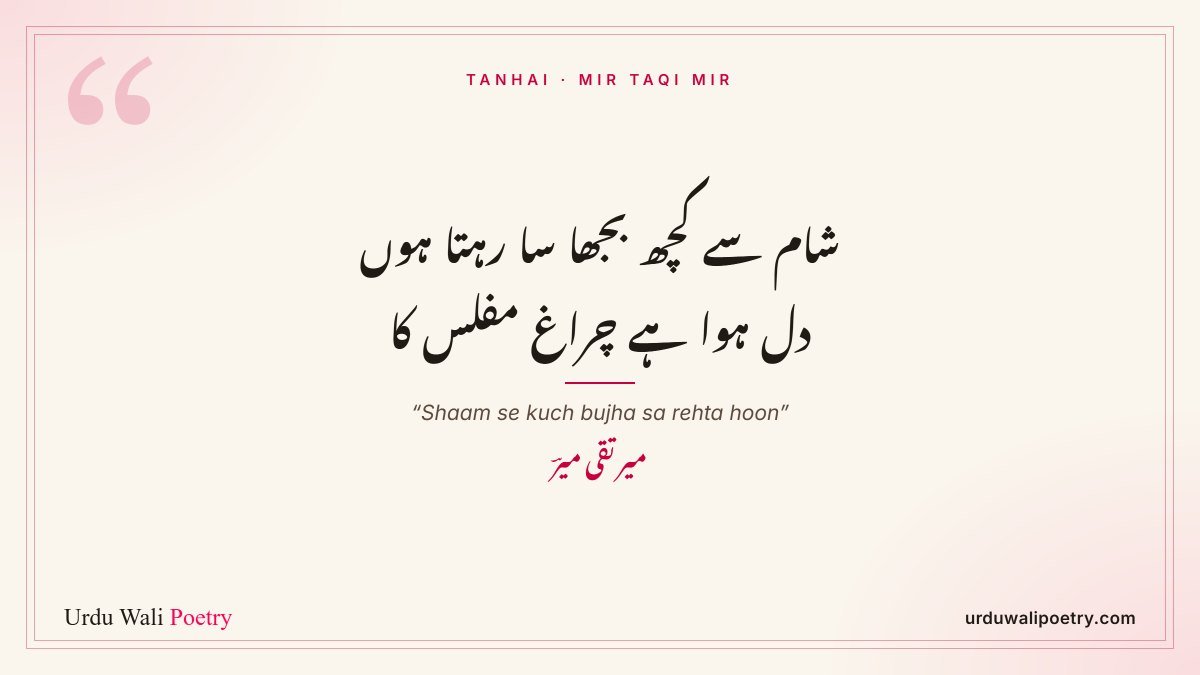
9. Mir Taqi Mir: Shaam Se Kuch Bujha Sa Rehta Hoon
شام سے کچھ بجھا سا رہتا ہوں
دل ہوا ہے چراغ مفلس کا
Shaam se kuch bujha sa rehta hoon
Dil hua hai charagh muflis ka
Mir Taqi Mir
Explanation: From evening on, Mir feels dim, like a lamp that is going out. His heart has become a poor man’s lamp (charagh-e-muflis): a poor man cannot afford oil, so his lamp is the first to go out at night. One small picture holds all the loneliness of an evening.
10. Mirza Ghalib: Koi Veerani Si Veerani Hai
کوئی ویرانی سی ویرانی ہے
دشت کو دیکھ کے گھر یاد آیا
Koi veerani si veerani hai
Dasht ko dekh ke ghar yaad aaya
Mirza Ghalib
Explanation: Dasht is a desert. Ghalib looks at an empty desert and is reminded of his own home, because his house is even more deserted. The repeated word “veerani” (emptiness) is the trick: what a desolation this is. Few lines describe a lonely home better.
11. Fani Badayuni: Fani Hum To Jeete Ji
فانیؔ ہم تو جیتے جی وہ میت ہیں بے گور و کفن
غربت جس کو راس نہ آئی اور وطن بھی چھوٹ گیا
Fani hum to jeete ji wo mayyat hain be-gor-o-kafan
Ghurbat jis ko raas na aayi aur watan bhi chhoot gaya
Fani Badayuni
Explanation: Here ghurbat does not mean poverty; it means living far from home. Fani calls himself someone who could not settle in a strange city, yet has already lost his own hometown (watan). It is the sadness of a person who belongs nowhere. Fani himself left Badayun and spent his last years in Hyderabad Deccan.
Bewafai and Intezar Shayari
Bewafai (broken faith) and intezar (waiting) are the oldest pair in Urdu sad poetry: one person makes a promise, and the other waits for it to be kept.
12. Mirza Ghalib: Hum Ne Maana Ke Taghaful Na Karoge
ہم نے مانا کہ تغافل نہ کرو گے لیکن
خاک ہو جائیں گے ہم تم کو خبر ہوتے تک
Hum ne maana ke taghaful na karoge lekin
Khaak ho jayenge hum tum ko khabar hote tak
Mirza Ghalib
Explanation: Taghaful means deliberate neglect. Ghalib says: fine, I believe you will not ignore me. But by the time the news of my state reaches you, I will already have turned to dust (khaak). Note the words “khabar hote tak”: many pages write “khabar hone tak”, but the whole ghazal ends every sher with “hote tak”.
13. Dagh Dehlvi: Wafa Karenge Nibahenge
وفا کریں گے نباہیں گے بات مانیں گے
تمہیں بھی یاد ہے کچھ یہ کلام کس کا تھا
Wafa karenge nibahenge baat manenge
Tumhen bhi yaad hai kuch ye kalam kis ka tha
Dagh Dehlvi
Explanation: The first line repeats the beloved’s own old promises: I will be faithful, I will stay, I will listen to you. The second line asks the sharp question: do you even remember whose words these were? Dagh does not shout “bewafa”; he simply reminds, and that hurts more.
14. Mir Taqi Mir: Dil Wo Nagar Nahin
دل وہ نگر نہیں کہ پھر آباد ہو سکے
پچھتاؤ گے سنو ہو یہ بستی اجاڑ کر
Dil wo nagar nahin ke phir aabad ho sake
Pachhtaoge suno ho ye basti ujaad kar
Mir Taqi Mir
Explanation: Nagar and basti both mean a town. Mir warns the person who is breaking his heart: this is not the kind of town that gets rebuilt. Listen, you will regret it once you have ruined it. “Suno ho” is old Delhi speech, and it makes the line sound like a real conversation.
Sad Lines in Urdu Text About Tears and Sighs
Some of the most beautiful sad lines in Urdu are about aansu (tears) and aah (a sigh), the small signs of a pain that cannot be spoken.
15. Mir Taqi Mir: Mere Rone Ki Haqeeqat
میرے رونے کی حقیقت جس میں تھی
ایک مدت تک وہ کاغذ نم رہا
Mere rone ki haqeeqat jis mein thi
Ek muddat tak wo kaghaz nam raha
Mir Taqi Mir
Explanation: Mir wrote down the story of his crying on a piece of paper, and that paper stayed wet (nam) for a long time. He never says “I cried a lot”. He lets the paper say it.
16. Mirza Ghalib: Rone Se Aur Ishq Mein Bebaak Ho Gaye
رونے سے اور عشق میں بے باک ہو گئے
دھوئے گئے ہم اتنے کہ بس پاک ہو گئے
Rone se aur ishq mein bebaak ho gaye
Dhoye gaye hum itne ke bas paak ho gaye
Mirza Ghalib
Explanation: Crying made Ghalib more fearless (bebaak) in love, not weaker. He was washed by his tears so many times that he became paak, pure. A rare sad sher that ends on strength.
17. Mirza Ghalib: Aah Ko Chahiye Ik Umr
آہ کو چاہیے اک عمر اثر ہوتے تک
کون جیتا ہے تری زلف کے سر ہوتے تک
Aah ko chahiye ik umr asar hote tak
Kaun jeeta hai teri zulf ke sar hote tak
Mirza Ghalib
Explanation: A lover’s sigh (aah) needs a whole lifetime to have any effect (asar) on the beloved. And who lives long enough to see her tangled hair (zulf) finally tamed? It is the opening sher of the same ghazal as number 4 and number 12 above.
A Famous Ghalib Sher That Is Often Misquoted
Ghalib’s sher number 12 is often shared with one wrong word. You will see it written as “tum ko khabar hone tak”, but the correct words are “khabar hote tak”.
You can check it yourself without any book. Every sher of this ghazal ends with the same radeef, “hote tak”: “asar hote tak”, “sar hote tak”, “sahar hote tak”. A line ending in “hone tak” simply does not belong to the ghazal.
When you share a sher, a small change can make it a different line. Copy it from a source that names the poet and gives the full ghazal.
How to Share Sad Poetry on WhatsApp Status
Short sad poetry works best for a WhatsApp status because people read it in a second.
- Pick by mood: Mir’s “Shaam se kuch bujha sa rehta hoon” for a lonely evening, Dagh’s “Wafa karenge nibahenge” for a broken promise, Ghalib’s “Ranj se khugar hua insan” after a hard phase.
- Always add the poet’s name. It gives the line its weight and stops wrong names from spreading.
- Use the picture if Urdu text breaks on your phone. Nastaliq in an image looks cleaner than plain text.
For more status lines read our shayari for WhatsApp status and heart touching 2 line Urdu poetry.
Write sad poetry of your own?
If one of these sher reminded you of your own pain, try putting it in your own words. On Urdu Wali Poetry you can post your sad shayari in Urdu or Roman Urdu under your own name, and every post is checked before it goes live. Post your own shayari here.
Conclusion
The best sad poetry in Urdu does not complain loudly. Ghalib calls life and grief one prison, Mir compares his heart to a poor man’s lamp, and Dagh simply asks whose promise it was. All 17 sher here are real, credited to the right poet and written as they appear in the poets’ ghazals.
Read more lines by these masters on the Mirza Ghalib and Mir Taqi Mir poet pages, or explore our Sad Poetry category.
FAQs
What is sad poetry called in Urdu?
Sad poetry in Urdu is often called dard bhari shayari, gham ki shayari or udaas shayari. Most of it is written as a sher of two lines, usually as part of a ghazal.
Who is the best poet of sad poetry in Urdu?
Mir Taqi Mir and Mirza Ghalib are the two classic masters of sad poetry. Fani Badayuni is also known as the poet of despair, because grief fills almost all of his poetry.
Who wrote “Hum ne maana ke taghaful na karoge lekin”?
Mirza Ghalib wrote it. The correct second line is “Khaak ho jayenge hum tum ko khabar hote tak”, not “khabar hone tak”.
Who wrote “Shaam se kuch bujha sa rehta hoon”?
Mir Taqi Mir wrote it. The full sher is “Shaam se kuch bujha sa rehta hoon, dil hua hai charagh muflis ka”.
Which sad poetry is best for WhatsApp status?
Short two line sher work best. Mir’s “Kya kahun tum se main ke kya hai ishq” and Ghalib’s “Koi veerani si veerani hai” are short, clear and easy to read in a second.
Can I post my own sad poetry on Urdu Wali Poetry?
Yes. Create a free account and post your shayari in Urdu or Roman Urdu. Each post is reviewed before it is published, and your name stays with your poetry.
Comments0
No comments yet. Be the first to share your thoughts.