

Heart touching 2 line Urdu poetry is the kind you read once and then quietly send to one person. This page brings together 16 such sher by classical poets, each in Urdu and Roman Urdu with the poet’s name and a short explanation of the feeling behind it.
Our older version of this page had lines with no poet and no source. We have replaced them with sher by Mir Taqi Mir, Ghalib, Momin, Khwaja Mir Dard, Hasrat Mohani, Amir Minai, Dagh, Fani Badayuni and Allama Iqbal, so you know exactly whose words you are sharing.
Quick answer: Heart touching 2 line Urdu poetry is a single sher (couplet) that carries a deep feeling, like love, silence, regret or longing, in just two lines. Some of the most touching examples come from Mir Taqi Mir, Mirza Ghalib, Momin Khan Momin and Fani Badayuni.
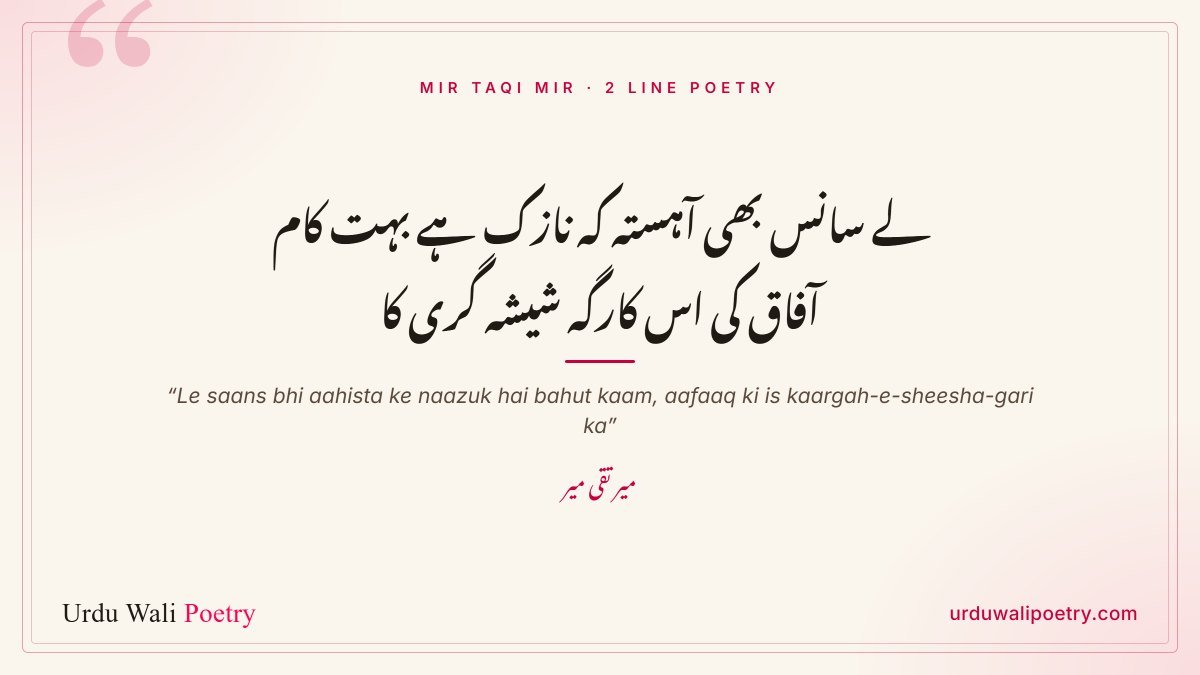
Table of Contents
Silence and Unspoken Emotions
The most heart touching Urdu sher are often about what was never said. These six sher by Mir, Momin, Hasrat Mohani and Khwaja Mir Dard turn a quiet feeling into two lines you can read again and again.
لے سانس بھی آہستہ کہ نازک ہے بہت کام
آفاق کی اس کارگہ شیشہ گری کا
Le saans bhi aahista ke naazuk hai bahut kaam
Aafaaq ki is kaargah-e-sheesha-gari ka
Mir Taqi Mir (1723-1810)
Explanation: Mir compares the whole world to a glass-maker’s workshop (kaargah-e-sheesha-gari), where everything is fragile. Even breathe softly here, he says. It is a line about care: hearts, like glass, break from small carelessness, not only from big blows.
تم ہمارے کسی طرح نہ ہوئے
ورنہ دنیا میں کیا نہیں ہوتا
Tum hamare kisi tarah na hue
Warna duniya mein kya nahin hota
Momin Khan Momin (1800-1852)
Explanation: In this world anything can happen, says Momin, except the one thing I wanted: you never became mine. There is no anger in the line, only a tired surprise. That calm tone is what makes it hurt.
آئینے میں وہ دیکھ رہے تھے بہار حسن
آیا مرا خیال تو شرما کے رہ گئے
Aaine mein woh dekh rahe the bahaar-e-husn
Aaya mera khayal to sharma ke reh gaye
Hasrat Mohani (1875-1951)
Explanation: The beloved is looking at their own beauty in the mirror, and suddenly the thought of the poet comes to mind. They blush and stop. Nothing is spoken, no one else is in the room, yet the whole love story is in that one blush.
ہم فقیروں سے بے ادائی کیا
آن بیٹھے جو تم نے پیار کیا
Hum faqeeron se be-adaai kya
Aan baithe jo tum ne pyaar kiya
Mir Taqi Mir (1723-1810)
Explanation: Why show pride or coldness to faqirs like us? We are simple people: if you show us a little love, we will come and sit by your side. Mir makes humility sound like strength. People share it when they want to say, “I don’t need much, just a little care.”
ہم تجھ سے کس ہوس کی فلک جستجو کریں
دل ہی نہیں رہا ہے جو کچھ آرزو کریں
Hum tujh se kis hawas ki falak justuju karen
Dil hi nahin raha hai jo kuch aarzoo karen
Khwaja Mir Dard (1721-1785)
Explanation: Mir Dard speaks to the sky (falak), the old symbol of fate. What should I even ask from you? I no longer have a heart left that could wish for anything. It is the quietest kind of sadness: not crying, just having nothing left to want.
ٹک میرؔ جگر سوختہ کی جلد خبر لے
کیا یار بھروسا ہے چراغ سحری کا
Tuk Mir-e-jigar-sokhta ki jald khabar le
Kya yaar bharosa hai charagh-e-sehri ka
Mir Taqi Mir (1723-1810)
Explanation: This is the maqta of the same ghazal as “Le saans bhi aahista”. Mir asks the beloved to check on him soon, because he is like a lamp at dawn (charagh-e-sehri), which can go out at any moment. It is the line to send when someone you love keeps saying “I’ll call later.”
Short Shayari in Urdu That Touches the Heart
Short shayari in Urdu touches the heart when it turns love into a small, true picture. These six sher by Ghalib, Momin, Amir Minai and Hasrat Mohani are about love that cannot be controlled, hidden or fully won.
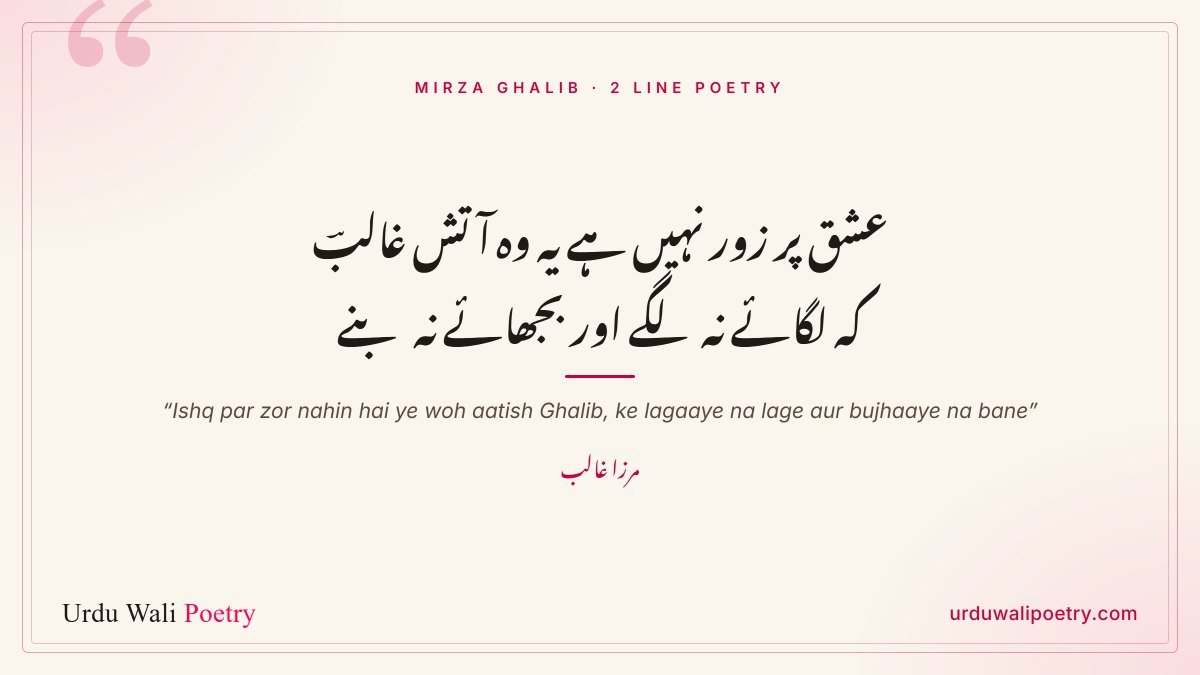
عشق پر زور نہیں ہے یہ وہ آتش غالبؔ
کہ لگائے نہ لگے اور بجھائے نہ بنے
Ishq par zor nahin hai ye woh aatish Ghalib
Ke lagaaye na lage aur bujhaaye na bane
Mirza Ghalib (1797-1869)
Explanation: Love is a fire (aatish) that no one controls. You cannot light it by trying, and once it starts, you cannot put it out. Ghalib explains in two lines why advice never works on someone in love.
نکلنا خلد سے آدم کا سنتے آئے ہیں لیکن
بہت بے آبرو ہو کر ترے کوچے سے ہم نکلے
Nikalna khuld se Aadam ka sunte aaye hain lekin
Bahut be-aabroo ho kar tere kooche se hum nikle
Mirza Ghalib (1797-1869)
Explanation: We have always heard how Hazrat Adam was sent out of paradise (khuld). But leaving your street, Ghalib says, was even more humiliating. He compares a lover’s rejection with the oldest exile in human history, half in pain and half with a smile.
تھی وصل میں بھی فکر جدائی تمام شب
وہ آئے تو بھی نیند نہ آئی تمام شب
Thi wasl mein bhi fikr-e-judaai tamaam shab
Woh aaye to bhi neend na aayi tamaam shab
Momin Khan Momin (1800-1852)
Explanation: Even on the night of meeting (wasl), the fear of separation kept him awake. The beloved finally came, and still there was no sleep. Anyone who has spent a happy moment worrying about when it will end knows this feeling.
تم کو آتا ہے پیار پر غصہ
مجھ کو غصے پہ پیار آتا ہے
Tum ko aata hai pyaar par ghussa
Mujh ko ghusse pe pyaar aata hai
Amir Minai (1829-1900)
Explanation: Amir Minai simply swaps two words, pyaar and ghussa, and creates one of the sweetest lines in Urdu. You get angry when I show love; I feel love when you get angry. It is perfect for the person whose anger you secretly find cute.
گاہے گاہے کی ملاقات ہی اچھی ہے امیرؔ
قدر کھو دیتا ہے ہر روز کا آنا جانا
Gaahe gaahe ki mulaqaat hi achhi hai Ameer
Qadr kho deta hai har roz ka aana jaana
Amir Minai (1829-1900)
Explanation: Meeting now and then is best, Amir says, because daily visits lose their value. It sounds like a complaint, but it is also practical advice for any relationship: a little distance keeps respect and longing alive.
دیکھنے آئے تھے وہ اپنی محبت کا اثر
کہنے کو یہ ہے کہ آئے ہیں عیادت کر کے
Dekhne aaye the woh apni mohabbat ka asar
Kehne ko ye hai ke aaye hain iyaadat kar ke
Hasrat Mohani (1875-1951)
Explanation: The beloved came to visit the sick lover. Officially it was iyaadat, asking after his health. But Hasrat knows the real reason: they came to see what their love had done to him. A small, clever line about pride hidden inside kindness.
Heart Touching 2 Line Poetry About Life
Some of the most heart touching Urdu poetry is not about a person at all, but about life itself. These four sher by Fani Badayuni, Allama Iqbal and Dagh Dehlvi are about living on, speaking from the heart and finding joy in love.
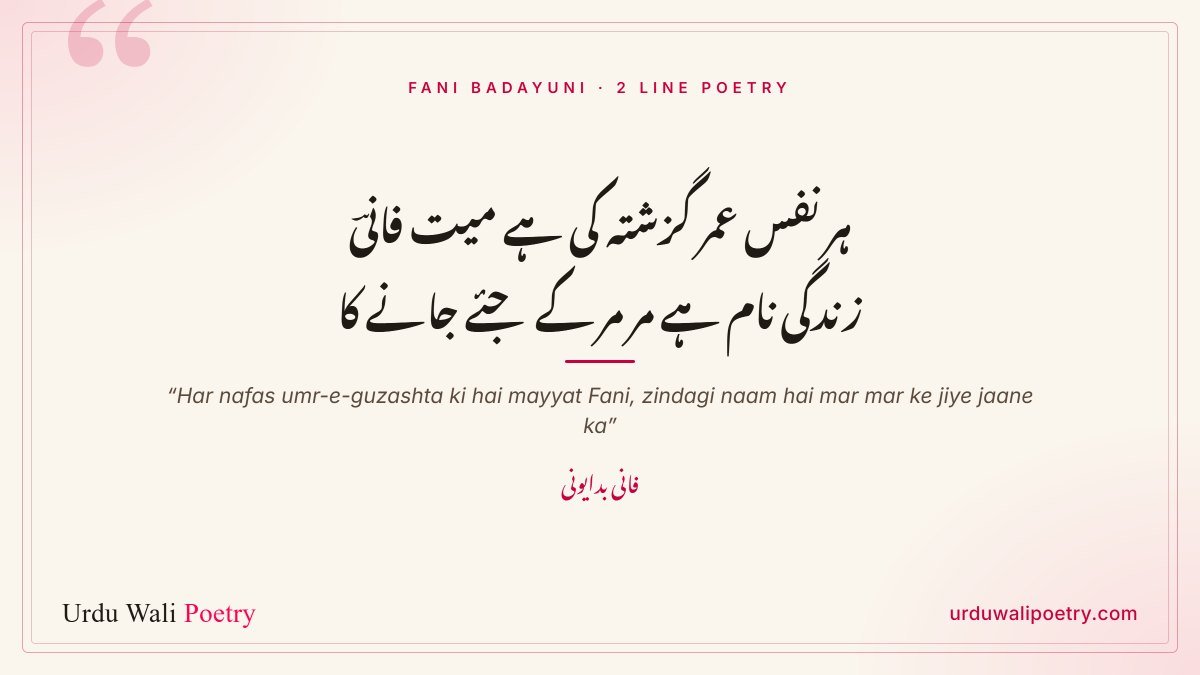
ہر نفس عمر گزشتہ کی ہے میت فانیؔ
زندگی نام ہے مر مر کے جئے جانے کا
Har nafas umr-e-guzashta ki hai mayyat Fani
Zindagi naam hai mar mar ke jiye jaane ka
Fani Badayuni (1879-1941)
Explanation: Every breath (nafas) is the funeral of a moment that has already passed. So life, Fani says, is just dying again and again and still living on. Fani is known for the sad colour of his poetry, and this is one of his most quoted sher.
اک معمہ ہے سمجھنے کا نہ سمجھانے کا
زندگی کاہے کو ہے خواب ہے دیوانے کا
Ik mu’amma hai samajhne ka na samjhaane ka
Zindagi kaahe ko hai, khwaab hai deewane ka
Fani Badayuni (1879-1941)
Explanation: Life is a riddle (mu’amma) that can neither be understood nor explained. What is it, really? Just a madman’s dream. Many readers love this sher even more than Fani’s famous “mar mar ke jiye jaane ka”.
دل سے جو بات نکلتی ہے اثر رکھتی ہے
پر نہیں طاقت پرواز مگر رکھتی ہے
Dil se jo baat nikalti hai asar rakhti hai
Par nahin taaqat-e-parwaaz magar rakhti hai
Allama Iqbal (1877-1938), Bang-e-Dra
Explanation: These are the opening lines of Iqbal’s poem Jawab-e-Shikwa. Words that come from the heart have an effect; they have no wings, yet they can fly. It is the best answer to anyone who asks why a simple, honest message can move people more than clever words.
ہزاروں کام محبت میں ہیں مزے کے داغؔ
جو لوگ کچھ نہیں کرتے کمال کرتے ہیں
Hazaron kaam mohabbat mein hain maze ke Dagh
Jo log kuch nahin karte kamaal karte hain
Dagh Dehlvi (1831-1905)
Explanation: Love is full of delightful things to do, says Dagh, and those who do nothing at all are the real masters. It is a playful line with a soft lesson: in love, sometimes just being there, doing “nothing”, is the greatest thing you can do.
Share Your Own Poetry
Do you write sher that touch the heart? Urdu Wali Poetry is a community for readers and poets. You can post your poetry on our site, share it with other readers and receive their daad.
Conclusion
Heart touching 2 line Urdu poetry works because it says one true feeling in very few words. Mir’s fragile glass world, Momin’s sleepless night, Amir Minai’s love for anger and Fani’s life of dying and living all fit in two lines, yet they stay with you for years.
For more classic sher, read our famous Urdu poetry collection or our 4 line Urdu shayari from classic ghazals. You can also visit the poet pages of Mir Taqi Mir and Dagh Dehlvi.
FAQs
What is heart touching 2 line Urdu poetry?
It is a single Urdu sher (two lines) that expresses a deep feeling such as love, longing, regret or silence in a way that stays with the reader. The best examples come from classical poets like Mir, Ghalib and Momin.
Who wrote “Tum ko aata hai pyaar par ghussa”?
This sher was written by Amir Minai (1829-1900). Its beauty is in the simple swap of two words, pyaar and ghussa, between the two lines.
Who wrote “Zindagi naam hai mar mar ke jiye jaane ka”?
It was written by Fani Badayuni (1879-1941), a poet known for the sad tone of his ghazals. The full sher begins “Har nafas umr-e-guzashta ki hai mayyat Fani”.
Which 2 line Urdu poetry is best to send to someone you love?
Light and sweet sher work best, like Amir Minai’s “Tum ko aata hai pyaar par ghussa” or Mir’s “Hum faqeeron se be-adaai kya”. For a sad mood, Momin’s “Tum hamare kisi tarah na hue” says a lot in very few words.
Where does “Dil se jo baat nikalti hai asar rakhti hai” come from?
These are the opening lines of Allama Iqbal’s poem Jawab-e-Shikwa, which is part of his first Urdu collection, Bang-e-Dra (1924).
Should I write the poet’s name when sharing 2 line poetry?
Yes. Writing the poet’s name gives credit to the person who wrote the words and helps readers find more of their poetry. Many lines shared online have the wrong name or no name at all.
Comments0
No comments yet. Be the first to share your thoughts.