


Faiz Ahmad Faiz poetry is loved because it speaks of two things at once: love for a person and love for a fairer world. In this post you will find 9 verified 2 line Faiz sher (couplets) in Urdu and Roman Urdu, each with a short explanation, plus a quick guide to his life, his famous nazms and his books.
Faiz Ahmad Faiz (1911-1984) was a Pakistani Urdu poet from Sialkot. His collected kalam (poetry) is known as Nuskha-ha-e-Wafa. He wrote ghazals and nazms in which “mehboob” (the beloved) can mean a person, the homeland or freedom itself. He won the Lenin Peace Prize in 1962 and died in Lahore on 20 November 1984.
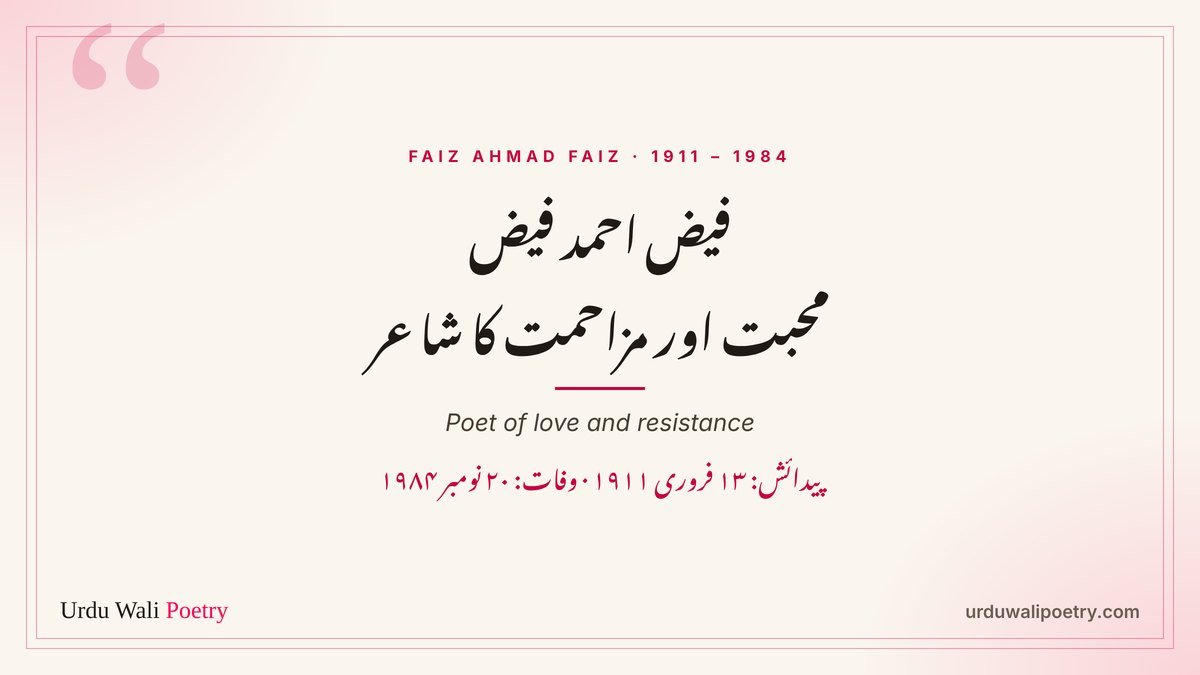
Table of Contents
- Who Was Faiz Ahmad Faiz?
- Faiz Ahmad Faiz Poetry – Best 2 Line Urdu & Roman Shayari
- Top 2 Line Faiz Poetry – Heart-Touching Urdu Shayari
- Famous Nazms of Faiz Ahmad Faiz
- Faiz Ahmad Faiz Books
- Ishq aur Inqilab: The Style of Faiz’s Poetry
- Faiz Ahmad Faiz Death Anniversary
- Share Your Own Poetry
- Conclusion
- Frequently Asked Questions
Who Was Faiz Ahmad Faiz?
Faiz Ahmad Faiz was one of the most important Urdu poets of the 20th century. He is remembered as the poet of love and resistance, and his lines are still recited at mushairas, in songs and at protests.
Faiz was born on 13 February 1911 in Kala Qader, a village of Sialkot district in Punjab. Today the village is in Narowal district and is called Faiz Nagar.
He studied at Murray College, Sialkot and then at Government College, Lahore, where he did his MA in English. He also earned a degree in Arabic from Oriental College, Lahore.
He taught English as a college lecturer, served in the army during the Second World War and, after 1947, became the editor of the English newspaper The Pakistan Times.
In 1951 he was arrested in the Rawalpindi Conspiracy Case and spent about four years in jail. Much of his best-known poetry, including Dast-e-Saba and Zindan-Nama, comes from these prison years.
For his full life story, from Sialkot to the jail years and his death in Lahore, read our detailed Faiz Ahmad Faiz biography
Quick facts:
• Full name: Faiz Ahmad Faiz (“Faiz” is also his takhallus, the pen name used in the last sher of a ghazal)
• Born: 13 February 1911, Kala Qader, Sialkot district
• Died: 20 November 1984, Lahore
• Wife: Alys Faiz
• Major honour: Lenin Peace Prize (1962); Nishan-e-Imtiaz (1990, after his death)
• Complete poetry: Nuskha-ha-e-Wafa
Faiz Ahmad Faiz Poetry – Best 2 Line Urdu & Roman Shayari
These five sher are among Faiz’s most quoted lines. Each one is from his own kalam, and the explanation under it tells you what the lines mean and when people use them.
گلوں میں رنگ بھرے، بادِ نوبہار چلے
چلے بھی آؤ کہ گلشن کا کاروبار چلے
Gulon mein rang bharay, baad-e-naubahaar chalay
Chale bhi aao ke gulshan ka karobaar chalay
Faiz Ahmad Faiz
Explanation: This is the matla (opening sher) of one of his most loved ghazals. Notice the word “karobar”, a word from the bazaar, used for a garden. Faiz is saying that spring has come, but the garden’s real work only starts when the beloved arrives. Mehdi Hassan’s ghazal made these lines famous in every Pakistani home.
بول کہ لب آزاد ہیں تیرے
بول زباں اب تک تیری ہے
Bol ke lab azaad hain teray
Bol, zubaan ab tak teri hai
Faiz Ahmad Faiz
Explanation: These are the opening lines of his nazm “Bol” (Speak). The word “bol” comes like a push on the shoulder. The quiet warning sits in “ab tak”: your tongue is yours for now, so speak before that time runs out. Students and writers still share it whenever someone is afraid to tell the truth.
مجھ سے پہلی سی محبت، مرے محبوب نہ مانگ
میں نے سمجھا تھا کہ تو ہے تو درخشاں ہے حیات
Mujh se pehli si mohabbat mere mehboob na maang
Main ne samjha tha ke tu hai to darakhshan hai hayat
Faiz Ahmad Faiz
Explanation: The poet is not saying his love has ended. He is telling his beloved that he can no longer love the way he did when she was his whole world, because he has now seen the pain of ordinary people around him. Later in the same nazm comes the famous line “aur bhi dukh hain zamane mein mohabbat ke siwa” (there are other sorrows in the world besides love). Noor Jehan’s voice made this nazm part of Pakistan’s memory.
دل نا امید تو نہیں، ناکام ہی تو ہے
لمبی ہے غم کی شام مگر شام ہی تو ہے
Dil na-umeed to nahi, nakaam hi to hai
Lambi hai gham ki shaam, magar shaam hi to hai
Faiz Ahmad Faiz
Explanation: The whole sher rests on the gap between two words. “Nakaam” means you failed this time; “na-umeed” means you stopped hoping, and Faiz refuses the second. The evening of grief is long, he admits, but an evening is still only an evening, and a new morning follows it. People send this sher to friends after a bad result or a lost job.
رات یوں دل میں تیری کھوئی ہوئی یاد آئی
جیسے ویرانے میں چپکے سے بہار آ جائے
Raat yun dil mein teri khoyi hui yaad aayi
Jaise veerane mein chupke se bahaar aa jaye
Faiz Ahmad Faiz
Explanation: Look at “chupke se” (quietly). The memory did not knock; it just came, the way spring arrives in a wasteland before anyone notices. These two lines open a four-line qita (short poem), and the next two lines add two more images of the same soft relief. It is a favourite for late-night WhatsApp status.
Top 2 Line Faiz Poetry – Heart-Touching Urdu Shayari
These four sher are short, easy to remember and full of yaad (memory) and intezar (waiting), the two moods Faiz wrote about most tenderly.
کر رہا تھا غم جہاں کا حساب
آج تم یاد بے حساب آئے
Kar raha tha gham-e-jahan ka hisab
Aaj tum yaad be-hisab aaye
Faiz Ahmad Faiz
Explanation: A playful sher with a sad heart. The poet sat down to count the sorrows of the world (“hisaab”), and the beloved’s memory came “be-hisaab”, beyond counting. The same root word appears twice, and that small echo is what makes the sher stay in your mind.
تمہاری یاد کے جب زخم بھرنے لگتے ہیں
کسی بہانے تمہیں یاد کرنے لگتے ہیں
Tumhari yaad ke jab zakhm bharne lagte hain
Kisi bahane tumhein yaad karne lagte hain
Faiz Ahmad Faiz
Explanation: Most people try to forget a painful memory. Faiz admits the opposite: the moment the wound starts to heal, he finds an excuse to remember again, as if the pain is the only thing still connecting him to the beloved. Anyone who has gone through judai (separation) will recognise this habit.
نہیں نگاہ میں منزل تو جستجو ہی سہی
نہیں وصال میسر تو آرزو ہی سہی
Nahin nigah mein manzil to justuju hi sahi
Nahin wisal muyassar to arzu hi sahi
Faiz Ahmad Faiz
Explanation: If the destination is not in sight, let the search itself be enough; if meeting is not possible, let the longing be enough. The repeated “hi sahi” sounds like a person calmly settling with life. It is a good sher for anyone who is still on the way and not yet there.
دونوں جہان تیری محبت میں ہار کے
وہ جا رہا ہے کوئی شبِ غم گزار کے
Donon jahan teri mohabbat mein haar ke
Woh ja raha hai koi shab-e-gham guzar ke
Faiz Ahmad Faiz
Explanation: Someone has lost both worlds, this one and the next, for love, and is now walking away after surviving a night of grief (“shab-e-gham”). Faiz does not name him; he only says “koi” (someone), which lets every reader see himself in the line. Read it slowly on a sad night and the word “guzar ke” feels like a long breath let out.
Famous Nazms of Faiz Ahmad Faiz
A nazm is a poem built around one theme, unlike a ghazal where every sher can stand alone. Faiz’s nazms are where his voice for justice is loudest.
• Mujh Se Pehli Si Mohabbat Mere Mehboob Na Maang: a love poem that turns towards the suffering of the world. It is from his first collection, Naqsh-e-Faryadi.
• Bol: a short call to speak the truth while you still can.
• Subh-e-Azadi (August 1947): written at the time of independence, it asks whether the long-awaited dawn has really come.
• Hum Dekhenge: written in 1979 and first published in Mere Dil Mere Musafir. Iqbal Bano sang it before a packed hall at Alhamra, Lahore, on 13 February 1986, Faiz’s birthday, and it became one of the most famous protest poems in South Asia.
Faiz Ahmad Faiz Books (Poetry Collections)
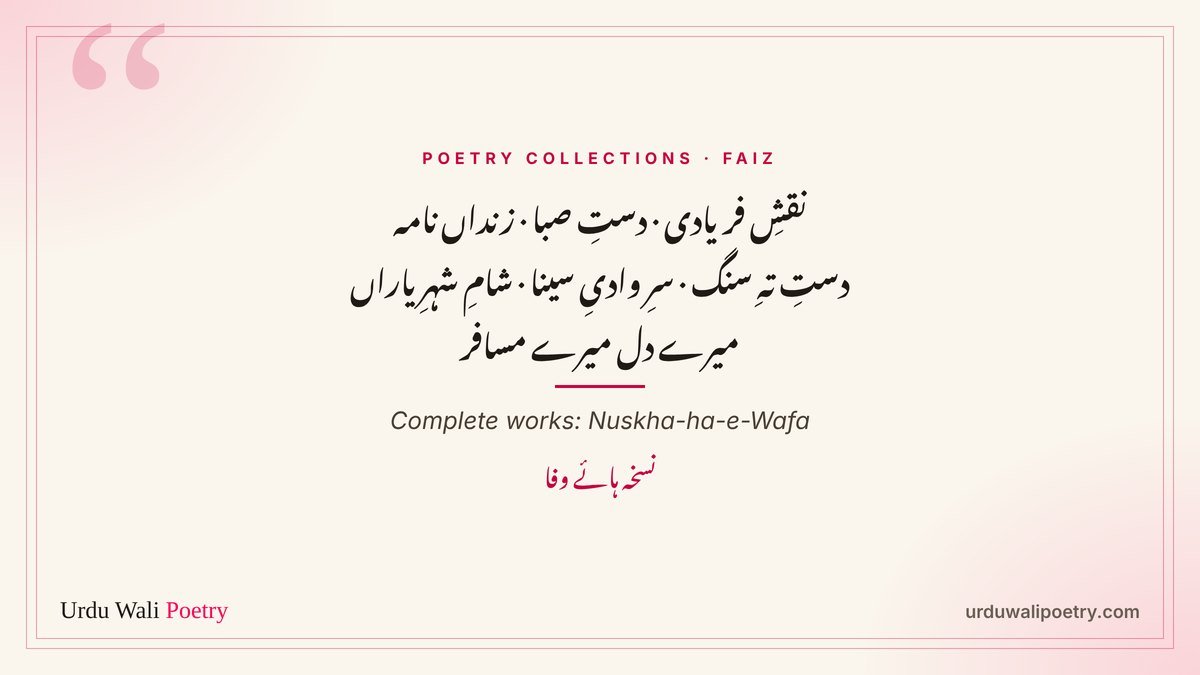
Faiz wrote poetry in several collections over about forty years. All of them were later gathered in one kulliyat (complete works) called Nuskha-ha-e-Wafa.
Main poetry collections of Faiz Ahmad Faiz:
• Naqsh-e-Faryadi – his first collection
• Dast-e-Saba – written mostly in jail
• Zindan-Nama – also from the prison years (“zindan” means prison)
• Dast-e-Tah-e-Sang
• Sar-e-Wadi-e-Seena
• Sham-e-Shehr-e-Yaran
• Mere Dil Mere Musafir – includes “Hum Dekhenge”
• Nuskha-ha-e-Wafa – the complete collection
Ishq aur Inqilab: The Style of Faiz’s Poetry
Faiz’s style mixes classic ghazal words with modern ideas. He used old symbols like gulshan (garden), saba (morning breeze), qafas (cage) and shab-e-gham (night of grief), but gave them new meaning.
In a Faiz sher, the beloved can be a woman, the homeland or freedom. The cage can be a real jail. This double meaning is why his romantic lines are also read as political ones.
His language is soft and musical, which is why so many of his ghazals became songs. Singers like Noor Jehan, Mehdi Hassan and Iqbal Bano gave his words to people who never read a book of poetry.
Faiz Ahmad Faiz Death Anniversary (20 November)
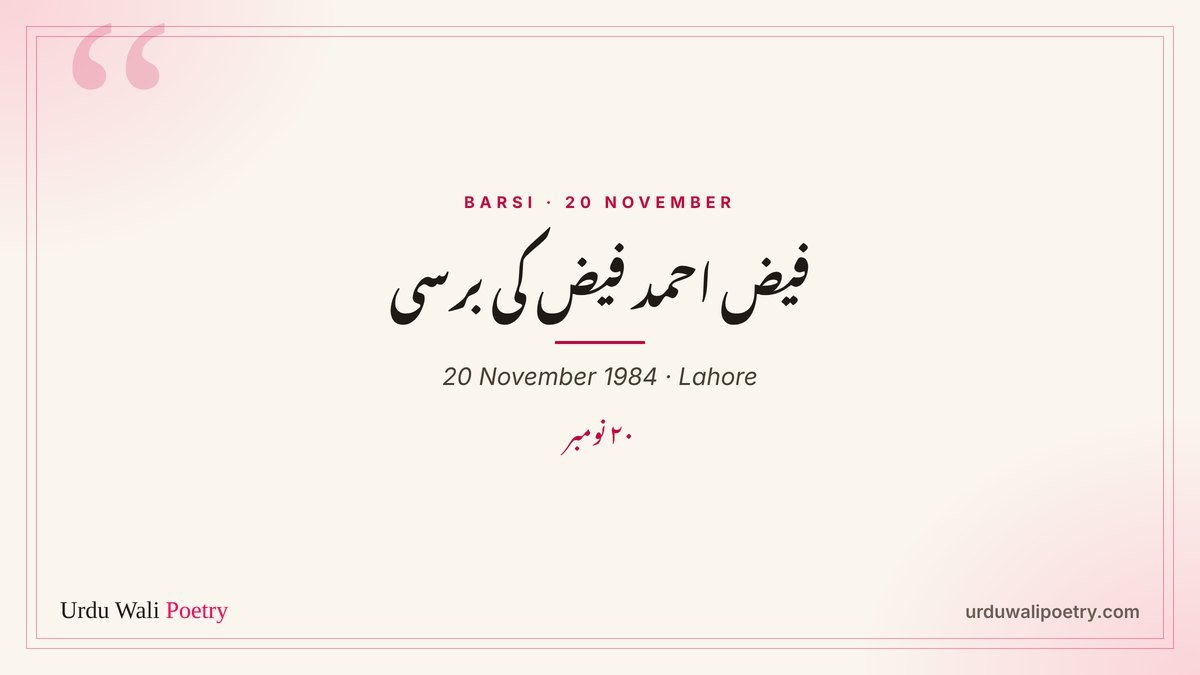
Faiz Ahmad Faiz died in Lahore on 20 November 1984, and he is buried in Lahore. Every year on 20 November, his barsi (death anniversary), people share his poetry, and literary programmes are held in his memory.
His birthday, 13 February, is also remembered, and the yearly Faiz Festival in Lahore celebrates his work.
Share Your Own Poetry
Do you write poetry inspired by Faiz, or your own lines on love, hope or the homeland? Send your shayari to Urdu Wali Poetry through our post shayari page, and your poetry can be published on the website with your name.
Conclusion
Faiz Ahmad Faiz poetry lives on because it holds love and justice in the same breath. A sher like “dil na-umeed to nahin” gives hope in a bad time, while “Bol” gives courage when silence feels safer.
If you love Faiz, you will also enjoy famous Allama Iqbal poetry and Mirza Ghalib poetry, and our short 4 line poetry collection. You can read more posts in the Faiz Ahmad Faiz category.
Frequently Asked Questions
Who was Faiz Ahmad Faiz?
Faiz Ahmad Faiz (1911-1984) was a Pakistani Urdu poet, journalist and teacher from Sialkot. He is known as the poet of love and resistance and won the Lenin Peace Prize in 1962.
When is the death anniversary of Faiz Ahmad Faiz?
Faiz Ahmad Faiz died on 20 November 1984 in Lahore, so his death anniversary (barsi) is observed every year on 20 November.
What is the most famous poetry of Faiz Ahmad Faiz?
His most famous works include the nazms “Mujh Se Pehli Si Mohabbat Mere Mehboob Na Maang”, “Bol”, “Subh-e-Azadi” and “Hum Dekhenge”, and the ghazal “Gulon mein rang bhare”.
Who wrote “Hum Dekhenge”?
“Hum Dekhenge” was written by Faiz Ahmad Faiz in 1979. Iqbal Bano’s performance of it in Lahore in 1986 made it famous across South Asia.
What are the names of Faiz Ahmad Faiz’s books?
His main poetry collections are Naqsh-e-Faryadi, Dast-e-Saba, Zindan-Nama, Dast-e-Tah-e-Sang, Sar-e-Wadi-e-Seena, Sham-e-Shehr-e-Yaran and Mere Dil Mere Musafir. His complete poetry is published as Nuskha-ha-e-Wafa.
Where was Faiz Ahmad Faiz born?
He was born on 13 February 1911 in Kala Qader, a village of Sialkot district in Punjab. The village is now in Narowal district and is called Faiz Nagar.
Comments0
No comments yet. Be the first to share your thoughts.