

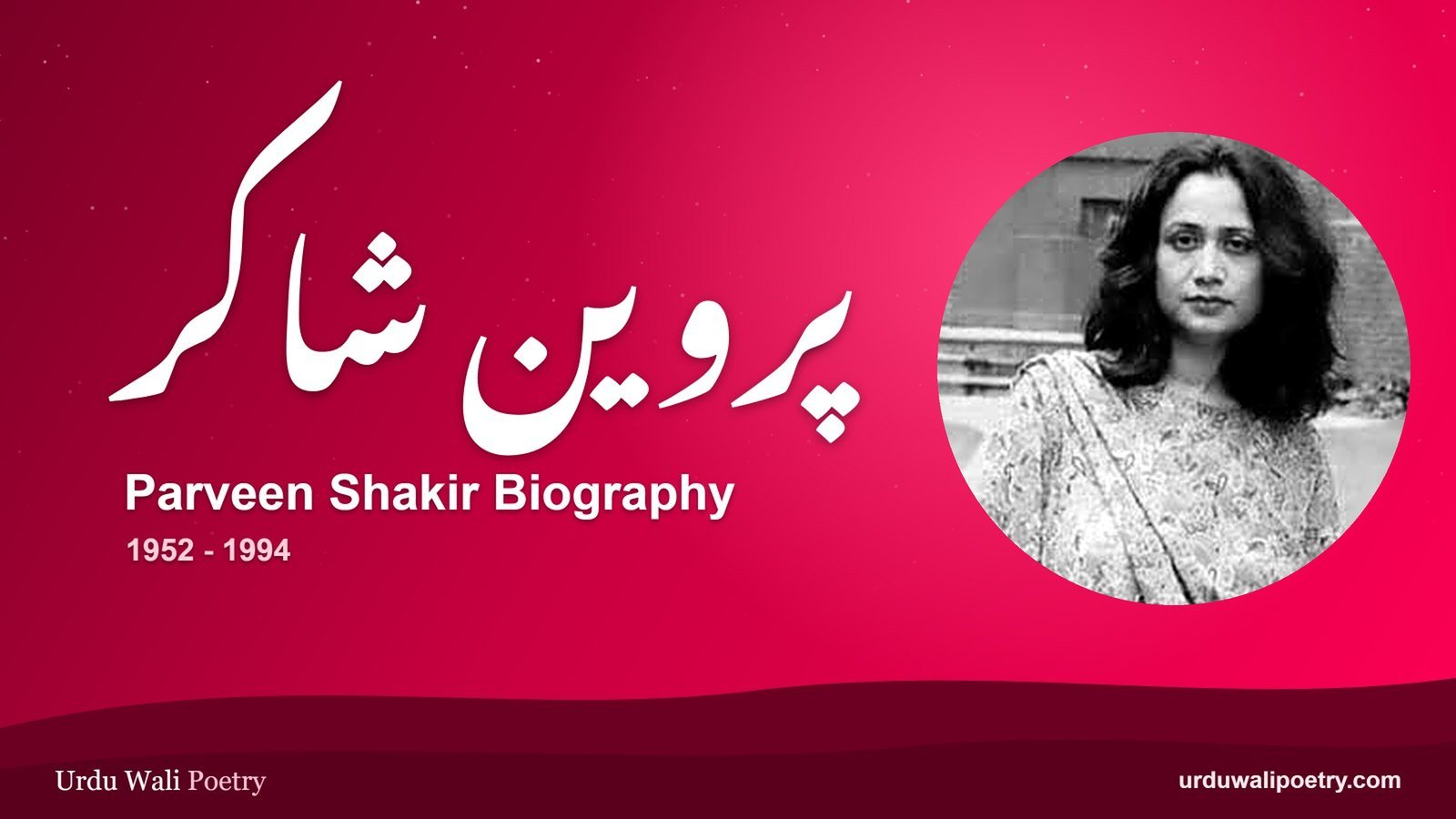
Parveen Shakir was born on 24 November 1952 in Karachi and died in a road accident in Islamabad on 26 December 1994, at the age of 42. This Parveen Shakir biography covers her full life story: her family, education, teaching and civil service career, marriage, books, awards, the day she died, where she is buried, and how her birth and death anniversaries are remembered today.

Parveen Shakir (1952 to 1994) was a Pakistani Urdu poet, teacher and civil servant, best known for her first book Khushbu (1976). She was born in Karachi on 24 November 1952 and died in a car accident in Islamabad on 26 December 1994. She is buried in the H-8 graveyard, Islamabad, and is remembered as the poet who gave Urdu ghazal a woman’s own voice.
Table of Contents
- Parveen Shakir: Quick Facts
- Early Life and Family
- Education: From Karachi to Harvard
- Teacher and Civil Servant
- How Her Poetry Career Began
- Parveen Shakir Books in Order
- Style and Themes of Her Poetry
- Marriage, Divorce and Her Son Murad
- Awards and Honours
- Parveen Shakir Death: How She Died on 26 December 1994
- Parveen Shakir Birth Anniversary and Death Anniversary
- Legacy: How Parveen Shakir Is Remembered
- Parveen Shakir Timeline
- Do You Write in Your Own Voice Like Parveen Shakir?
- Conclusion
- FAQs
Parveen Shakir: Quick Facts
These are the key facts about Parveen Shakir’s life, each checked against at least two sources.
- Full name: Syeda Parveen Bano, later known as Parveen Shakir (Shakir comes from her father’s name).
- Early pen name: Beena.
- Born: 24 November 1952, Karachi, Pakistan.
- Died: 26 December 1994, Islamabad, Pakistan, aged 42.
- Cause of death: Road accident on her way to work.
- Buried: H-8 graveyard, Islamabad.
- Father: Syed Shakir Hussain Saqib, himself a poet.
- Mother: Afzal-un-Nisa.
- Husband: Dr Syed Naseer Ali (married 1976, divorced 1987).
- Son: Syed Murad Ali.
- First book: Khushbu (1976).
- Major awards: Adamjee Literary Award (1976) and Pride of Performance.
- Profession: Lecturer in English, then an officer of the Customs and Central Board of Revenue.
Early Life and Family
Parveen Shakir came from a literary family that had moved to Karachi after Partition. Her father, Syed Shakir Hussain Saqib, wrote poetry himself and encouraged her to write from a young age.
The family’s roots were in Laheriasarai, in the Darbhanga district of Bihar. Her father migrated to Karachi after 1947, and Parveen was born there in 1952 as the second daughter of Syed Shakir Hussain and Afzal-un-Nisa.
Her name Parveen is the Persian name for the Pleiades, the bright star cluster. The surname Shakir, by which the whole Urdu world knows her, comes from her father’s name.
Education: From Karachi to Harvard
Parveen Shakir was unusually well educated, even by the standards of today. She studied in Karachi up to her Master’s degrees and later earned a Master’s in Public Administration from Harvard University.
She passed her matriculation from Rizvia Girls School, Karachi, and joined Sir Syed Girls College, where she completed her BA in 1971. She then earned an MA in English literature from the University of Karachi in 1972, followed by a second MA in linguistics.
She also held a PhD and another Master’s degree in Bank Administration. Later, while she was already a government officer, she studied at Harvard University and earned an MA in Public Administration. Most sources give the Harvard year as 1991.
Teacher and Civil Servant
Before she was known as an officer, Parveen Shakir was a teacher. After her MA she joined Abdullah Girls College, Karachi, as a lecturer in English and taught there for about nine years.
In 1982 she passed the Central Superior Services (CSS) examination, the competitive exam for Pakistan’s civil service. Some sources report that she secured second position in the country. She joined the Customs service and worked in Karachi before moving to Islamabad.
In 1986 she was appointed Second Secretary in the Central Board of Revenue (now the Federal Board of Revenue) in Islamabad. A close friend later recalled that on her first day in Islamabad the guards would not let her in, because they did not believe such a young woman could be a senior customs officer. For most of her life, every poem she wrote was written alongside a full time government job.
How Her Poetry Career Began
Parveen Shakir started writing as a schoolgirl, first under the pen name Beena, and later wrote under her own name. Her father’s interest in poetry and the guidance of the senior poet Ahmad Nadeem Qasmi shaped her early years.
She considered Ahmad Nadeem Qasmi her ustad (teacher) and affectionately called him “Ammu jaan”. Qasmi published much of her early work and later wrote that she made Urdu poetry shine with the colours of true feeling.
She also wrote prose: columns for Urdu newspapers and some articles for English dailies. Her newspaper columns were later collected in a book called Gosha-e-Chashm.
In 1976 she published her first collection, Khushbu (Fragrance). It was an immediate success, won the Adamjee Literary Award, and made her one of the most talked about young poets in Pakistan.

Parveen Shakir Books in Order
Parveen Shakir published four collections of poetry in her lifetime, and all four were brought together in 1994 in one volume, Mah-e-Tamam. Two more books appeared after her death.
- Khushbu (Fragrance), 1976.
- Sad-barg (a hundred-petalled rose), 1980.
- Khud-kalami (Soliloquy), 1990.
- Inkar (Denial), 1990.
- Mah-e-Tamam (Full Moon), 1994, her collected poetry from the four books above.
- Kaf-e-Aina (The Mirror’s Edge), published after her death, from her diaries and unpublished work.
- Gosha-e-Chashm (Corner of the Eye), a collection of her newspaper columns.
If you want to read her verses with simple explanations, our Parveen Shakir poetry page has 17 of her verified sher with meaning.
Style and Themes of Her Poetry
Parveen Shakir wrote mainly in two forms: the ghazal and azad nazm (free verse). Her great change to Urdu poetry was that the woman in her poems speaks for herself, about her own love, pride and pain.
In classical Urdu ghazal the beloved usually stays silent while the male lover speaks. Parveen Shakir reversed this. Her images came from a woman’s daily world: khushbu (fragrance), kajal, silk thread, rain and the moon, used in very simple words.
A few lines show her range. In “main sach kahungi magar phir bhi haar jaungi” she writes about a woman who tells the truth and still loses the argument. In “wo to khushboo hai hawaon mein bikhar jayega” she compares a man’s freedom to fragrance and a woman to the flower that cannot move. In “ko ba ko phail gayi baat shanasai ki”, famously sung by Mehdi Hassan, she writes about how a quiet love becomes public news.
She also wrote about society and justice, about cities where people could not speak freely, and about the pressures women faced at home and at work. Critic Gopi Chand Narang wrote that the picture of modern Urdu poetry is incomplete without Parveen Shakir.
Marriage, Divorce and Her Son Murad
In 1976, the same year Khushbu was published, Parveen Shakir married her cousin, Dr Syed Naseer Ali, a doctor. Their only child, Syed Murad Ali, was born in the late 1970s (sources give 1978 or 1979).
The marriage was not a happy one and ended in divorce in 1987. Friends and biographers say the separation affected her deeply, and some of her later poems reflect that pain. She did not marry again.
Her son, whom she lovingly called Geetu, became the centre of her life. Friends recall her bringing him along to gatherings and spending her free time with him. Syed Murad Ali has attended her anniversary events in Pakistan and has spoken about his mother in interviews.
Awards and Honours
Parveen Shakir received Pakistan’s highest literary recognition while still in her thirties. Her awards include:
- Adamjee Literary Award (1976) for Khushbu.
- An Iqbal award for poetry in the 1980s. Sources differ on the exact year and title, giving 1983 or 1985.
- Faiz Ahmad Faiz International Award, reported as 1989.
- Pride of Performance, one of Pakistan’s highest civil awards. Most sources give the year as 1990.
After her death she was honoured with a postage stamp and a Google Doodle, described in the legacy section below.
Parveen Shakir Death: How She Died on 26 December 1994
Parveen Shakir died on the morning of Monday, 26 December 1994, when her car collided with a heavy vehicle (most reports say a truck) while she was on her way to work in Islamabad. She was 42 years old.
The accident happened in sector F-7 of Islamabad. The road was later renamed Parveen Shakir Road in her memory.
She was buried in the H-8 graveyard in Islamabad. On her death anniversaries, friends, poets and officers of the Customs department have gathered at her grave to lay flowers and remember her.
Mah-e-Tamam, the collected edition of her poetry, had been published earlier the same year, so she lived to see her complete work in one volume.

Parveen Shakir Birth Anniversary and Death Anniversary
Parveen Shakir’s birth anniversary is on 24 November and her death anniversary is on 26 December. Both days are marked in Pakistan with literary sessions, newspaper tributes and social media posts.
On 24 November 2026 it is her 74th birth anniversary, and on 26 December 2026 it will be her 32nd death anniversary. If she were alive, she would have turned 74 this year.
Legacy: How Parveen Shakir Is Remembered
More than thirty years after her death, Parveen Shakir is still one of the most read and quoted Urdu poets. Her legacy is kept alive through a trust, a festival, a stamp and her readers.
1. Parveen Shakir Trust: set up after her death by her close friend Parveen Qadir Agha. The trust gives the yearly Aks-e-Khushbu award.
2. Parveen Shakir Urdu Literature Festival: held every year in Islamabad, focused on young writers and readers.
3. Postage stamp: Pakistan Post issued a Rs 10 commemorative stamp on 26 December 2013, her 19th death anniversary, in its “Poets of Pakistan” series.
4. Google Doodle: on 24 November 2019, Google celebrated her 67th birthday with a Doodle.
5. Parveen Shakir Road: the road in sector F-7, Islamabad, where the accident happened, carries her name.
6. Books about her: a biography, “Parveen Shakir: Jaisa Mein Nay Dekha” by Rafaqat Javed, was published by the Parveen Shakir Trust, and her poems have been translated into English.
Parveen Shakir Timeline
1. 1952: Born on 24 November in Karachi.
2. 1971: Completed her BA at Sir Syed Girls College, Karachi.
3. 1972: MA in English literature, University of Karachi.
4. 1973: Began teaching English at Abdullah Girls College, Karachi.
5. 1976: Published Khushbu, won the Adamjee Literary Award, and married Dr Syed Naseer Ali.
6. 1980: Published Sad-barg.
7. 1982: Passed the CSS examination and joined the civil service.
8. 1986: Appointed Second Secretary, Central Board of Revenue, Islamabad.
9. 1987: Divorce.
10. 1990: Published Khud-kalami and Inkar; Pride of Performance (most sources).
11. 1991: MA in Public Administration, Harvard University (most sources).
12. 1994: Mah-e-Tamam published; died on 26 December in Islamabad.
13. 2013: Commemorative postage stamp issued on her 19th death anniversary.
14. 2019: Google Doodle on her 67th birthday.
Do You Write in Your Own Voice Like Parveen Shakir?
Parveen Shakir became famous because she wrote exactly what she felt, in her own simple words. If you write poetry in that honest spirit, share it with our readers in Urdu or Roman Urdu under your own name. Every post is checked before it goes live. Post your own shayari here.
Conclusion
Parveen Shakir lived only 42 years, but in that short time she taught for nine years, served the government as a senior officer, studied at Harvard and gave Urdu poetry books that are still read every day. Her biography is the story of a woman who kept writing through a demanding career, a broken marriage and the pressures of society.
To read her verses with meaning, visit our Parveen Shakir poetry page, and for the life of another great poet of the same era, read the Faiz Ahmad Faiz biography. You can also see her profile on Parveen Shakir’s poet page.
FAQs
When was Parveen Shakir born?
Parveen Shakir was born on 24 November 1952 in Karachi, Pakistan.
When and how did Parveen Shakir die?
Parveen Shakir died on 26 December 1994 in Islamabad, when her car collided with a heavy vehicle while she was on her way to work. She was 42 years old.
Where is Parveen Shakir buried?
She is buried in the H-8 graveyard in Islamabad, where admirers have gathered on her death anniversaries to lay flowers.
What was Parveen Shakir’s real name?
Her birth name was Syeda Parveen Bano. She wrote her earliest poems under the pen name Beena and became famous as Parveen Shakir.
Who was Parveen Shakir’s husband?
She married her cousin Dr Syed Naseer Ali in 1976. They had one son, Syed Murad Ali, and divorced in 1987.
What was Parveen Shakir’s first book?
Her first book was Khushbu (1976), which won the Adamjee Literary Award.
When is Parveen Shakir’s death anniversary?
Her death anniversary is on 26 December. Her birth anniversary is on 24 November.
Comments0
No comments yet. Be the first to share your thoughts.