


Tehzeeb Hafi poetry in Urdu is loved for one reason: it says big feelings in small, everyday words. Here you will find 16 of his verified 2 line sher, sorted by mood: love, separation, self and silence, village and nature, and one line from Madina. Each sher has a short meaning in plain words, so you know exactly what you are reading or sharing.
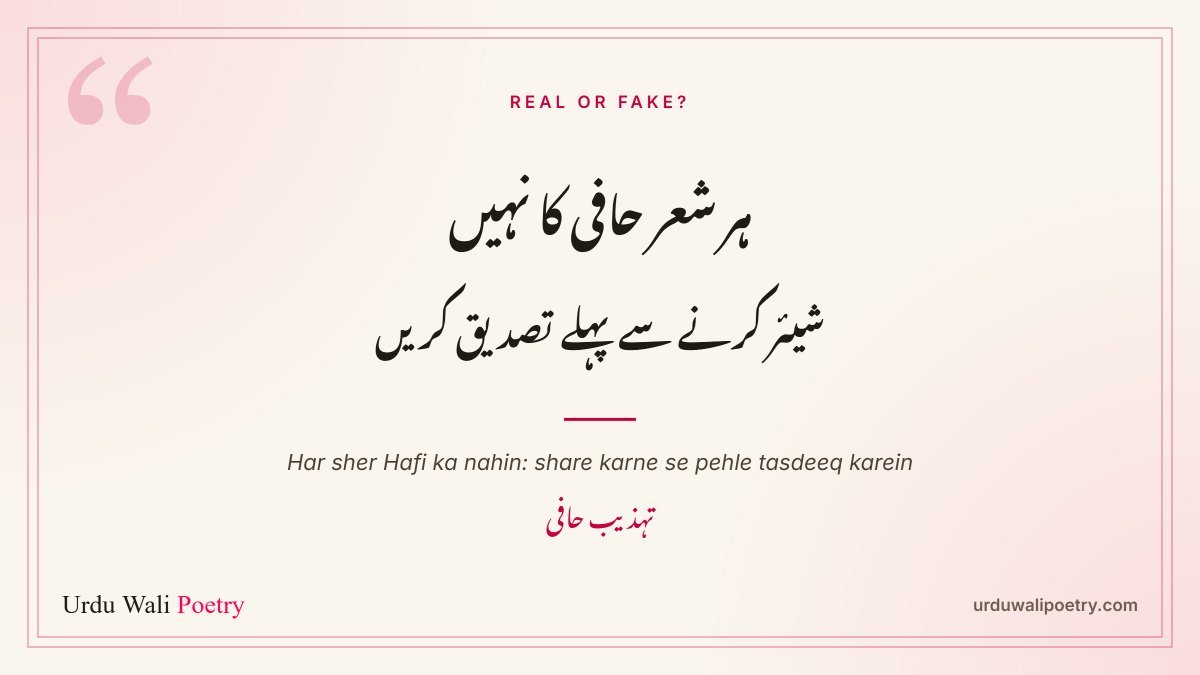
Note: an earlier version of this page included lines that are shared online under Tehzeeb Hafi’s name but could not be found in his published work. We removed them and kept only verses that are confirmed as his.
Table of Contents
- Tehzeeb Hafi Poetry: Quick Answer
- Why Tahzeeb Hafi Urdu Poetry Feels So Real
- Tehzeeb Hafi Love Poetry in 2 Lines
- Tehzeeb Hafi Sad Poetry on Judai
- Tehzeeb Hafi Poetry on Self and Silence
- Tehzeeb Hafi Poetry on Village and Nature
- Tehzeeb Hafi’s Line on Madina
- How to Spot a Real Tehzeeb Hafi Sher
- Have a Line That Hafi Would Like?
- Conclusion
- FAQs about Tehzeeb Hafi Poetry
Tehzeeb Hafi Poetry: Quick Answer
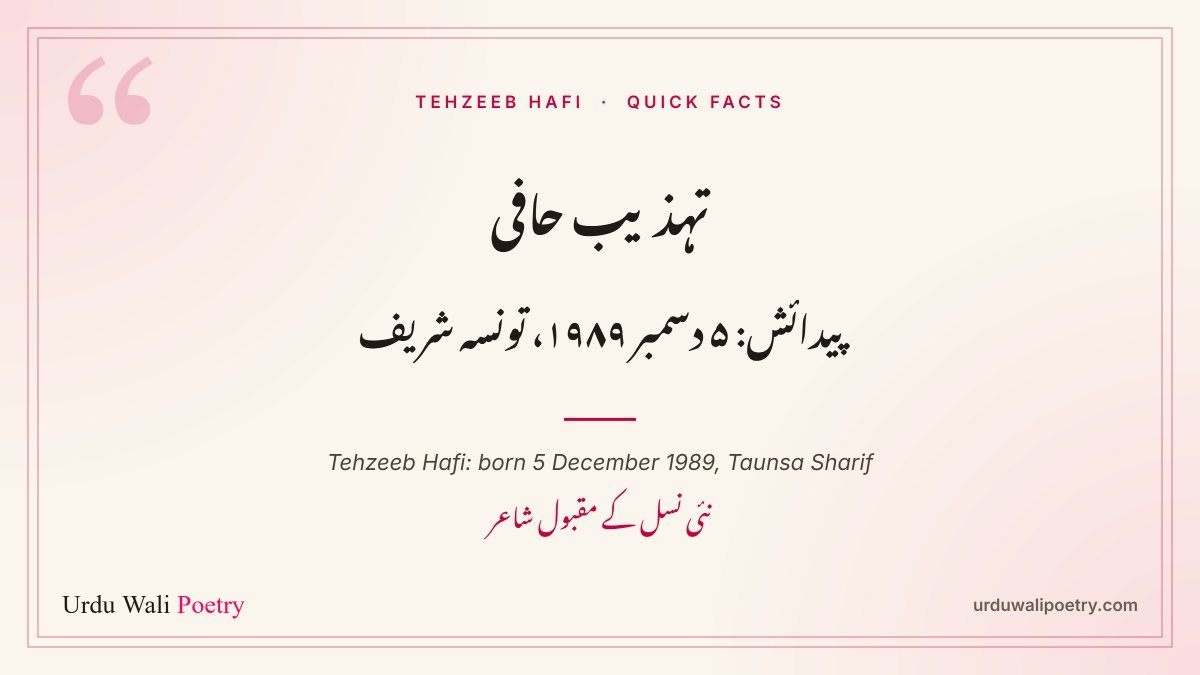
Tehzeeb Hafi (also written Tahzeeb Hafi) is a Pakistani Urdu poet, born on 5 December 1989 in Taunsa Sharif, and one of the most popular poets of the younger generation. His poetry mixes classical ghazal with simple modern language. His best known sher is “Tera chup rehna mere zehan mein kya baith gaya”, about a silence that hurts more than any word.
Why Tahzeeb Hafi Urdu Poetry Feels So Real
Hafi writes the way people actually feel today. A phone call that suddenly drops, a tree in the home village, a paper boat in the first rain: his images come from ordinary life, so readers recognise themselves in them.
He also keeps one foot in the old ghazal tradition. The meter and rhyme are classical, but the words are the ones you would use with a friend. That mix is why his lines travel so fast on WhatsApp and Instagram, and why young listeners crowd his mushaira recitations.
Tehzeeb Hafi Love Poetry in 2 Lines
Hafi’s love poetry is gentle and a little anxious. He loves fully, but he is always aware of how easily it can be lost.
تجھ کو پانے میں مسئلہ یہ ہے
تجھ کو کھونے کے وسوسے رہیں گے
Tujh ko paane mein masla yeh hai
Tujh ko khone ke waswase rahenge
Tehzeeb Hafi
Explanation: The problem with finding you, he says, is that the fear of losing you will always stay. “Waswase” are small, nagging worries. It is the most honest line about love: having someone does not end the worry, it starts a new one.
تجھ میں یہ عیب ہے کہ خوبی ہے
جو تجھے دیکھ لے ترا ہو جائے
Tujh mein yeh aib hai ke khoobi hai
Jo tujhe dekh le tera ho jaye
Tehzeeb Hafi
Explanation: He cannot decide whether it is a flaw or a quality that anyone who sees the beloved becomes hers. “Aib” means flaw and “khoobi” means virtue; the playful doubt is the whole charm of the sher.
داستاں ہوں میں اک طویل مگر
تو جو سن لے تو مختصر بھی ہوں
Daastaan hoon main ik taweel magar
Tu jo sun le to mukhtasar bhi hoon
Tehzeeb Hafi
Explanation: I am a long story, says the poet, but if you listen, I am short too. A “dastaan” is a long tale; he is telling the beloved that he is complicated for the world but simple for her. A sweet line for someone who truly understands you.
بس وہ اتنا کہے مجھے تم سے
اور پھر کال منقطع ہو جائے
Bas woh itna kahe mujhe tum se
Aur phir call munqata ho jaye
Tehzeeb Hafi
Explanation: He wishes the beloved would only say that she loves him, and then the call drops (“call munqata”). Only Hafi would put a dropped phone call inside a classical ghazal, and that is exactly why young readers love this line.
Tehzeeb Hafi Sad Poetry on Judai
Separation in Hafi’s poetry is quiet. He does not shout; he notices how long it lasts and how it changes everything else.
تیرا چپ رہنا مرے ذہن میں کیا بیٹھ گیا
اتنی آوازیں تجھے دیں کہ گلا بیٹھ گیا
Tera chup rehna mere zehan mein kya baith gaya
Itni aawazein tujhe deen ke gala baith gaya
Tehzeeb Hafi
Explanation: Your silence settled so deep in my mind that I called out to you until my voice gave up. “Gala baith gaya” means losing your voice, and Hafi uses “baith gaya” twice in two different meanings. This is his most famous sher and the line most people link with his name.
اک ترا ہجر دائمی ہے مجھے
ورنہ ہر چیز عارضی ہے مجھے
Ik tera hijr daimi hai mujhe
Warna har cheez aarzi hai mujhe
Tehzeeb Hafi
Explanation: “Hijr” is separation and “daaimi” means permanent. Only your absence is permanent for me, he says; everything else is temporary (“aarzi”). Two simple lines that sum up what heartbreak feels like.
میں تجھے چھوڑ کر چلا جاؤں
سایا دیوار سے جدا ہو جائے
Main tujhe chhod kar chala jaoon
Saaya deewar se juda ho jaye
Tehzeeb Hafi
Explanation: If I leave you, it would be like a shadow separating from its wall, which never happens. He is saying that leaving is impossible, using one of the plainest images in the language.
بچھڑ کے تجھ سے نہ خوش رہ سکوں گا سوچا تھا
تری جدائی ہی وجہِ نشاط ہو گئی ہے
Bichhad ke tujh se na khush reh sakoonga socha tha
Teri judai hi wajh-e-nashat ho gayi hai
Tehzeeb Hafi
Explanation: I thought I could never be happy after leaving you, and now your separation itself has become my reason for joy (“wajh-e-nashat”). The twist can be read as relief or as bitter irony, and that double meaning is what makes it stay with you.
Tehzeeb Hafi Poetry on Self and Silence
Some of Hafi’s best lines are about himself: how fragile he is, how free, and how confused about winning and losing.
میں کہ کاغذ کی ایک کشتی ہوں
پہلی بارش ہی آخری ہے مجھے
Main ke kaaghaz ki aik kashti hoon
Pehli baarish hi aakhri hai mujhe
Tehzeeb Hafi
Explanation: I am a paper boat; the first rain is also my last. In just two lines he describes a person so delicate that the first real test ends him. It is one of his most shared sher and fits a quiet, sad status.
اپنی مستی میں بہتا دریا ہوں
میں کنارہ بھی ہوں بھنور بھی ہوں
Apni masti mein behta darya hoon
Main kinara bhi hoon bhanwar bhi hoon
Tehzeeb Hafi
Explanation: I am a river flowing in my own mood; I am the shore and also the whirlpool (“bhanwar”). He is calm and dangerous at once. A good line for someone who wants to say “I am complicated, and I am fine with it”.
یہ ایک بات سمجھنے میں رات ہو گئی ہے
میں اس سے جیت گیا ہوں کہ مات ہو گئی ہے
Yeh aik baat samajhne mein raat ho gayi hai
Main us se jeet gaya hoon ke maat ho gayi hai
Tehzeeb Hafi
Explanation: It took the whole night to understand one thing: did I win against her, or was it my defeat (“maat”)? After a fight with someone you love, winning often feels like losing, and Hafi catches that feeling perfectly.
تمام ناخدا ساحل سے دور ہو جائیں
سمندروں سے اکیلے میں بات کرنی ہے
Tamaam nakhuda saahil se door ho jayein
samandaron se akele mein baat karni hai
Tehzeeb Hafi
Explanation: Let all the boat captains (“nakhuda”) stay away from the shore; I need to talk to the seas alone. It is a line about wanting space and facing your problems by yourself, without anyone steering you.
Tehzeeb Hafi Poetry on Village and Nature
Hafi was born in Retra, a village in Tehsil Taunsa Sharif, and trees, rain and the jungle keep returning in his poetry. These sher carry that village memory.
پیڑ مجھے حسرت سے دیکھا کرتے تھے
میں جنگل میں پانی لایا کرتا تھا
Pair mujhe hasrat se dekha karte the
Main jungle mein paani laya karta tha
Tehzeeb Hafi
Explanation: The trees used to look at me with longing, because I was the one who carried water into the jungle. It is a picture of a dry land where even trees wait for a person. Anyone from a dry, rain-starved area will feel this line at once.
وہ جس کی چھاؤں میں پچیس سال گزرے ہیں
وہ پیڑ مجھ سے کوئی بات کیوں نہیں کرتا
Woh jis ki chhaon mein pachhees saal guzre hain
Woh pair mujh se koi baat kyun nahi karta
Tehzeeb Hafi
Explanation: The tree under whose shade I spent twenty five years, why does it not speak to me? The tree can be a real tree, a parent or an old home that has gone silent. It is a deeply nostalgic line for anyone who has moved to a city.
بتا اے ابر مساوات کیوں نہیں کرتا
ہمارے گاؤں میں برسات کیوں نہیں کرتا
Bata ae abr musawaat kyun nahi karta
Hamare gaon mein barsaat kyun nahi karta
Tehzeeb Hafi
Explanation: Tell me, cloud, why are you not fair (“musawat” means equality); why does it never rain in our village? A simple complaint to the sky becomes a question about why some places always get less.
Tehzeeb Hafi’s Line on Madina
Among his ghazals is a sher that many readers save for its love of Madina.
رہے گا یاد مدینے سے واپسی کا سفر
میں نظم لکھنے لگا تھا کہ نعت ہو گئی ہے
Rahega yaad Madine se waapsi ka safar
Main nazm likhne laga tha ke naat ho gayi hai
Tehzeeb Hafi
Explanation: I will always remember the journey back from Madina: I had started writing a nazm, and it became a naat. The poet sat down to write a poem and his words turned into praise of the Prophet (peace be upon him) on their own. It is a beautiful line to share after Umrah or on Rabi ul Awwal.
How to Spot a Real Tehzeeb Hafi Sher
Because Hafi is so popular, many lines are shared online under his name that he never wrote. Before you post a line as his, check three things:
- Does it have a meter and a rhyme? His sher always follow the ghazal’s rhythm, even when the words are simple.
- Does the last sher of the ghazal carry his takhallus (pen name) “Hafi”? Many of his ghazals end that way.
- Can you find it in a reliable collection or in his own mushaira recitation? If not, it is safer not to credit it to him.
Have a Line That Hafi Would Like?
If Tehzeeb Hafi’s simple style makes you want to write, try two lines of your own about something ordinary: a call, a tree, a rainy evening. Share them in Urdu or Roman Urdu under your own name. Every post is checked before it goes live, so post your own shayari here and let readers hear your voice.
Conclusion
Tehzeeb Hafi’s poetry proves that a ghazal does not need difficult words to go deep. A paper boat, a dropped call or a silent tree is enough for him to say what many people feel and cannot say.
For more of his work on our site, visit Tehzeeb Hafi’s poet profile. If you like modern voices, read Jaun Elia poetry in 2 lines next, or explore our heart touching 2 line Urdu poetry and deep sad poetry in 2 lines.
FAQs about Tehzeeb Hafi Poetry
Who is Tehzeeb Hafi?
Tehzeeb Hafi is a Pakistani Urdu poet born on 5 December 1989 in Retra, Taunsa Sharif (Dera Ghazi Khan district). He writes mainly ghazal and nazm and is one of the most popular poets among young readers.
What is Tehzeeb Hafi’s most famous sher?
His most famous sher is “Tera chup rehna mere zehan mein kya baith gaya / Itni awaazein tujhe deen ke gala baith gaya”, about calling out to someone whose silence hurts.
Is it Tehzeeb or Tahzeeb Hafi?
Both spellings are used in Roman Urdu for the same poet: تہذیب حافی. “Tehzeeb” is more common in searches, while “Tahzeeb” is closer to the Urdu spelling.
Does Tehzeeb Hafi write ghazal or nazm?
He writes both. Most of his famous 2 line sher come from his ghazals, while his nazms are longer, more free-flowing poems.
Are all poems shared online as Tehzeeb Hafi poetry really his?
No. Many lines are credited to him without proof. On this page we kept only sher that can be confirmed as his work, and you should check a line before sharing it with his name.
Where is Tehzeeb Hafi from?
He is from Retra village in Tehsil Taunsa Sharif, Dera Ghazi Khan district, Punjab, and is now based in Lahore.
Comments0
No comments yet. Be the first to share your thoughts.