

Famous Urdu poetry is the kind you have heard at weddings, in dramas and on WhatsApp statuses long before you knew who wrote it. This page collects 22 of the most famous Urdu sher, each with Urdu text, Roman Urdu, the real poet’s name and a short explanation of what it means.
Every sher here comes from a classical poet whose work is part of Urdu’s shared heritage, from Mir Taqi Mir in the 18th century to Allama Iqbal in the 20th. The best-known classical sher from our older version of this page are still here, now with corrected Roman spelling and an explanation for each.
Quick answer: The most famous Urdu poetry comes from classical poets such as Mir Taqi Mir, Mirza Ghalib, Momin, Zauq, Dagh Dehlvi and Allama Iqbal. Their best-known sher, like Ghalib’s “Hazaron khwahishen aisi” and Mir’s “Patta patta boota boota”, are still quoted every day across Pakistan and India.
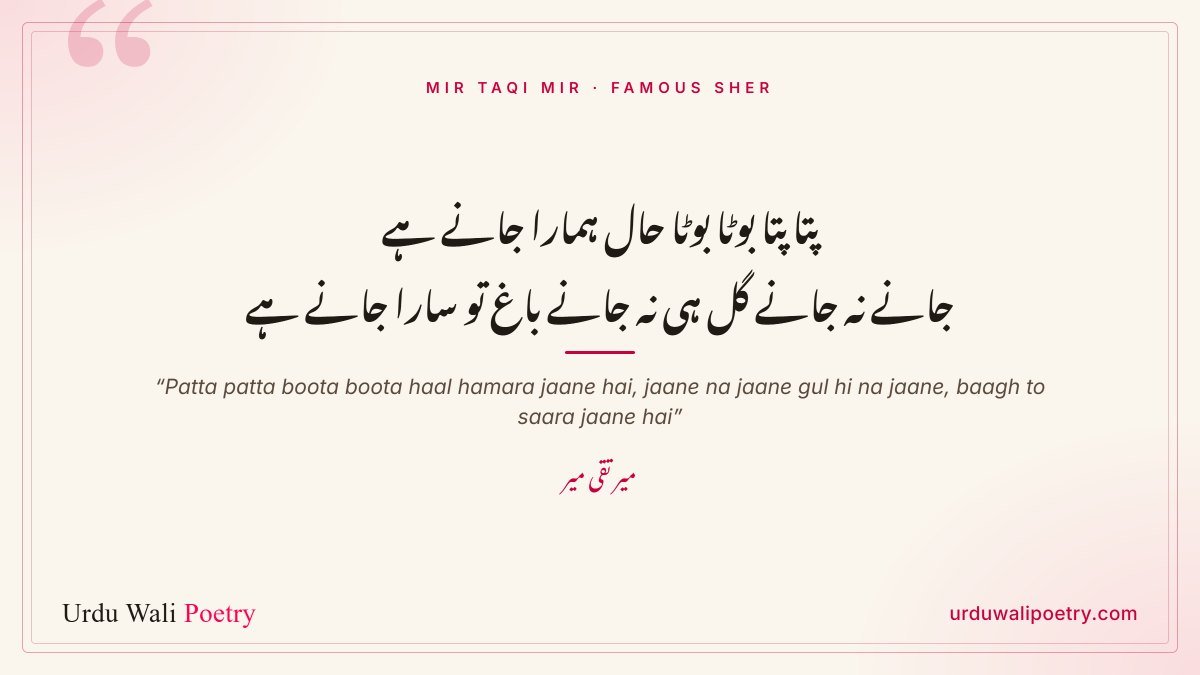
Table of Contents
What Makes an Urdu Sher Famous?
A sher becomes famous when people start using it in daily life, often without knowing the poet. The best-known sher say a big feeling in two short lines, so they are easy to remember and repeat.
A sher is a couplet of two lines, and each line is called a misra. Most famous sher come from a ghazal, a poem made of several sher that share the same rhyme (qafia) and refrain (radeef).
The first sher of a ghazal is the matla, and the last one, where the poet often uses his pen name (takhallus), is the maqta.
Many sher became famous in the mushaira, the gathering where poets recite to an audience. A good sher there gets daad, the loud “wah wah” of approval, and the best lines travel from that room to the whole country.
Dagh Dehlvi wrote one of the proudest sher about the Urdu language itself:
اردو ہے جس کا نام ہمیں جانتے ہیں داغؔ
ہندوستاں میں دھوم ہماری زباں کی ہے
Urdu hai jis ka naam hamein jaante hain Dagh
Hindustan mein dhoom hamari zaban ki hai
Dagh Dehlvi (1831-1905)
Explanation: Dagh was known for clean, everyday Urdu, so this pride is earned. He says, in effect, “We are the ones who really know this language called Urdu, and its fame has spread across the land.” The word “dhoom” gives the line its energy: it is not quiet fame, it is fame with noise.
Famous Urdu Poetry That Touches the Heart
The most famous Urdu love poetry is about longing more than union. These eight sher come from Ghalib, Mir, Momin, Hasrat Mohani, Dagh, Amir Minai and Akbar Allahabadi, and each one is still quoted for a heartbreak or a memory.
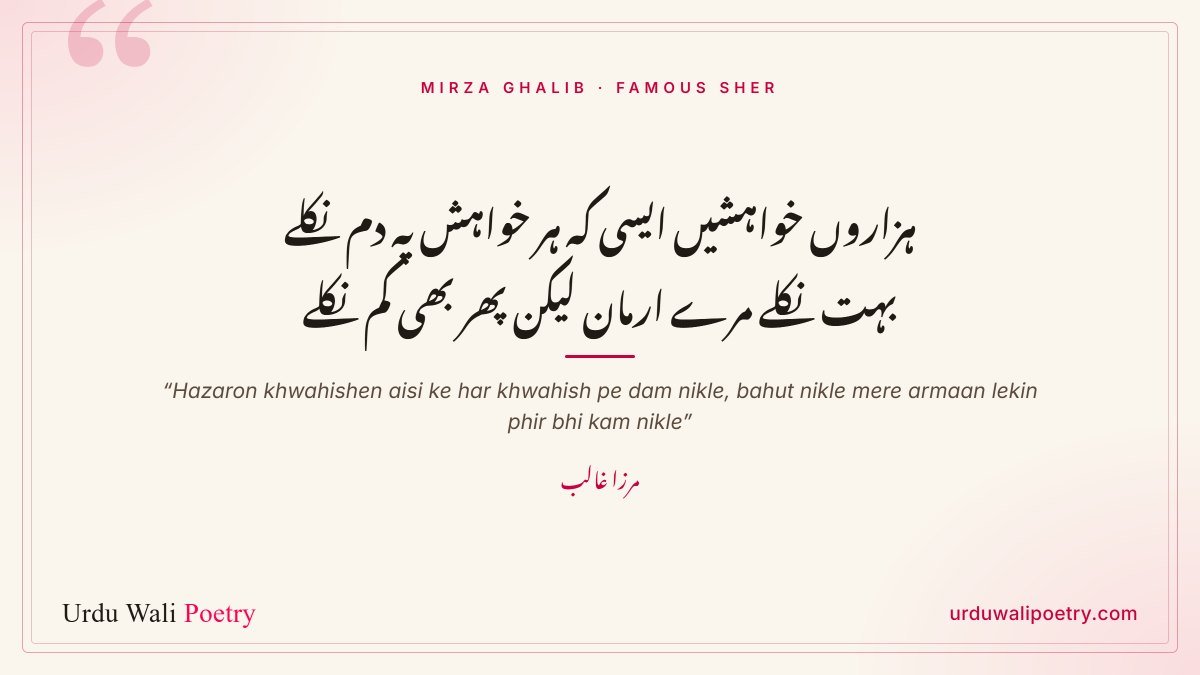
ہزاروں خواہشیں ایسی کہ ہر خواہش پہ دم نکلے
بہت نکلے مرے ارمان لیکن پھر بھی کم نکلے
Hazaron khwahishen aisi ke har khwahish pe dam nikle
Bahut nikle mere armaan lekin phir bhi kam nikle
Mirza Ghalib (1797-1869)
Explanation: Ghalib plays with the word “nikle” in both lines. In the first it means life leaving the body; in the second it means wishes coming true. So many of his wishes were fulfilled, and yet it felt like too few. It is probably the most quoted sher in Urdu.
دل ہی تو ہے نہ سنگ و خشت درد سے بھر نہ آئے کیوں
روئیں گے ہم ہزار بار کوئی ہمیں ستائے کیوں
Dil hi to hai na sang o khisht, dard se bhar na aaye kyun
Royenge hum hazaar baar, koi hamein sataye kyun
Mirza Ghalib (1797-1869)
Explanation: “Sang o khisht” means stone and brick. Ghalib reminds us that a heart is not a wall, so of course it fills with pain. The second line has a small protest in it: I will cry a thousand times, that is my right, but why should anyone torment me?
پتا پتا بوٹا بوٹا حال ہمارا جانے ہے
جانے نہ جانے گل ہی نہ جانے باغ تو سارا جانے ہے
Patta patta boota boota haal hamara jaane hai
Jaane na jaane gul hi na jaane, baagh to saara jaane hai
Mir Taqi Mir (1723-1810)
Explanation: Every leaf and every plant in the garden knows the lover’s state. Only one does not: the “gul”, the flower, which means the beloved. The repeated words “patta patta, boota boota” make the line sound like a folk song, which is why people who have never read Mir can still sing it.
تم مرے پاس ہوتے ہو گویا
جب کوئی دوسرا نہیں ہوتا
Tum mere paas hote ho goya
Jab koi doosra nahin hota
Momin Khan Momin
Explanation: When no one else is around, you are with me. It can mean the beloved fills every lonely moment, or it can be read as being about Allah, who is present when everyone else is gone. A famous story says Ghalib was ready to give away his whole diwan in exchange for this one sher.
چپکے چپکے رات دن آنسو بہانا یاد ہے
ہم کو اب تک عاشقی کا وہ زمانا یاد ہے
Chupke chupke raat din aansoo bahana yaad hai
Hum ko ab tak aashiqi ka woh zamana yaad hai
Hasrat Mohani (1875-1951)
Explanation: This is the matla of the ghazal that Ghulam Ali later made famous in every Pakistani home. The key words are “chupke chupke”: the tears were secret, no one knew. Years later the poet still remembers that hidden time, and that memory is the whole poem.
تمہارے خط میں نیا اک سلام کس کا تھا
نہ تھا رقیب تو آخر وہ نام کس کا تھا
Tumhare khat mein naya ik salaam kis ka tha
Na tha raqeeb to aakhir woh naam kis ka tha
Dagh Dehlvi (1831-1905)
Explanation: A small detail in a letter becomes a whole drama. The lover finds a new “salaam” from someone in the beloved’s letter and asks, half joking and half jealous: if it was not my rival, then whose name was it? Dagh was a master of this playful, conversational tone.
خنجر چلے کسی پہ تڑپتے ہیں ہم امیرؔ
سارے جہاں کا درد ہمارے جگر میں ہے
Khanjar chale kisi pe tadapte hain hum Ameer
Saare jahan ka dard hamare jigar mein hai
Amir Minai (1829-1900)
Explanation: When a dagger strikes anyone, it is Amir who writhes in pain. The sher turns love into something bigger: a heart so soft that the whole world’s pain lives in it. People quote it today when someone else’s suffering hurts them too.
ہم آہ بھی کرتے ہیں تو ہو جاتے ہیں بدنام
وہ قتل بھی کرتے ہیں تو چرچا نہیں ہوتا
Hum aah bhi karte hain to ho jaate hain badnaam
Woh qatl bhi karte hain to charcha nahin hota
Akbar Allahabadi (1846-1921)
Explanation: If we even sigh, we get a bad name; they can commit murder and no one talks about it. Akbar was a sessions judge in Allahabad, so he knew how unequal justice can be. That is why the line works for love and for the powerful people of any age.
Classic Urdu Shayari That Reflects Life and Love
Classic Urdu shayari about life is often about how short and uncertain it is. These seven sher from Chakbast, Zauq, Mir, Ghalib and Khwaja Mir Dard turn big questions about life, death and faith into two easy lines.
زندگی کیا ہے عناصر میں ظہور ترتیب
موت کیا ہے انہیں اجزا کا پریشاں ہونا
Zindagi kya hai anasir mein zahoor-e-tarteeb
Maut kya hai inhi ajza ka pareshan hona
Brij Narayan Chakbast (1882-1926)
Explanation: Life is the elements coming together in order; death is the same parts scattering. “Anasir” are the elements and “ajza” are the parts. Chakbast gives a scientific-sounding definition of life and death, and it is one of the most quoted lines in any talk about mortality.
لائی حیات آئے قضا لے چلی چلے
اپنی خوشی نہ آئے نہ اپنی خوشی چلے
Laai hayaat aaye, qaza le chali chale
Apni khushi na aaye na apni khushi chale
Sheikh Ibrahim Zauq (1790-1854)
Explanation: Life brought us, so we came; death takes us, so we go. We did not choose to arrive, and we will not choose when to leave. Zauq was the ustad of the last Mughal emperor, Bahadur Shah Zafar, and Ghalib’s great rival at the Delhi court.
اب تو گھبرا کے یہ کہتے ہیں کہ مر جائیں گے
مر کے بھی چین نہ پایا تو کدھر جائیں گے
Ab to ghabra ke ye kehte hain ke mar jayenge
Mar ke bhi chain na paaya to kidhar jayenge
Sheikh Ibrahim Zauq (1790-1854)
Explanation: In panic we say we will just die. But the second line stops us: and if even death brings no peace, where will we go then? It is a gentle warning against thinking that running away ends every problem.
ہستی اپنی حباب کی سی ہے
یہ نمائش سراب کی سی ہے
Hasti apni habaab ki si hai
Ye numaish saraab ki si hai
Mir Taqi Mir (1723-1810)
Explanation: Our existence is like a bubble (habaab), and all this show is like a mirage (saraab). Both images are about things that look real and vanish. Mir needs only a few simple words, which is why he was called Khuda-e-Sukhan, the master of poetry.
یہ نہ تھی ہماری قسمت کہ وصال یار ہوتا
اگر اور جیتے رہتے یہی انتظار ہوتا
Ye na thi hamari qismat ke visaal-e-yaar hota
Agar aur jeete rehte yahi intezaar hota
Mirza Ghalib (1797-1869)
Explanation: This is the matla of one of Ghalib’s best-loved ghazals. Meeting the beloved was never in our fate; even if we had lived longer, we would only have waited longer. The calm tone makes the sadness heavier: no complaint, only acceptance.
ہم کو معلوم ہے جنت کی حقیقت لیکن
دل کے خوش رکھنے کو غالبؔ یہ خیال اچھا ہے
Hum ko maloom hai jannat ki haqeeqat lekin
Dil ke khush rakhne ko Ghalib ye khayal achha hai
Mirza Ghalib (1797-1869)
Explanation: This is one of Ghalib’s most quoted sher, and also one of the most debated. Many readers take it as Ghalib being honest about the human heart: a hopeful thought keeps us going, even when we cannot fully picture what lies ahead. People still argue about its meaning, which is part of why it stays famous.
درد دل کے واسطے پیدا کیا انسان کو
ورنہ طاعت کے لیے کچھ کم نہ تھے کر و بیاں
Dard-e-dil ke waaste paida kiya insaan ko
Warna taa’at ke liye kuch kam na the karr-o-bayaan
Khwaja Mir Dard (1721-1785)
Explanation: Allah created human beings to feel the pain of others; for worship alone, the angels (karr-o-bayaan) were already enough. Mir Dard was a Sufi of Delhi, and this sher is still the simplest answer to the question of what makes us human.
Famous Urdu Poetry on Hope and Self-Respect
Not all famous Urdu poetry is sad. These three sher from Allama Iqbal and Amir Minai are the ones people share before an exam, a new job or a hard decision.
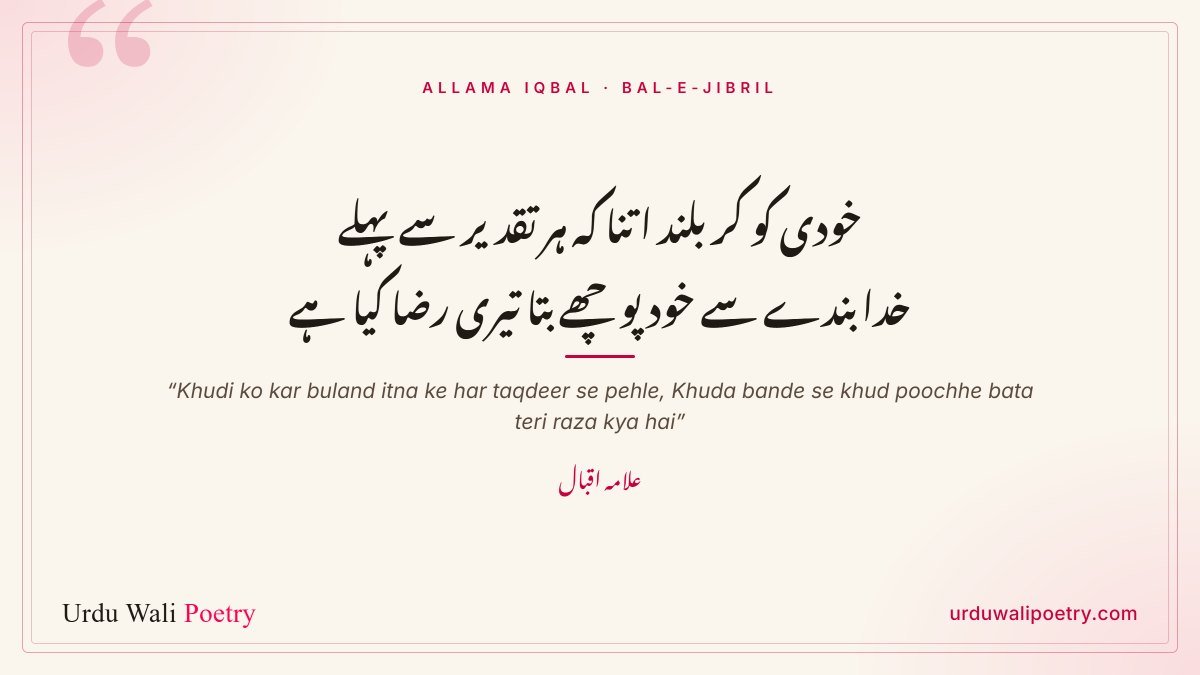
خودی کو کر بلند اتنا کہ ہر تقدیر سے پہلے
خدا بندے سے خود پوچھے بتا تیری رضا کیا ہے
Khudi ko kar buland itna ke har taqdeer se pehle
Khuda bande se khud poochhe bata teri raza kya hai
Allama Iqbal (1877-1938), Bal-e-Jibril
Explanation: Khudi is Iqbal’s word for self-respect and inner strength. Raise it so high, he says, that before writing your fate Allah asks you what you want. It does not mean pride; it means becoming a person whose efforts and prayers carry weight.
ستاروں سے آگے جہاں اور بھی ہیں
ابھی عشق کے امتحاں اور بھی ہیں
Sitaron se aage jahan aur bhi hain
Abhi ishq ke imtihan aur bhi hain
Allama Iqbal (1877-1938), Bal-e-Jibril
Explanation: There are worlds beyond the stars, and more tests of love still ahead. For Iqbal “ishq” is passion for a high goal, not only romance. Students and young people love this sher because it says: do not stop at your first success.
کشتیاں سب کی کنارے پہ پہنچ جاتی ہیں
ناخدا جن کا نہیں ان کا خدا ہوتا ہے
Kashtiyan sab ki kinare pe pahunch jaati hain
Nakhuda jin ka nahin un ka Khuda hota hai
Amir Minai (1829-1900)
Explanation: Everyone’s boat reaches the shore; those who have no “nakhuda” (boatman) have Khuda. The beauty is in the wordplay between nakhuda and Khuda. It is a sher of tawakkul, perfect for anyone who feels they have no support.
Witty and Playful Famous Urdu Sher
Urdu poets could laugh at themselves too. These three sher by Mir, Ghalib and Atish are famous because they make people smile while saying something true.
میرؔ کیا سادے ہیں بیمار ہوئے جس کے سبب
اسی عطار کے لڑکے سے دوا لیتے ہیں
Mir kya saade hain beemar hue jis ke sabab
Usi attaar ke ladke se dawa lete hain
Mir Taqi Mir (1723-1810)
Explanation: How simple Mir is: he fell ill because of the perfume-seller’s son, and now he goes to the same boy for medicine. An “attaar” sold perfumes and medicines in old Delhi. The joke is gentle, and the lesson is real: we often look for the cure in the very cause of our pain.
عشق نے غالبؔ نکما کر دیا
ورنہ ہم بھی آدمی تھے کام کے
Ishq ne Ghalib nikamma kar diya
Warna hum bhi aadmi the kaam ke
Mirza Ghalib (1797-1869)
Explanation: Love has made Ghalib useless; otherwise he was a man of some use too. People quote it as a joke, but Ghalib is also laughing at himself. It is the perfect line for a friend who has stopped doing anything since falling in love.
بڑا شور سنتے تھے پہلو میں دل کا
جو چیرا تو اک قطرۂ خوں نہ نکلا
Bara shor sunte the pehlu mein dil ka
Jo cheera to ik qatra-e-khoon na nikla
Khwaja Haidar Ali Atish
Explanation: We heard a lot of noise about the heart in the chest, but when it was cut open, not even one drop of blood came out. This sher has become a proverb (zarb-ul-masal) for anything that is all talk and no substance, from a big promise to a much-hyped film.
Share Your Own Poetry
Do you write sher of your own, or have a favourite line that is not on this list? Urdu Wali Poetry is a community for readers and poets. You can post your poetry on our site and let other readers give you daad.
Conclusion
Famous Urdu poetry lasts because it says what people feel in very few words. Mir, Ghalib, Momin, Zauq, Dagh, Iqbal and the other poets on this page wrote these lines more than a century ago, yet they still fit a WhatsApp status, a wedding speech or a quiet sad night.
If one poet on this page stayed with you, read more of their work in our collection of Mirza Ghalib poetry, our Mir Taqi Mir poetry and our famous Allama Iqbal poetry with book references. You can also visit the poet pages of Dagh Dehlvi and Momin Khan Momin, or read heart touching 2 line Urdu poetry.
FAQs
What is the most famous sher in Urdu poetry?
Mirza Ghalib’s “Hazaron khwahishen aisi ke har khwahish pe dam nikle” is often called the most famous Urdu sher. Mir Taqi Mir’s “Patta patta boota boota” and Iqbal’s “Khudi ko kar buland itna” are close behind.
Who are the most famous Urdu poets?
The best-known classical Urdu poets are Mir Taqi Mir, Mirza Ghalib, Momin Khan Momin, Sheikh Ibrahim Zauq, Dagh Dehlvi and Allama Iqbal. Among 20th-century poets, Faiz Ahmad Faiz and Ahmad Faraz are among the most widely read.
What is the difference between a sher and a ghazal?
A sher is a single couplet of two lines. A ghazal is a poem made of several sher that share the same rhyme (qafia) and refrain (radeef). Each sher in a ghazal usually makes its own complete point.
Who wrote “Zindagi kya hai anasir mein zahoor-e-tarteeb”?
This famous sher was written by Brij Narayan Chakbast (1882-1926), a poet from Lucknow. It defines life as the elements coming together in order and death as the same parts scattering.
Who wrote “Bara shor sunte the pehlu mein dil ka”?
It was written by Khwaja Haidar Ali Atish, a classical poet of Lucknow. The sher is now used as a proverb for anything that makes a lot of noise but has nothing inside.
Why is Mir Taqi Mir called Khuda-e-Sukhan?
Mir Taqi Mir is called Khuda-e-Sukhan, the master of poetry, because of his simple words and deep feeling. Even Ghalib admired him, writing that people say there was once a Mir who was the real ustad of Urdu poetry (“Kehte hain agle zamane mein koi Mir bhi tha”).
Comments0
No comments yet. Be the first to share your thoughts.