


Looking for Allah quotes in Urdu that you can actually trust? This page has 24 short Allah quotes about His mercy, His plan, dua and sukoon (peace of heart).
Every quote is written in Urdu and Roman Urdu, with a simple explanation and the exact Quran or Hadith reference, so you always know where the line comes from. At the end you will also find 3 classic sher about Allah by Mirza Ghalib and Allama Iqbal.
Allah quotes in Urdu are short lines about Allah, His mercy, power and wisdom, usually taken from the meaning of a Quran ayat or a sahih hadith and written in simple Urdu. Muslims read and share them for comfort in hard days, as daily reminders and as WhatsApp status. A good Allah quote always tells you its source.
A note before you read: the Quran lines below are mafhoom, which means they give the sense of the ayat in simple Urdu, based on well-known Urdu translations. They are not word-for-word translations, so the surah and ayat number is given with every line. You can open each one on Quran.com and read the full ayat yourself.
Table of Contents
- The Power of Allah’s Mercy and Trust
- Allah’s Wisdom, Power, and Perfect Plan
- Allah Quotes from Hadith: Mercy, Nearness and the Heart
- Short Allah Quotes for Sukoon and WhatsApp Status
- Urdu Poetry About Allah by Ghalib and Iqbal
- The Names of Allah Behind These Quotes
- Have Your Own Lines About Allah?
- Conclusion
- FAQs – Allah Quotes in Urdu
The Power of Allah’s Mercy and Trust
Allah’s mercy is wider than any mistake a person can make, and trusting Him is what keeps a believer steady when life shakes. These eight quotes are about rehmat (mercy), tawakkul (trust in Allah) and umeed (hope).
اللہ کی رحمت ہر چیز پر چھائی ہوئی ہے
Allah ki rehmat har cheez par chhai hui hai
Surah Al-A’raf, Ayat 156 (Mafhoom)
Explanation: The Arabic word in this ayat is “wasi’at”, which means wide enough to cover everything. Nothing in a person’s life sits outside that mercy: not the sinner, not the sick, not the one who missed his namaz yesterday. Keep this line close on the day you feel you have done too much wrong to come back.
جو اللہ پر بھروسہ کرے، اللہ اس کے لیے کافی ہے
Jo Allah par bharosa kare, Allah us ke liye kaafi hai
Surah At-Talaq, Ayat 3 (Mafhoom)
Explanation: “Kaafi” is the word that carries this line. It does not promise that every plan of yours will work out; it promises that Allah Himself will be enough for you.
People share it while waiting for a result, a job or a rishta, and that is exactly the kind of waiting it speaks to. If this is the feeling you are looking for, our tawakkul quotes in Urdu go deeper into trusting Allah.
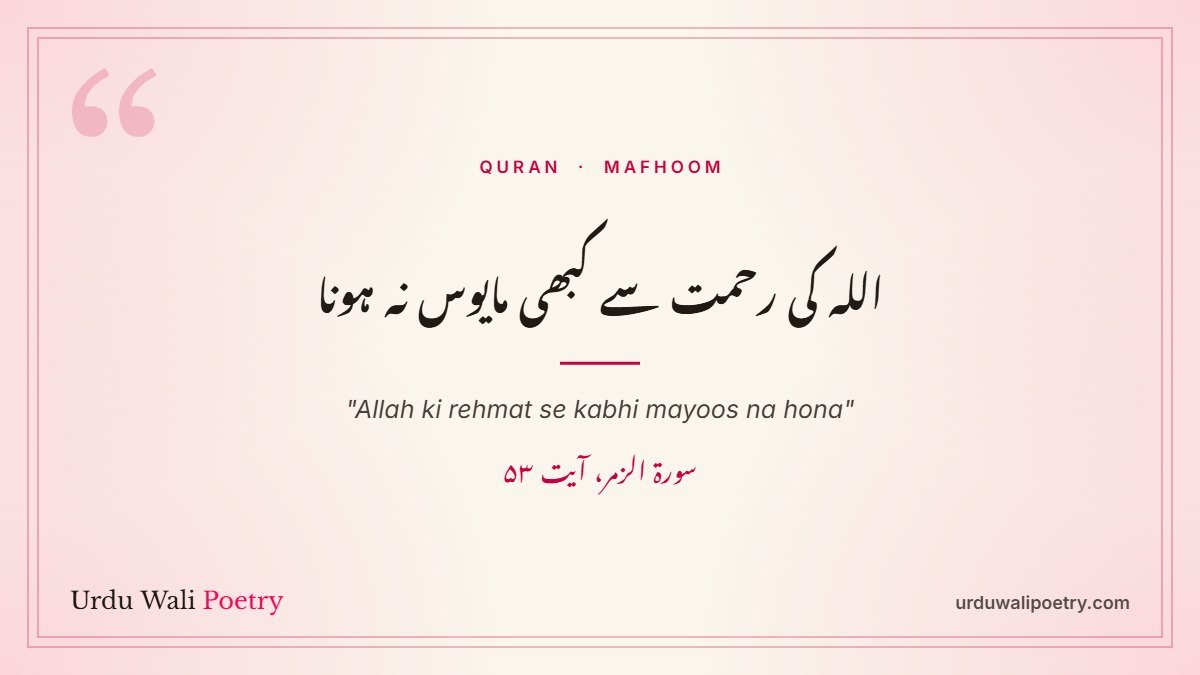
اللہ کی رحمت سے کبھی مایوس نہ ہونا
Allah ki rehmat se kabhi mayoos na hona
Surah Az-Zumar, Ayat 53 (Mafhoom)
Explanation: Read the full ayat and notice who it speaks to: people who have “wronged their own souls”. So this promise was made for sinners, not for perfect people.
The same message comes in Surah Yusuf, ayat 87, where Hazrat Yaqub (A.S) tells his sons never to lose hope in Allah’s mercy, which is why people say that hopelessness has no place in a believer’s heart.
Explanation: Some pain cannot be explained to anyone, not even to your closest friend. This line is a quiet relief for that moment: the One who matters already knows what you could not put into words. It is one of the most shared lines on sad WhatsApp statuses for this reason.
صبر کرنے والوں کو ان کا اجر بے حساب دیا جائے گا
Sabr karne walon ko un ka ajr be-hisaab diya jaye ga
Surah Az-Zumar, Ayat 10 (Mafhoom)
Explanation: Most good deeds have a measured reward. Sabr (patience) is the one Allah describes as “be-hisaab”, without counting. Patience here is not sitting silently and suffering; it is holding on to what is right for as long as the hard time lasts.
Explanation: Look at who heard these words first. They were believers shaken so badly that they cried out, “When will Allah’s help come?” The answer opens with “Sun lo” (in Arabic “ala”), a word that asks you to stop and listen. Help is near even on the days it does not feel near.
ہر دعا سنی جاتی ہے، وقت اللہ بہتر جانتا ہے
Har dua suni jati hai, waqt Allah behtar jaanta hai
Surah Al-Baqarah, Ayat 186 (Mafhoom of the first half)
Explanation: In this ayat Allah says that He is near and answers the one who calls on Him. The second half of the quote is not part of the ayat.
It is simply how many of us have learned to read our own duas over the years: some are answered at once, some later, and some in a better form than we asked for.
اللہ اپنے بندوں پر اس سے کہیں زیادہ مہربان ہے جتنی ماں اپنے بچے پر
Allah apne bandon par us se kahin zyada meharban hai jitni maa apne bache par
Sahih Bukhari 5999 (Mafhoom)
Explanation: The Prophet Muhammad (peace be upon him) said this after a mother among the captives found her lost baby and pressed him to her chest. He asked the companions whether she would ever throw her child into fire.
They said never, and then he said these words. He picked the strongest love people had seen with their own eyes, and told them Allah’s mercy is greater still.
Allah’s Wisdom, Power, and Perfect Plan
Allah’s plan is wiser than ours, even when we cannot see the reason yet. These eight quotes help on the days when something did not go the way you wanted, or when you feel wronged and unseen.
اللہ سب سے بہتر تدبیر کرنے والا ہے
Allah sab se behtar tadbeer karne wala hai
Surah Al-Anfal, Ayat 30 (Mafhoom)
Explanation: This ayat speaks of the night the leaders of Makkah plotted against the Prophet (peace be upon him) before the hijrat. They made their plan, Allah made His, and His plan won. “Tadbeer” means the plan working quietly behind the scenes, which is how Allah’s plans usually feel to us while they are happening.
Explanation: The ayat says that even our own wishing works only within what Allah wills. That is the meaning behind the words “Ma sha Allah”, which the Quran teaches in Surah Al-Kahf, ayat 39. Saying it is not just politeness; it is admitting who is really in control.
ہو سکتا ہے تم کسی چیز کو ناپسند کرو اور وہی تمہارے لیے بہتر ہو
Ho sakta hai tum kisi cheez ko napasand karo aur wahi tumhare liye behtar ho
Surah Al-Baqarah, Ayat 216 (Mafhoom)
Explanation: This is the line people hold on to after a rejection, a closed door or a plan that fell apart. The ayat goes on to say the opposite too: you may love something that is bad for you. Both halves end in the same place: Allah knows, and we do not.
کیا وہ نہیں جانتا کہ اللہ دیکھ رہا ہے؟
Kya woh nahi jaanta ke Allah dekh raha hai?
Surah Al-Alaq, Ayat 14 (Mafhoom)
Explanation: Notice that this is a question, not a statement. It works in two directions: a warning when you are tempted to do wrong in private, and a comfort when someone has wronged you and thinks nobody saw.
اللہ کے ہاں دیر ہے، اندھیر نہیں
Allah ke haan der hai, andher nahi
Urdu Proverb (meaning supported by Surah Ibrahim, Ayat 42)
Explanation: This line is not an ayat or a hadith; it is an old Urdu kahawat (proverb). “Der” means delay and “andher” means injustice, so the proverb says justice may come late but it does come. Its meaning matches Surah Ibrahim, ayat 42, where Allah says never to think He is unaware of what the wrongdoers do.
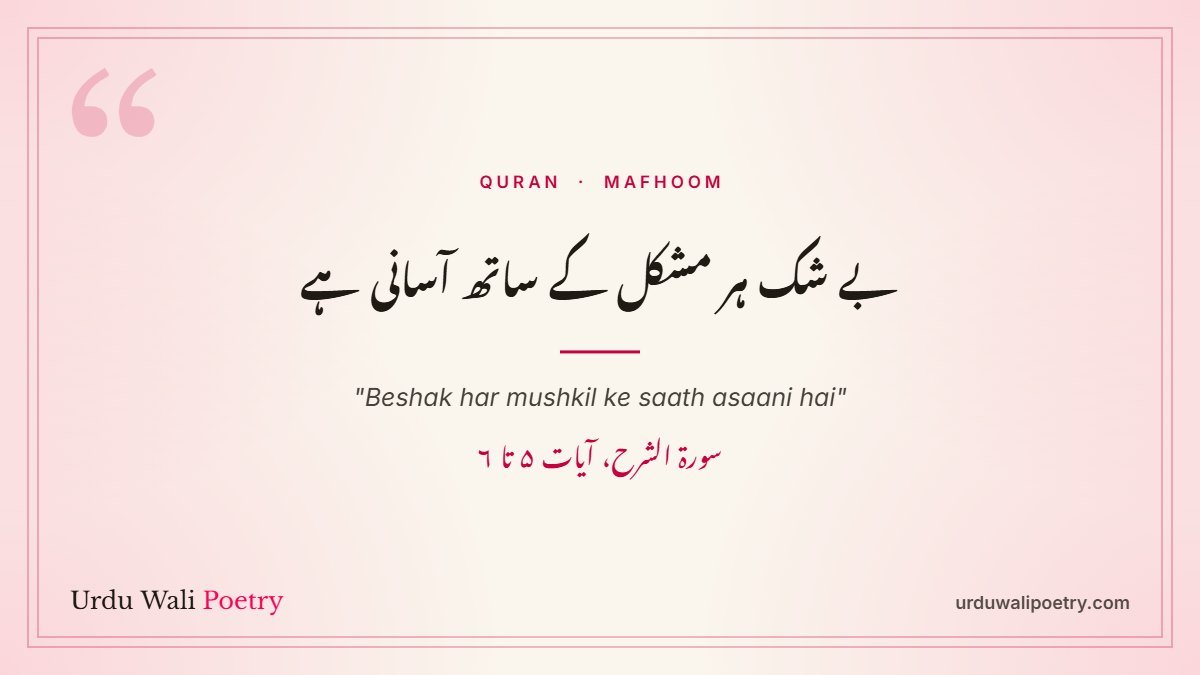
بے شک ہر مشکل کے ساتھ آسانی ہے
Beshak har mushkil ke saath asaani hai
Surah Ash-Sharh, Ayat 5 to 6 (Mafhoom)
Explanation: Most people say “mushkil ke baad asaani”, after hardship comes ease. The Arabic word in the ayat is “ma’a”, which means “with”, so the ease is already there inside the hardship. And Allah says it twice, back to back, so that nobody misses it.
تو جسے چاہے عزت دے اور جسے چاہے ذلت دے
Tu jise chahe izzat de aur jise chahe zillat de
Surah Aal-e-Imran, Ayat 26 (Mafhoom)
Explanation: These words are part of a dua that begins “Allahumma Malik al-Mulk”, O Allah, Owner of all power. Izzat (honour) and zillat (disgrace) are both in His hands, not in the hands of a boss, a family or a crowd. It is a good line to remember when people’s opinion starts to feel like the final word.
اللہ کسی جان پر اس کی طاقت سے زیادہ بوجھ نہیں ڈالتا
Allah kisi jaan par us ki taqat se zyada bojh nahi daalta
Surah Al-Baqarah, Ayat 286 (Mafhoom)
Explanation: This is from the last ayat of Surah Al-Baqarah, which many people recite before sleeping. Read it the other way around and it becomes a kind of trust: if a load is on your shoulders, Allah already knew you could carry it.
Allah Quotes from Hadith: Mercy, Nearness and the Heart
The Prophet (peace be upon him) told us a lot about Allah, sometimes in Allah’s own words, which is called a hadith qudsi. These four come from Sahih Bukhari and Sahih Muslim, the two most trusted hadith books.
میری رحمت میرے غضب پر غالب ہے
Meri rehmat mere ghazab par ghalib hai
Sahih Bukhari 3194 (Mafhoom, Hadith Qudsi)
Explanation: The Prophet (peace be upon him) said that when Allah finished creating, He wrote these words in a Book kept with Him above His Throne. Of everything Allah could have written about Himself at the very start, He chose this. “Ghalib” means stronger, the one that wins.
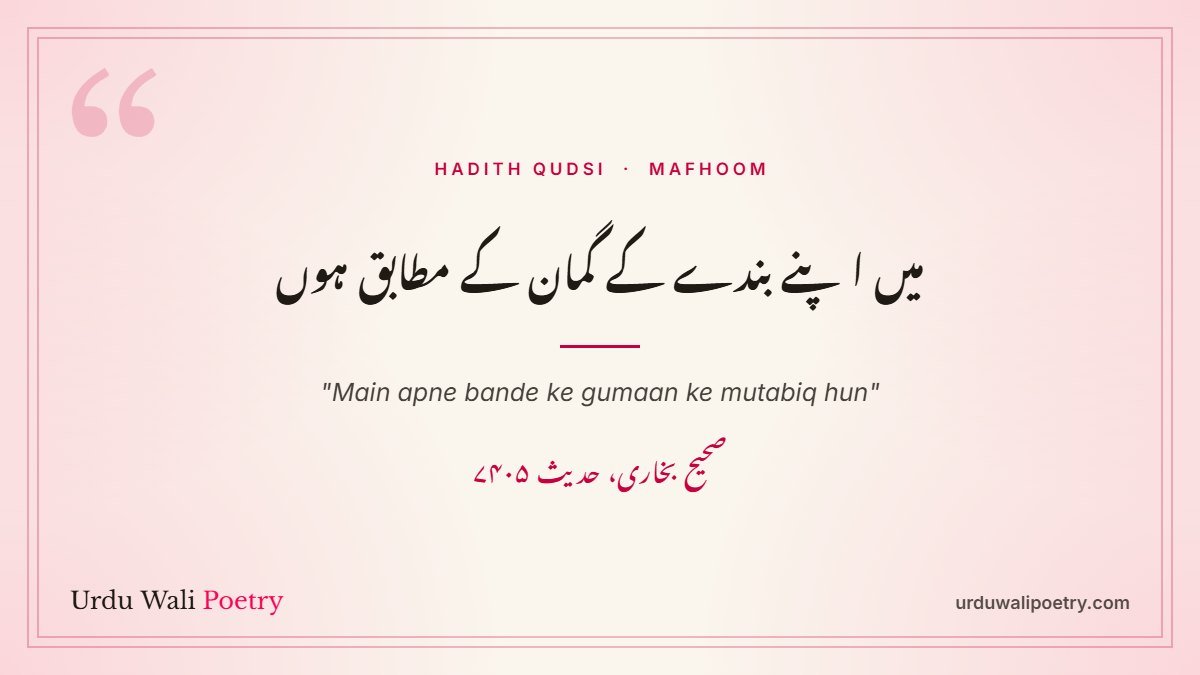
میں اپنے بندے کے گمان کے مطابق ہوں
Main apne bande ke gumaan ke mutabiq hun
Sahih Bukhari 7405 (Mafhoom, Hadith Qudsi)
Explanation: “Gumaan” is what you expect from someone. If you expect forgiveness from Allah, that is how you will find Him, so a believer should think well of his Lord. The same hadith goes on to say that if a servant comes to Allah walking, Allah comes to him running.
اللہ تمہاری صورتوں اور مالوں کو نہیں دیکھتا، وہ تمہارے دلوں اور عملوں کو دیکھتا ہے
Allah tumhari sooraton aur maalon ko nahi dekhta, woh tumhare dilon aur amalon ko dekhta hai
Sahih Muslim 2564 (Mafhoom)
Explanation: People judge each other by faces, clothes and phones. This hadith says Allah looks at two things only: what is in the heart and what you actually do. Both are needed; a good heart is shown through good deeds.
ہے کوئی جو مجھ سے دعا کرے کہ میں اس کی دعا قبول کروں؟
Hai koi jo mujh se dua kare ke main us ki dua qubool karun?
Sahih Bukhari 1145 (Mafhoom)
Explanation: The Prophet (peace be upon him) said that Allah calls out these words every night in the last third of the night. That is the time of tahajjud, when the house is asleep and nobody else is listening. If you have a dua you keep putting off, this hadith tells you when to make it.
Short Allah Quotes for Sukoon and WhatsApp Status
Short lines with a clear reference work best as a status, because the reader can check them in a few seconds. These four are among the most loved Quran lines about Allah, and each one fits in a single status.
سن لو! اللہ کے ذکر سے ہی دلوں کو سکون ملتا ہے
Sun lo! Allah ke zikr se hi dilon ko sukoon milta hai
Surah Ar-Ra’d, Ayat 28 (Mafhoom)
Explanation: The word “hi” (only) matters here. The ayat does not say that zikr is one of many ways to find peace; it says hearts find their rest in the remembrance of Allah. Money, people and success can make a person busy, but they cannot make the heart settle.
تم مجھے یاد کرو، میں تمہیں یاد رکھوں گا
Tum mujhe yaad karo, main tumhein yaad rakhun ga
Surah Al-Baqarah, Ayat 152 (Mafhoom)
Explanation: A simple deal with an unequal price: a servant remembers his Lord for a few moments, and the Lord of everything remembers that servant. Even a “SubhanAllah” said in traffic counts as remembering Him.
ہم انسان کی شہ رگ سے بھی زیادہ اس کے قریب ہیں
Hum insaan ki shah-rag se bhi zyada us ke qareeb hain
Surah Qaf, Ayat 16 (Mafhoom)
Explanation: “Shah-rag” is the jugular vein, the big vein in the neck that keeps a person alive. Nothing in the body is closer to you than that, and Allah says He is closer still. For anyone who feels alone, few lines say more in fewer words.
ہمیں اللہ کافی ہے اور وہ بہترین کارساز ہے
Hasbunallahu wa ni’mal wakeel
Surah Aal-e-Imran, Ayat 173 (Mafhoom) and Sahih Bukhari 4563
Explanation: Sahih Bukhari 4563 reports that Hazrat Ibrahim (A.S) said these words when he was thrown into the fire. The Prophet (peace be upon him) and his companions said them when they were told a big army had gathered against them.
“Wakeel” is the one you hand your affairs to, which is why this line is read when a problem is bigger than you.
Before you share any of these on WhatsApp, Facebook or Instagram, keep three small things in mind:
Write the surah and ayat number, or the hadith book and number, with the quote.
Call a Quran line “mafhoom” when it is a meaning and not a word-for-word translation.
Never add “Hazrat Ali” or any other name to a line you cannot trace. If you cannot find the source, share it without a name, or do not share it.
Urdu Poetry About Allah by Ghalib and Iqbal
Urdu poets have written about Allah too, usually through questions and longing rather than sermons. These three sher come from two of the greatest names in Urdu poetry: Mirza Ghalib (1797 to 1869) and Allama Iqbal (1877 to 1938).
نہ تھا کچھ تو خدا تھا، کچھ نہ ہوتا تو خدا ہوتا
ڈبویا مجھ کو ہونے نے، نہ ہوتا میں تو کیا ہوتا
Na tha kuch to Khuda tha, kuch na hota to Khuda hota
Duboya mujh ko hone ne, na hota main to kya hota
Mirza Ghalib
Explanation: Ghalib builds the whole sher on one word, “hona” (to exist). Before anything existed, God was there, and if nothing existed, God would still be there.
Only “I” was added, and that existence is what drowned me in worry. It is the kind of matla people quote when they want to say how small a human being is in front of Allah.
جب کہ تجھ بن نہیں کوئی موجود
پھر یہ ہنگامہ اے خدا کیا ہے
Jab ke tujh bin nahin koi maujood
Phir ye hangama ae Khuda kya hai
Mirza Ghalib
Explanation: This sher is from Ghalib’s famous ghazal “Dil-e-nadan tujhe hua kya hai”. If nothing truly exists except You, he asks Allah, then what is all this noise and rush of the world? It is a question a Sufi would ask, and Ghalib asks it with his usual mix of wonder and mischief.
کبھی اے حقیقتِ منتظر نظر آ لباسِ مجاز میں
کہ ہزاروں سجدے تڑپ رہے ہیں مری جبینِ نیاز میں
Kabhi ae haqeeqat-e-muntazar nazar aa libaas-e-majaaz mein
Ke hazaron sajde tarap rahe hain meri jabeen-e-niyaz mein
Allama Iqbal, Bang-e-Dra
Explanation: “Haqeeqat-e-muntazar” means the Reality I have been waiting for, and “jabeen-e-niyaz” is a forehead full of humility. Iqbal says thousands of sajdas are restless in his forehead, waiting for a glimpse of Allah.
Few lines in Urdu show such longing for Allah in just two misre. You can read more of his poetry on our Allama Iqbal page and in our collection of religious poetry in Urdu.
The Names of Allah Behind These Quotes
Almost every quote on this page points to one of Allah’s beautiful names, called Asma-ul-Husna. In Surah Al-A’raf, ayat 180, Allah tells believers to call on Him by these names. Here is how they connect with the quotes above:
- Ar-Rahman and Ar-Raheem (the Most Merciful): the quotes about rehmat, from the mother hadith to “meri rehmat mere ghazab par ghalib hai”.
- Al-Wakeel (the One you can trust with your affairs): “Hasbunallahu wa ni’mal wakeel” and every line about tawakkul.
- Al-Hakeem (the All-Wise): the quotes about Allah’s plan and the things we dislike that turn out good.
- As-Samee’ and Al-Baseer (the All-Hearing, the All-Seeing): the lines about dua and “Allah dekh raha hai”.
- Al-Ghafoor (the Most Forgiving): Surah Az-Zumar, ayat 53, which ends by calling Allah Al-Ghafoor and Ar-Raheem.
When you make dua, calling Allah by the name that matches your need (Ya Ghafoor when asking forgiveness, Ya Raheem when asking mercy) brings the words and the heart together.
Have Your Own Lines About Allah?
If a line about Allah’s mercy, or a dua you wrote in your own words, has stayed in your heart, you can share it with other readers on Urdu Wali Poetry. Write it in Urdu or Roman Urdu under your own name, and every post is checked before it goes live. Post your own shayari here.
Conclusion
These 24 Allah quotes in Urdu cover His mercy, His plan, His nearness and the peace that comes from remembering Him, and every one of them carries its source with it.
Keep a few in your phone for the days when you need them, and share them with the reference so others can trust them too. For more, read our Islamic quotations with meaning, our tawakkul quotes in Urdu, or the Sufi poetry in Urdu collection.
FAQs – Allah Quotes in Urdu
What are Allah quotes in Urdu?
Allah quotes in Urdu are short lines about Allah’s mercy, power and wisdom, mostly taken from the meaning of Quran ayat and sahih hadith. They are written in simple Urdu, often with Roman Urdu, so they are easy to read and share.
Are these Allah quotes from the Quran and Hadith?
Yes, 22 of the 24 quotes are the mafhoom of a Quran ayat or a hadith from Sahih Bukhari or Sahih Muslim, and the exact reference is given under each one.
The other two are clearly marked: “Allah ke haan der hai, andher nahi” is an Urdu proverb, and the second half of the dua quote is our own wording.
Are Allah quotes suitable for WhatsApp and social media status?
Yes. Short lines such as “Allah ki madad qareeb hai” or “Allah dilon ke haal khoob jaanta hai” work well as a status. Add the surah and ayat number so your contacts can check the line themselves.
Can these Allah quotes be shared without reference?
It is better not to. A Quran or hadith line without a reference can easily be changed or wrongly attributed as it travels from phone to phone. Writing the reference keeps the message correct and makes people trust it.
Do Allah quotes help during stress and sadness?
Many people find real comfort in them, because they remind the heart that Allah sees, hears and is near. Surah Ar-Ra’d, ayat 28 says hearts find peace in the remembrance of Allah. If sadness stays for a long time, talking to someone you trust or a doctor is also part of taking care of yourself.
Is “Allah ke ghar der hai andher nahi” in the Quran?
No, it is not an ayat or a hadith. It is an Urdu proverb that means justice may come late but it will come. Its meaning matches Surah Ibrahim, ayat 42, which says Allah is never unaware of what the wrongdoers do.
Comments0
No comments yet. Be the first to share your thoughts.