

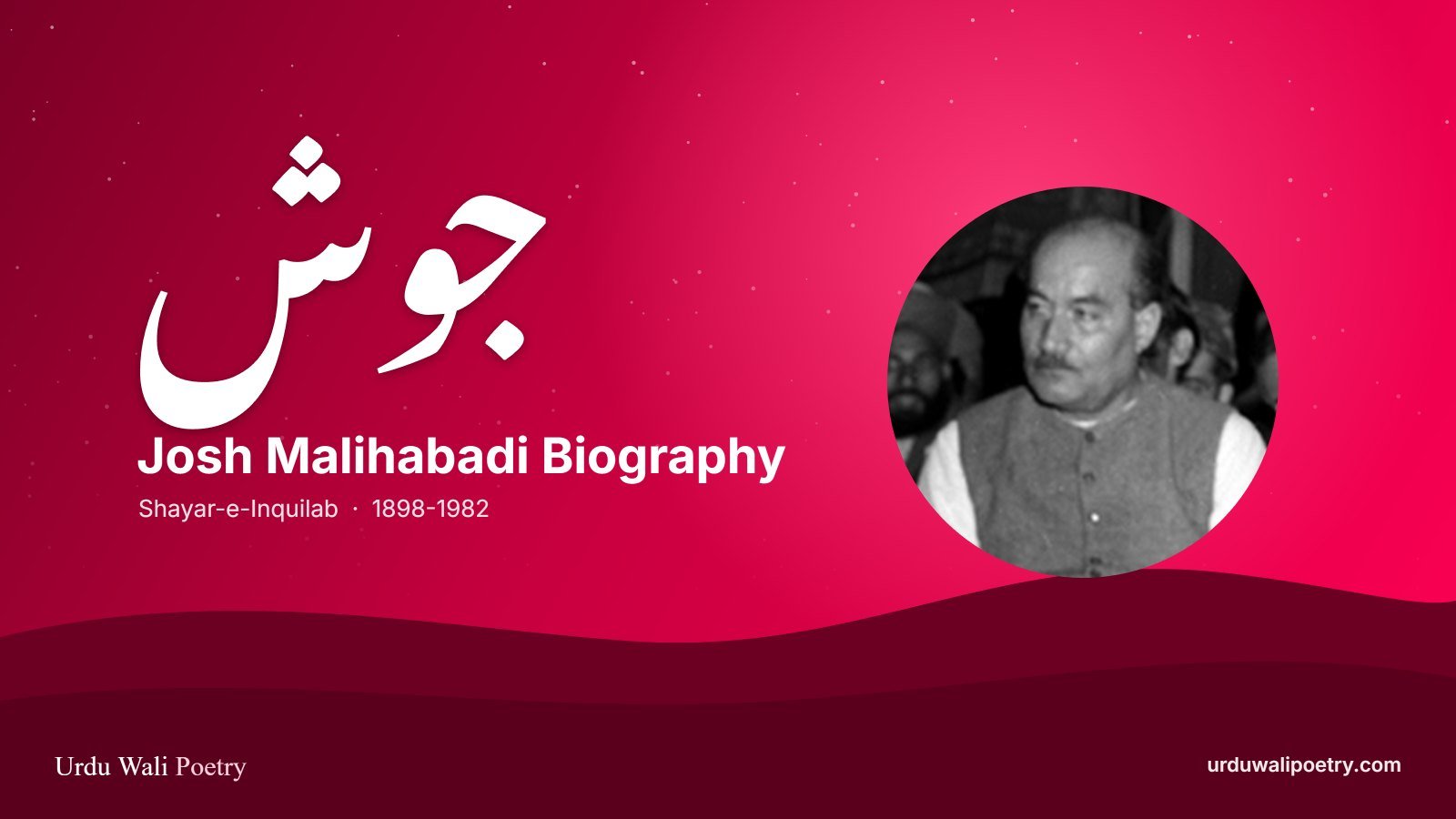
Josh Malihabadi (1898-1982) was an Urdu poet from Malihabad near Lucknow, remembered as Shayar-e-Inquilab, the poet of revolution. This biography answers what people most want to know about him: his real name, family, education, the jobs he held, his film songs, why he moved to Pakistan in 1956, his books including the autobiography Yaadon Ki Baraat, his family, and his death in Islamabad on 22 February 1982. Where sources disagree on a date or a detail, we say so plainly instead of hiding it.
Table of Contents
- Josh Malihabadi Biography: Quick Answer
- Early Life and Family in Malihabad
- Education: Agra and Shantiniketan
- How Josh Became Shayar-e-Inquilab
- Hyderabad, Kaleem and Aaj-Kal: Josh’s Working Years
- Josh Malihabadi Film Songs
- Why Josh Malihabadi Migrated to Pakistan
- Life in Pakistan: Urdu Board and Hard Years
- Josh Malihabadi Family: Son and Grandchildren
- Famous Books of Josh Malihabadi
- Yaadon Ki Baraat: Josh’s Autobiography
- Poetry Style and Themes
- Josh Malihabadi Death, Grave and Legacy
- Facts Where Sources Disagree
- Josh Malihabadi Timeline
- Have a Revolutionary Sher of Your Own?
- Conclusion
- FAQs about Josh Malihabadi
Josh Malihabadi Biography: Quick Answer
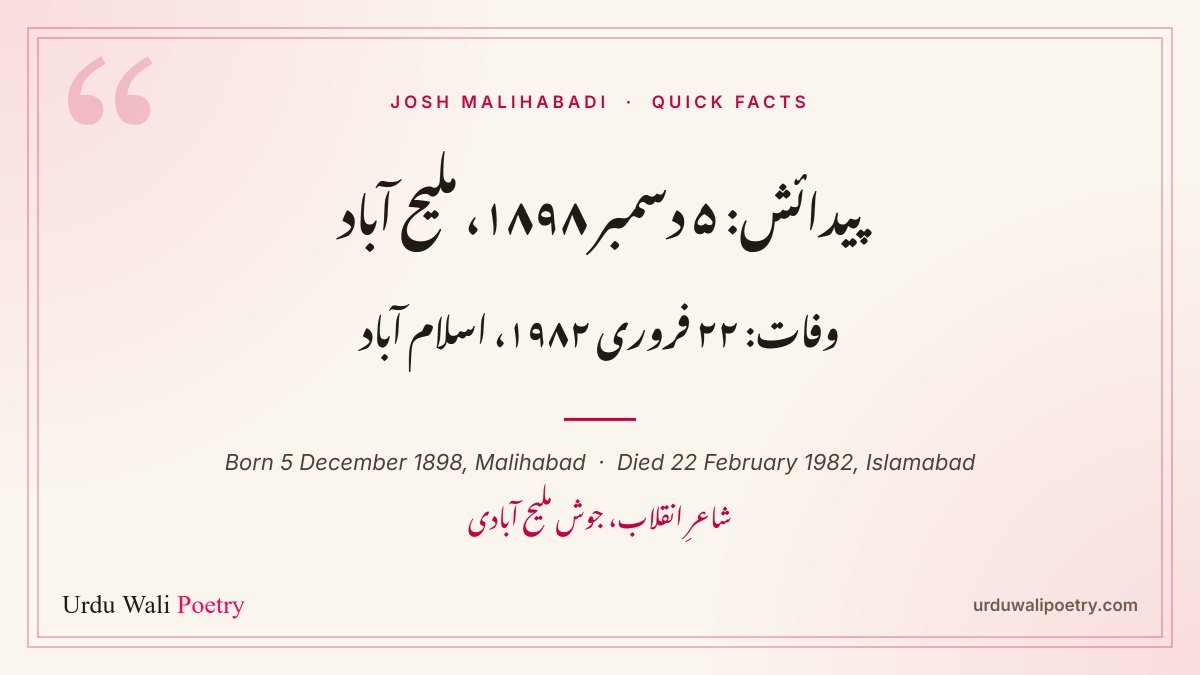
Josh Malihabadi, born Shabbir Hasan Khan on 5 December 1898 in Malihabad, was one of the leading Urdu poets of the Progressive Writers’ Movement. His fiery nazms against British rule earned him the title Shayar-e-Inquilab. He received India’s Padma Bhushan in 1954, moved to Pakistan in 1956, died in Islamabad on 22 February 1982 and lies buried in the H-8 graveyard.
Quick facts about Josh Malihabadi:
- Real name: Shabbir Hasan Khan
- Pen name (takhallus): Josh, which means passion or intensity; “Malihabadi” comes from his hometown
- Born: 5 December 1898, Malihabad, near Lucknow (then United Provinces, British India)
- Died: 22 February 1982, Islamabad, Pakistan, aged 83
- Grave: H-8 graveyard, Islamabad
- Title: Shayar-e-Inquilab (poet of revolution)
- Literary movement: Progressive Writers’ Movement
- Autobiography: Yaadon Ki Baraat (1970)
- Awards: Padma Bhushan from India (1954), Hilal-e-Imtiaz from Pakistan (presented in 2013, after his death)
Early Life and Family in Malihabad
Josh was born into a landowning family of Afridi Pathan origin in Malihabad, a small town near Lucknow. Poetry ran in the house: his father, Bashir Ahmad Khan, and his grandfather, Nawab Muhammad Ahmad Khan, both wrote verse.
His father died in 1916, when Josh was still a young man. Another relative, Abdur Razzaq Malihabadi, became a well-known journalist and a close associate of Maulana Abul Kalam Azad.
As a boy, Josh was taught Arabic, Persian, Urdu and English at home. That early grounding in Persian and Arabic explains the rich, heavy vocabulary that later became his trademark.
Education: Agra and Shantiniketan
Josh studied at St Peter’s College, Agra, and passed the Senior Cambridge examination in 1914. A few older newspaper reports place his schooling at Aligarh instead, but most detailed profiles name Agra.
In 1918 he spent about six months at Rabindranath Tagore’s Visva-Bharati in Shantiniketan.
How Josh Became Shayar-e-Inquilab
Josh got the title Shayar-e-Inquilab because his poetry openly called for revolution against British rule. Wikipedia and several Indian profiles link the title to his poem “Hussain aur Inquilab” (Hussain and Revolution), while others credit his anti-colonial nazms such as “Shikast-e-Zindan ka Khwab” (The Dream of Breaking the Prison) and “East India Company ke Farzandon se Khitaab” (Address to the Sons of the East India Company).
Both explanations point to the same thing. In the years before 1947, these nazms took the subcontinent by storm. The couplet below is the one most often used to sum him up:
کام ہے میرا تغیر نام ہے میرا شباب
میرا نعرہ انقلاب و انقلاب و انقلاب
Kaam hai mera taghayyur, naam hai mera shabaab
Mera naara: inquilab-o-inquilab-o-inquilab
Josh Malihabadi
Explanation: “Taghayyur” means change and “shabaab” means youth. The second line says inquilab three times, the way a slogan is shouted in a procession, so the sher sounds less like one man speaking and more like a crowd.
His poem on Karbala carries the same spirit. Here are its opening lines:
کیا صرف مسلمان کے پیارے ہیں حسین
چرخِ نوعِ بشر کے تارے ہیں حسین
Kya sirf musalman ke pyaare hain Hussain
Charkh-e-nau-e-bashar ke taare hain Hussain
Josh Malihabadi, from “Hussain aur Inquilab”
Explanation: Josh asks whether Imam Hussain (R.A) is loved only by Muslims, then answers that he is a star in the sky of all mankind (“nau-e-bashar” means the human race). Karbala here is not only a story of grief but a lesson in standing up to injustice, which is exactly why this poem became tied to the word inquilab.
Hyderabad, Kaleem and Aaj-Kal: Josh’s Working Years
Josh earned his living through translation, editing and writing. In 1925 he began supervising translation work at Osmania University in Hyderabad, the princely state ruled by the Nizam.
That job ended badly. Josh wrote a nazm critical of the Nizam, and he was made to leave Hyderabad. It was an early sign of a pattern in his life: he said what he thought, and he paid for it.
He then founded his own magazine, Kaleem. After independence in 1947, he became the editor of Aaj-Kal, a literary journal in India. Jawaharlal Nehru, India’s first prime minister, admired his poetry and held him in high regard.
Josh Malihabadi Film Songs
Josh also wrote songs and dialogues for films. On the advice of director W. Z. Ahmed, he joined Shalimar Pictures, which at the time also employed writers like Krishan Chander and Akhtar-ul-Iman.
For Man Ki Jeet (1944), Josh wrote six of the film’s seven songs and shared the dialogues with Krishan Chander. He also wrote lyrics for Ghulami (1945), Prithviraj Sanyukta (1946) and Shahzadi (1947).
In Pakistan, he wrote songs for the film Aag Ka Darya (1966), including the patriotic song “Ae Watan Hum Hain Teri Shama Ke Parwanon Mein”, sung by Masood Rana and Ahmed Rushdi.
Why Josh Malihabadi Migrated to Pakistan
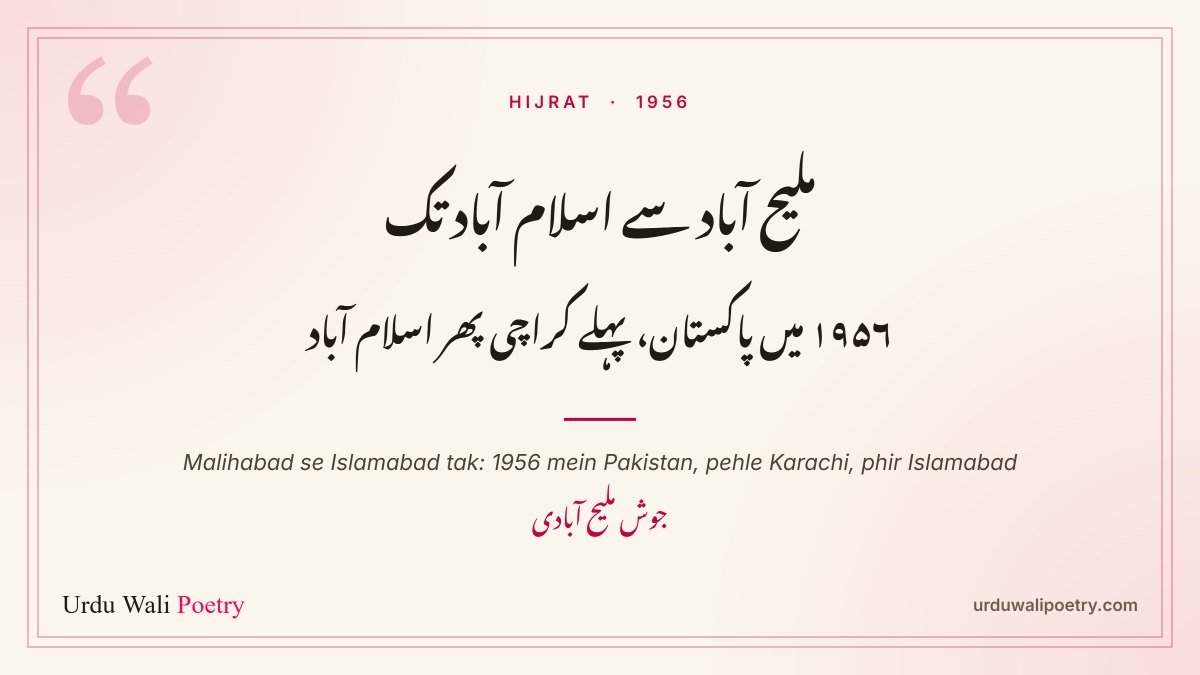
Josh Malihabadi moved to Pakistan in 1956, against the wishes of his friend Jawaharlal Nehru. The reason most often given is his worry about the future of Urdu in India, where he felt the language was being pushed aside.
A book by his grandson Farrukh Jamal Malihabadi supports this view and names his love for Urdu as the main reason. Some Indian writers, on the other hand, say he later regretted leaving. Josh’s own autobiography gives his side, and it is the best place to read his reasons in his own words.
Life in Pakistan: Urdu Board and Hard Years
In Pakistan, Josh first settled in Karachi and worked with Anjuman Taraqqi-e-Urdu alongside Maulvi Abdul Haq. He then became literary adviser to the Urdu Development Board, today’s Urdu Dictionary Board, where he worked on the Urdu dictionary. He later moved to Islamabad.
His time at the board ended after a visit to India. Rekhta’s profile says an interview he gave in Bombay in 1967 cost him the job, and his grandson Farrukh Jamal Malihabadi has said President Ayub Khan removed him. In Yaadon Ki Baraat, Josh wrote that he never spoke against Pakistan or against Ayub Khan, and that remarks were wrongly put in his mouth.
His outspokenness caused trouble again under General Zia-ul-Haq. According to his grandson, Josh criticised Zia and his work was then dropped from the school curriculum.
Josh Malihabadi Family: Son and Grandchildren
Josh’s only son was Sajjad Haider Kharosh, who remained part of his closest circle. Sajjad Haider’s daughter, the poet Tabassum Akhlaq, was born in Karachi in 1964 and moved to Islamabad with her family in 1973 to live with her grandfather.
Tabassum Akhlaq founded the Josh Memorial Committee in 1986, which holds events on his birthday and death anniversary. His maternal grandson, Farrukh Jamal Malihabadi, wrote “Josh: Mere Baba, Shakhs aur Shaair” about him and has led the Josh Literary Foundation.
Famous Books of Josh Malihabadi
Josh Malihabadi wrote more than two dozen books of poetry and prose. Wikipedia and other profiles say he wrote over 100,000 couplets and more than 1,000 rubaiyat (four-line poems) in his lifetime.
His main poetry collections are:
- Rooh-e-Adab, one of his earliest collections
- Aawaz-e-Haq (1921)
- Shola-o-Shabnam
- Fikr-o-Nishat (1937)
- Junoon-o-Hikmat
- Aayat-o-Naghmat (1941)
- Harf-o-Hikayat
- Arsh-o-Farsh (1944)
- Ramish-o-Rang
- Sumbul-o-Salasil
- Sarod-o-Kharosh
- Sumoom-o-Saba
- Tulu-e-Fikr
- Qatra-o-Qulzum
- Irfaniyat-e-Josh
His prose works include Nujoom-o-Jawahar, Mauja-e-Fikr, Auraaq-e-Sahar and Ishaaraat. Two books came out after his death: Mehraab-o-Mizraab in 1993, and Mehmil-o-Jaras, which Josh compiled himself in 1972 but which was published only 41 years after he died.
Yaadon Ki Baraat: Josh’s Autobiography
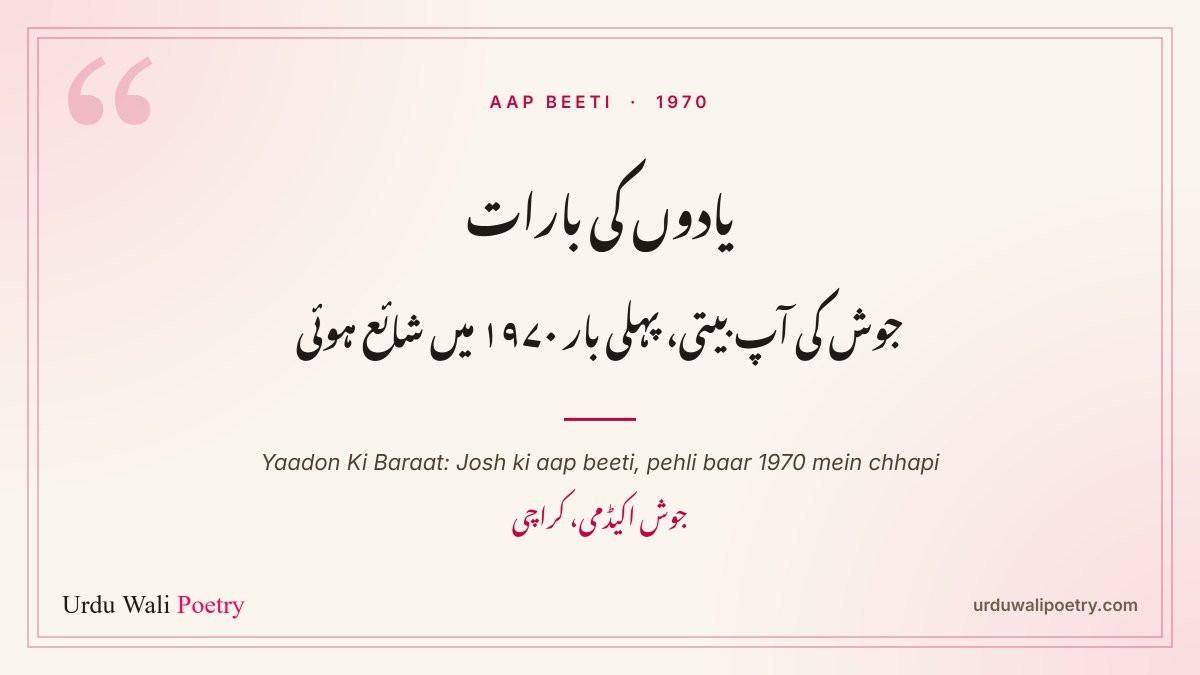
Yaadon Ki Baraat (The Procession of Memories) is Josh Malihabadi’s autobiography, first published in 1970 by Josh Academy, Karachi. The first edition runs to roughly 750 pages.
The book caused a storm. Some readers wanted it banned for its frankness, while critics praised its rich, ornate and often rhymed prose. Researcher Dr Hilal Naqvi has written that large parts of the manuscript were lost or stolen while the book was at the press, so the version we read today is incomplete.
Poetry Style and Themes
Josh preferred the nazm (a poem built around one subject) to the ghazal, and his last collection Mehmil-o-Jaras does not contain a single ghazal. He was also a master of the rubai, the four-line form with its own fixed meter.
His language is grand and heavily Persianised, and he loved long chains of images. His main themes were freedom, revolution, youth, nature, love, and a sharp questioning of blind tradition.
Yet the same poet could write very gently. This sher is one of his most shared lines:
دل کی چوٹوں نے کبھی چین سے رہنے نہ دیا
جب چلی سرد ہوا میں نے تجھے یاد کیا
Dil ki choton ne kabhi chain se rehne na diya
Jab chali sard hawa main ne tujhe yaad kiya
Josh Malihabadi
Explanation: People often say old injuries ache when the weather turns cold. Josh takes that everyday belief and turns it to the heart: every cold wind wakes the old hurt, and with it comes the memory of the beloved. That is why it fits so well as a winter WhatsApp status.
Josh Malihabadi Death, Grave and Legacy
Josh Malihabadi died in Islamabad on 22 February 1982, at the age of 83. He is buried in the old graveyard of Sector H-8, Islamabad, close to the entrance gate.
His close friends included Faiz Ahmad Faiz, Mustafa Zaidi and Syed Fakhruddin Balley, and Faiz visited him in Islamabad during his last illness. Every year, writers and his family gather at his grave on 22 February and hold events on his birthday, 5 December.
In August 2012 the Government of Pakistan announced the Hilal-e-Imtiaz for Josh. President Asif Ali Zardari presented it to his granddaughter Tabassum Akhlaq on 23 March 2013. His family and admirers have long asked for a road in Islamabad to be named after him.
Facts Where Sources Disagree
Different sources give different details about Josh’s life. Here is what we found and what we follow:
- Birth year: most sources, including Rekhta and Wikipedia, give 5 December 1898. Some Pakistani newspaper reports say 1894. We follow 1898, which also matches his recorded age of 83 at death.
- Year of migration: most sources say 1956, while some profiles and a 2014 report on his grandson’s book say 1958. We follow 1956.
- Real name: most sources write Shabbir Hasan Khan; Rekhta writes Shabbir Ahmad Hasan Khan.
- School: most profiles say St Peter’s College, Agra; a few older reports say Aligarh.
- Pakistani award: Wikipedia and most reports name the Hilal-e-Imtiaz; one Indian article calls it the Sitara-e-Imtiaz.
Josh Malihabadi Timeline
- 1898: born on 5 December in Malihabad
- 1914: passes the Senior Cambridge examination from St Peter’s College, Agra
- 1916: his father, Bashir Ahmad Khan, dies
- 1918: spends about six months at Tagore’s Shantiniketan
- 1921: publishes Aawaz-e-Haq
- 1925: starts translation work at Osmania University, Hyderabad
- 1937: publishes Fikr-o-Nishat
- 1941: publishes Aayat-o-Naghmat
- 1944: writes songs for the film Man Ki Jeet
- 1947: becomes editor of Aaj-Kal
- 1954: receives the Padma Bhushan from India
- 1956: migrates to Pakistan and settles in Karachi
- 1966: writes songs for the Pakistani film Aag Ka Darya
- 1967: loses his Urdu Board post after a visit to India (as per Rekhta)
- 1970: Yaadon Ki Baraat is published
- 1982: dies in Islamabad on 22 February
- 1986: Josh Memorial Committee is formed
- 1993: Mehraab-o-Mizraab is published
- 2013: Hilal-e-Imtiaz presented on 23 March
- 2023: Mehmil-o-Jaras is published
Have a Revolutionary Sher of Your Own?
Josh wrote for people who wanted change, and many of you write the same way: about injustice, freedom or simply about a life that needs to be different. Share those lines with our readers in Urdu or Roman Urdu under your own name. Every post is checked before it goes live, so you can post your own shayari here and join the community.
Conclusion
Josh Malihabadi lived a life as loud as his poetry. He gave up a job in Hyderabad for a poem, left India for the sake of Urdu, lost a post in Pakistan after a disputed interview, and still left behind one of the boldest autobiographies in the language.
To read his verses with meaning, visit our Josh Malihabadi poetry collection, or open Josh’s poet profile for more of his work on the site. You can also read the Faiz Ahmad Faiz biography to know more about one of his closest friends, and compare his style with Allama Iqbal poetry and Mirza Ghalib poetry.
FAQs about Josh Malihabadi
What was Josh Malihabadi’s real name?
His real name was Shabbir Hasan Khan. “Josh” was his takhallus (pen name), and “Malihabadi” comes from Malihabad, his hometown near Lucknow.
When was Josh Malihabadi born and when did he die?
He was born on 5 December 1898 in Malihabad and died on 22 February 1982 in Islamabad, at the age of 83. A few reports give his birth year as 1894, but most sources follow 1898.
Why is Josh Malihabadi called Shayar-e-Inquilab?
He is called Shayar-e-Inquilab, the poet of revolution, because his nazms openly called for freedom from British rule. Many sources link the title to his poem “Hussain aur Inquilab”.
When did Josh Malihabadi move to Pakistan?
He moved to Pakistan in 1956, despite Jawaharlal Nehru asking him to stay. Some sources give 1958, but 1956 is the year most widely recorded.
What is Yaadon Ki Baraat?
Yaadon Ki Baraat is Josh Malihabadi’s autobiography, first published in 1970 in Karachi. It is famous for its frank account of his life and its rich prose, and it was controversial from the day it came out.
Where is Josh Malihabadi buried?
He is buried in the old graveyard of Sector H-8 in Islamabad, Pakistan.
Comments0
No comments yet. Be the first to share your thoughts.