

The first cold wind of November changes everything in a Pakistani home. Evenings end early, the chai never leaves the table, razai comes out of the trunk and the nights suddenly feel twice as long. Urdu poets lived through the same season, and some wrote about it with a smile while others wrote with a sigh.
This collection of sardi poetry in Urdu brings together 15 verified classic sher and nazm lines by Nazeer Akbarabadi, Insha, Mirza Ghalib, Mir Taqi Mir, Momin, Allama Iqbal and others. Every piece is in Urdu text with Roman Urdu, the poet’s name and a short explanation. At the end you will find a few original winter lines for your WhatsApp status.
Quick answer: One of the best-known classic Urdu poems on winter is Nazeer Akbarabadi’s nazm “Jaade ki Baharen”, written in the 18th century. Classic ghazal poets rarely named the season directly, so most of their winter sher speak through long nights, sleeplessness, fire and snow. Insha, Muztar Khairabadi and Zareef Lakhnavi wrote lighter, playful sher about jaada.
Table of Contents
- What Makes Sardi Poetry in Urdu Different?
- Nazeer Akbarabadi’s Jaade ki Baharen: The Classic Winter Nazm
- Funny and Romantic Sardi Sher by Classic Poets
- Sard Raatein: Sher on Long Winter Nights and Tanhai
- Aag, Alaav and Garmi: Sher About Fire for Cold Days
- Barf aur Pahar: Allama Iqbal on Snow
- After Winter Comes Bahar: Iqbal’s Sher of Hope
- Sardi Mein Wuzu: A Hadith for Cold Mornings
- Sardi Poetry 2 Lines for WhatsApp Status
- Which Sardi Sher Fits Which Mood?
- Have a winter sher of your own?
- Conclusion
- FAQs
What Makes Sardi Poetry in Urdu Different?
Sardi poetry in Urdu mixes two moods: the comfort of the season and the loneliness of its long nights. A good winter sher can make you smile about a warm razai in one line and remind you of someone far away in the next.
Older poets usually wrote “jaada” (جاڑا), the traditional Urdu word for winter, instead of “sardi”. The word “sard” means cold, and “sard-mehri” means cold behaviour, which is why so many love sher use cold as a feeling rather than a temperature.
Most of the lines below are sher, two lines (misre) that complete one thought, taken from a ghazal. A few come from a nazm, a longer poem built around one subject. Knowing this helps you read them better: a sher stands alone, while nazm lines are part of a bigger picture.
Nazeer Akbarabadi’s Jaade ki Baharen: The Classic Winter Nazm
Nazeer Akbarabadi (1735-1830) wrote “Jaade ki Baharen”, a full nazm on the joys and troubles of winter. Each stanza closes with the same refrain, “tab dekh baharen jaade ki”, meaning “that is when you see the delights of winter”.
Nazeer was born in Delhi, lived most of his life in Agra and wrote about ordinary people, bazaars, festivals and seasons. That is why many writers call him the father of the Urdu nazm. His winter poem reads like a walk through a north Indian town in December.
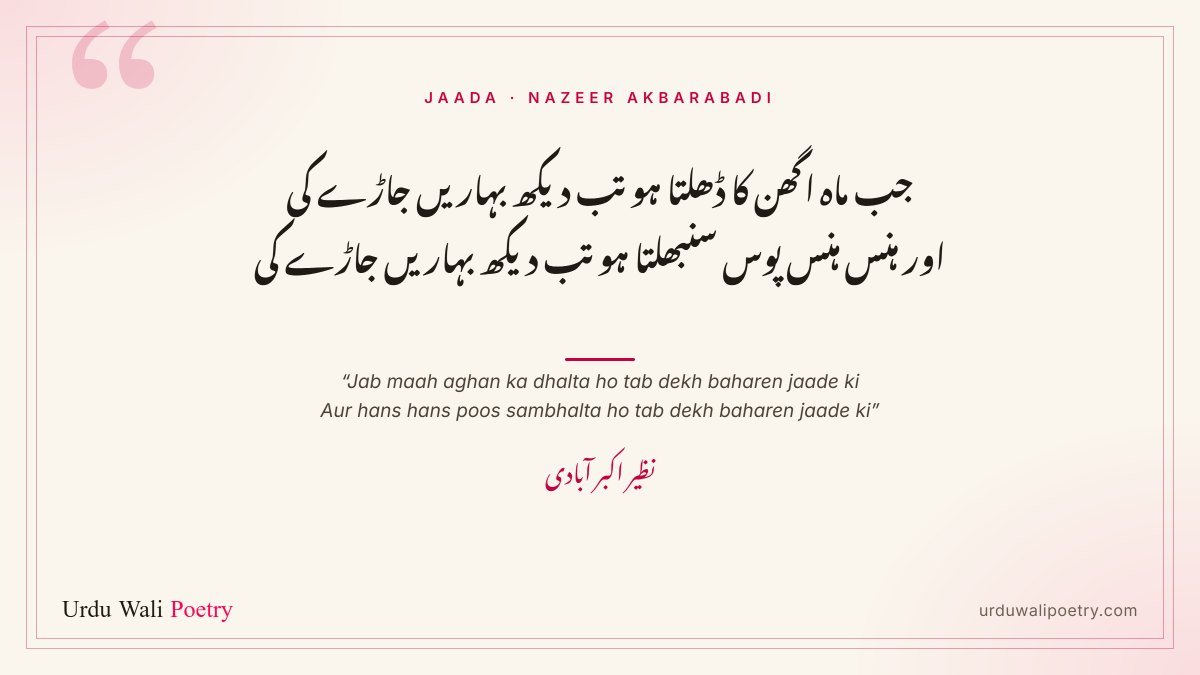
جب ماہ اگھن کا ڈھلتا ہو تب دیکھ بہاریں جاڑے کی
اور ہنس ہنس پوس سنبھلتا ہو تب دیکھ بہاریں جاڑے کی
Jab maah aghan ka dhalta ho tab dekh baharen jaade ki
Aur hans hans poos sambhalta ho tab dekh baharen jaade ki
Nazeer Akbarabadi
Explanation: Aghan and Poos are old desi months, roughly November-December and December-January. Nazeer says winter’s real fun starts when Aghan is fading and Poos arrives “laughing”. Giving a month a laugh is his way of saying the cold is coming in full mood.
دن جلدی جلدی چلتا ہو تب دیکھ بہاریں جاڑے کی
اور پالا برف پگھلتا ہو تب دیکھ بہاریں جاڑے کی
Din jaldi jaldi chalta ho tab dekh baharen jaade ki
Aur paala barf pighalta ho tab dekh baharen jaade ki
Nazeer Akbarabadi
Explanation: Everyone notices this in December: the day seems to run, and it is dark before the work is done. “Paala” is frost, the white layer on grass in the early morning. Nazeer picks two small things every reader has seen and turns them into the signs of the season.
کلّے پہ کلّا لگ لگ کر چلتی ہو منہ میں چکی سی
ہر دانت چنے سے دلتا ہو تب دیکھ بہاریں جاڑے کی
Kalle pe kalla lag lag kar chalti ho munh mein chakki si
Har daant chane se dalta ho tab dekh baharen jaade ki
Nazeer Akbarabadi
Explanation: This is Nazeer at his funniest. Teeth chatter so hard that the mouth works like a small chakki (grinding mill), as if every tooth were grinding chana. Anyone who has stepped out on a foggy January morning will laugh at how true it is.
Funny and Romantic Sardi Sher by Classic Poets
Classic poets enjoyed winter’s playful side too. The razai, the cold night and the long wait at a mushaira all found a place in their sher.
جاڑے میں کیا مزا ہو وہ تو سمٹ رہے ہوں
اور کھول کر رضائی ہم بھی لپٹ رہے ہوں
Jaade mein kya maza ho woh to simat rahe hon
Aur khol kar razai hum bhi lipat rahe hon
Insha Allah Khan Insha
Explanation: Insha (1752-1817) was known for his wit, and this matla shows it. The beloved is curled up against the cold, and the poet imagines opening the razai to join in. “Simatna” and “lipatna” are everyday words, and that ordinary language is exactly what makes the line so warm and cheeky.
وہ گلے سے لپٹ کے سوتے ہیں
آج کل گرمیاں ہیں جاڑوں میں
Woh gale se lipat ke sote hain
Aaj kal garmiyan hain jaadon mein
Muztar Khairabadi
Explanation: The trick is in the second line: it is jaada outside, but “garmiyan” inside. Muztar Khairabadi (1865-1927), the grandfather of lyricist Javed Akhtar, uses “garmi” for both warmth and closeness. Short, simple and perfect for a playful winter status.
ظریفؔ اب فائدہ کیا شاعروں کو سردی کھانے سے
غزل ہم پڑھ چکے گھر جائیں کیوں بے کار بیٹھے ہیں
Zareef ab faida kya shairon ko sardi khane se
Ghazal hum parh chuke ghar jayen kyun bekaar baithe hain
Zareef Lakhnavi
Explanation: Zareef Lakhnavi (1870-1937) was a humorous poet, and this sher pictures a long winter mushaira. His ghazal is done, so why should he sit in the cold for the rest of the night? “Sardi khana” means to bear the cold, and every poet who has waited for his turn late at night will smile at this one.
Sard Raatein: Sher on Long Winter Nights and Tanhai
Winter nights are the longest of the year, and classic poets wrote some of their most famous sher about sleepless nights and tanhai. These lines were not written for winter, but December nights make them feel brand new.
موت کا ایک دن معین ہے
نیند کیوں رات بھر نہیں آتی
Maut ka aik din muayyan hai
Neend kyun raat bhar nahi aati
Mirza Ghalib
Explanation: Ghalib’s logic is sharp: if the day of death is already fixed, what is there to fear? Then why does sleep stay away all night? The question has no answer, and that is the point. On a long sard raat, this sher speaks for every restless mind.
تھی وصل میں بھی فکرِ جدائی تمام شب
وہ آئے تو بھی نیند نہ آئی تمام شب
Thi wasl mein bhi fikr-e-judai tamam shab
Woh aaye to bhi neend na aayi tamam shab
Momin Khan Momin
Explanation: Wasl means meeting the beloved, and judai is separation. Momin says that even on the night they finally met, the fear of parting kept him awake. “Tamam shab” (the whole night) repeated at the end of both lines makes the night feel as long as a winter one.
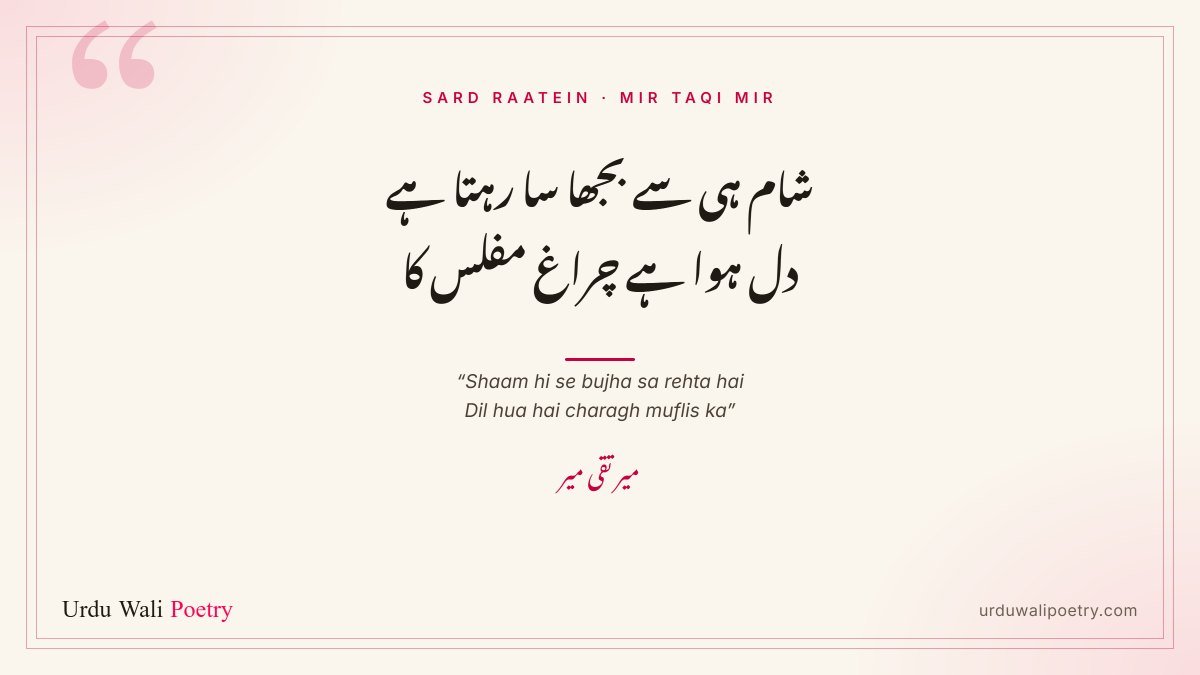
شام ہی سے بجھا سا رہتا ہے
دل ہوا ہے چراغ مفلس کا
Shaam hi se bujha sa rehta hai
Dil hua hai charagh muflis ka
Mir Taqi Mir
Explanation: A poor man (muflis) cannot afford much oil, so his lamp is dim from the evening itself. Mir compares his heart to that lamp. In winter, when darkness falls by five o’clock, this sher describes the low mood of an early evening better than any long paragraph.
تم مرے پاس ہوتے ہو گویا
جب کوئی دوسرا نہیں ہوتا
Tum mere paas hote ho goya
Jab koi doosra nahi hota
Momin Khan Momin
Explanation: Loneliness is not empty for Momin, because the beloved’s memory fills it. “Goya” means “as if”, so the closeness is only a feeling, yet it is real enough to comfort him. Many people share this on quiet winter nights when the house finally goes silent.
Aag, Alaav and Garmi: Sher About Fire for Cold Days
In winter, everyone gathers around a fire, an angeethi or an alaav. Classic poets used aag (fire) mostly as a picture of love, and these two sher show both of its sides.
عشق پر زور نہیں ہے یہ وہ آتش غالبؔ
کہ لگائے نہ لگے اور بجھائے نہ بنے
Ishq par zor nahi hai yeh woh aatish Ghalib
Ke lagaye na lage aur bujhaye na bane
Mirza Ghalib
Explanation: Ghalib calls love an “aatish” (fire) that you cannot light by force and cannot put out by force either. Anyone who has tried to start a fire with damp wood on a cold night knows the first half; the second half is about the heart.
آگ تھے ابتدائے عشق میں ہم
اب جو ہیں خاک انتہا ہے یہ
Aag the ibtida-e-ishq mein hum
Ab jo hain khaak intiha hai yeh
Mir Taqi Mir
Explanation: Mir tells the whole story of love in two lines: at the start he was fire, and now only ashes (khaak) are left. Think of the alaav at night and the grey ash in the morning. Mir needed no more words than that.
Barf aur Pahar: Allama Iqbal on Snow
Snow is the purest picture of winter, and Allama Iqbal gave Urdu one of its grandest snow images in his poem “Himala”, the opening poem of Bang-e-Dra (1924).
برف نے باندھی ہے دستارِ فضیلت تیرے سر
خندہ زن ہے جو کلاہِ مہرِ عالم تاب پر
Barf ne bandhi hai dastar-e-fazeelat tere sar
Khanda-zan hai jo kulah-e-mehr-e-alam-taab par
Allama Iqbal
Explanation: Iqbal speaks to the Himalaya. The snow on its peaks is a “dastar-e-fazeelat”, the turban of honour placed on a scholar’s head, and it even laughs (khanda-zan) at the crown of the world-lighting sun. Next time you see a photo of snowy peaks in the north, read this line with it.
After Winter Comes Bahar: Iqbal’s Sher of Hope
Every winter ends, and Urdu poetry often uses khizan (the bare, leafless season) and bahar (spring) to talk about hard times and better days. These two sher by Iqbal are among the most quoted lines of hope in Urdu.
ڈالی گئی جو فصلِ خزاں میں شجر سے ٹوٹ
ممکن نہیں ہری ہو سحابِ بہار سے
Daali gayi jo fasl-e-khizan mein shajar se toot
Mumkin nahi hari ho sahab-e-bahar se
Allama Iqbal
Explanation: A branch that breaks off the tree in the bare season will never turn green again, not even when spring clouds (sahab-e-bahar) bring rain. Iqbal is not talking about gardening. He means that a person cut off from his people and roots loses the chance to bloom again.
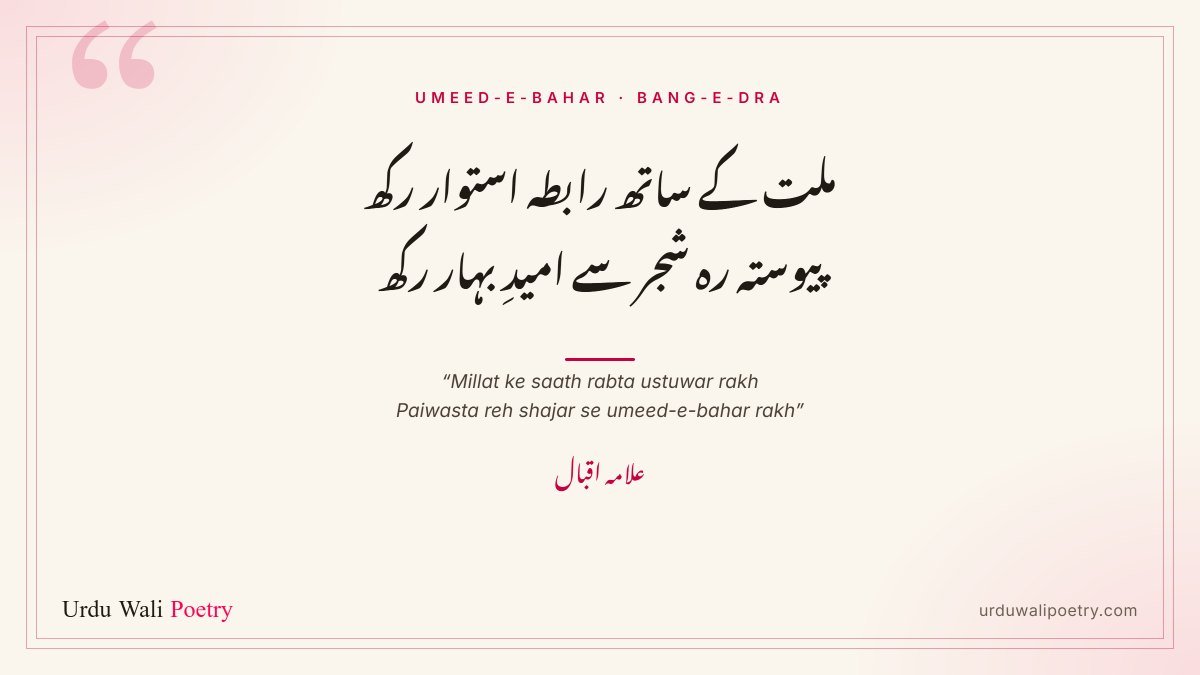
ملت کے ساتھ رابطہ استوار رکھ
پیوستہ رہ شجر سے امیدِ بہار رکھ
Millat ke saath rabta ustuwar rakh
Paiwasta reh shajar se umeed-e-bahar rakh
Allama Iqbal
Explanation: This is the answer to the sher above. Keep your bond with the millat (community) strong, stay joined to the tree, and keep hoping for spring. In the coldest weeks of the year, “umeed-e-bahar rakh” is a reminder that bare branches are not dead branches.
Sardi Mein Wuzu: A Hadith for Cold Mornings
For many people, the hardest moment of a winter day is the first wudu before Fajr. A well-known hadith in Sahih Muslim names this effort among the deeds that wipe away sins.
کیا میں تمہیں وہ عمل نہ بتاؤں جس سے اللہ گناہ مٹا دیتا ہے اور درجے بلند کرتا ہے؟ مشقت کے باوجود پورا وضو کرنا، مسجدوں کی طرف زیادہ قدم اٹھانا، اور ایک نماز کے بعد دوسری نماز کا انتظار کرنا۔
Kya main tumhein woh amal na bataun jis se Allah gunah mita deta hai aur darje buland karta hai? Mashaqqat ke bawajood poora wuzu karna, masjidon ki taraf zyada qadam uthana, aur aik namaz ke baad doosri namaz ka intezar karna.
Explanation: The Prophet (peace be upon him) asked this question to his companions and then gave the answer himself. Imam al-Nawawi explains in his commentary that the hardship here includes severe cold. Scholars also explain that you do not need to choose cold water on purpose: if warm water is available, using it is perfectly fine, and the reward is for the hardship you cannot avoid.
Note: The Urdu meaning (mafhoom) above is based on well-known Urdu translations of the hadith. For the full text, read the complete narration in Sahih Muslim.
Sardi Poetry 2 Lines for WhatsApp Status
Classic sher are best for depth, but sometimes you want a simple line for a status. The four lines below are original lines written by Urdu Wali Poetry, so you can share them freely with credit.
دسمبر کی ہوا نے پھر پرانی بات چھیڑی ہے
تری یادوں کی چادر اوڑھ کر یہ رات کاٹی ہے
December ki hawa ne phir purani baat chheri hai
Teri yaadon ki chadar orh kar yeh raat kaati hai
Urdu Wali Poetry
Explanation: A cold wind brings an old memory back, and the only shawl that helps is the memory itself. Good for a quiet December night status.
یہ دھند بھی چھٹ جائے گی، سورج بھی نکلے گا
ہر سرد رات کے پیچھے ایک سویرا ہے
Yeh dhund bhi chhat jayegi, suraj bhi niklega
Har sard raat ke peeche aik sawera hai
Urdu Wali Poetry
Explanation: Fog (dhund) always clears by noon, and that is the whole message. Share it when someone close to you is going through a hard phase.
چائے کی پیالی، ماں کی رضائی، آنگن کی دھوپ
سردی کے سارے سکھ انہی تین چیزوں میں ہیں
Chaye ki pyali, maa ki razai, aangan ki dhoop
Sardi ke saare sukh inhi teen cheezon mein hain
Urdu Wali Poetry
Explanation: No sad mood here, only the three small comforts every Pakistani home knows in winter.
کمرے میں ہیٹر جل رہا ہے پھر بھی ٹھنڈ ہے
شاید یہ سردی موسم کی نہیں، تنہائی کی ہے
Kamre mein heater jal raha hai phir bhi thand hai
Shayad yeh sardi mausam ki nahi, tanhai ki hai
Urdu Wali Poetry
Explanation: The room is warm, the heart is not. A modern line for those nights when the cold you feel has nothing to do with the weather.
Which Sardi Sher Fits Which Mood?
For a playful or romantic status, use Insha’s razai sher or Muztar’s “garmiyan hain jaadon mein”. For a sad December night, Mir’s “Shaam hi se bujha sa rehta hai” or Momin’s “tamam shab” sher work best.
If you want something funny for friends, Nazeer’s chattering teeth or Zareef’s mushaira sher will get a laugh. For hope in a hard time, nothing beats Iqbal’s “Paiwasta reh shajar se umeed-e-bahar rakh”.
Want more lines in the same mood? Read our sad poetry in Urdu collection for judai and tanhai, or browse heart touching 2 line Urdu poetry for short sher you can share any time of the year.
Have a winter sher of your own?
Cold nights bring out the best lines in many of us. If you have written something about sardi, December or a long night, share it on Urdu Wali Poetry in Urdu or Roman Urdu under your own name. Every post is checked before it goes live. Post your own shayari here.
Conclusion
Sardi poetry in Urdu is more than “thand” and “December” lines. Nazeer Akbarabadi turned the whole season into a festival, Insha and Muztar made it romantic, Zareef made it funny, and Mirza Ghalib, Mir Taqi Mir and Momin Khan Momin gave its long nights a voice.
Allama Iqbal adds the last and most useful lesson: winter ends. If you enjoyed his lines here, read more famous Allama Iqbal poetry with meaning, and find more short lines in our shayari for WhatsApp status collection.
FAQs
What is sardi poetry in Urdu called in classic poetry?
Classic poets usually wrote “jaada” (جاڑا) for winter, and words like “sard”, “paala” and “shab” for cold and night. Nazeer Akbarabadi’s nazm “Jaade ki Baharen” is one of the best-known classic poems built entirely on winter.
Who wrote “Jaade ki Baharen”?
Nazeer Akbarabadi (1735-1830) wrote “Jaade ki Baharen”. He also wrote similar poems with the same “baharen” style, such as “Holi ki Baharen” and “Barsaat ki Baharen”.
Did Mirza Ghalib write any poetry on winter?
Ghalib is not known for sher about sardi as a season. His sher on sleepless nights, such as “Neend kyun raat bhar nahi aati”, are shared widely in winter because December nights are long.
Which sardi sher is best for a romantic WhatsApp status?
Insha’s “Jaade mein kya maza ho woh to simat rahe hon” and Muztar Khairabadi’s “Aaj kal garmiyan hain jaadon mein” are short, playful and come from classic poets, so they are safe to share with the poet’s name.
Is there a hadith about winter or cold weather?
Sahih Muslim (251) mentions completing wudu despite hardship among the deeds that wipe away sins, and scholars explain that this hardship includes severe cold. You do not have to choose cold water when warm water is available.
Can I share these sardi poetry lines on WhatsApp and Facebook?
Yes. The classic sher come from poets whose work is now in the public domain, and the status lines are written by Urdu Wali Poetry. Please keep the poet’s name with every sher when you share it.