

Bano Qudsia poetry is one of the most searched phrases for Urdu quotes, but there is a surprise behind it: Bano Qudsia was not a poet. She was a novelist and playwright, and the “poetry” people share in her name is usually short lines from her prose.
This page gives you 8 of those lines from her books Raja Gidh and Hasil Ghat, each with Roman Urdu and a simple explanation.
Our older version of this page listed 16 lines with book names next to them, but we could not find a single one of them in her books or in any reliable source. We have removed them, and every line below comes with the book it is from.
Quick answer: Bano Qudsia (1928-2017), also called Bano Aapa, was a Pakistani Urdu novelist, playwright and spiritual thinker. She did not write poetry; her famous lines come from prose works such as her novel Raja Gidh (1981) and her book Hasil Ghat, and from plays like Aadhi Baat.
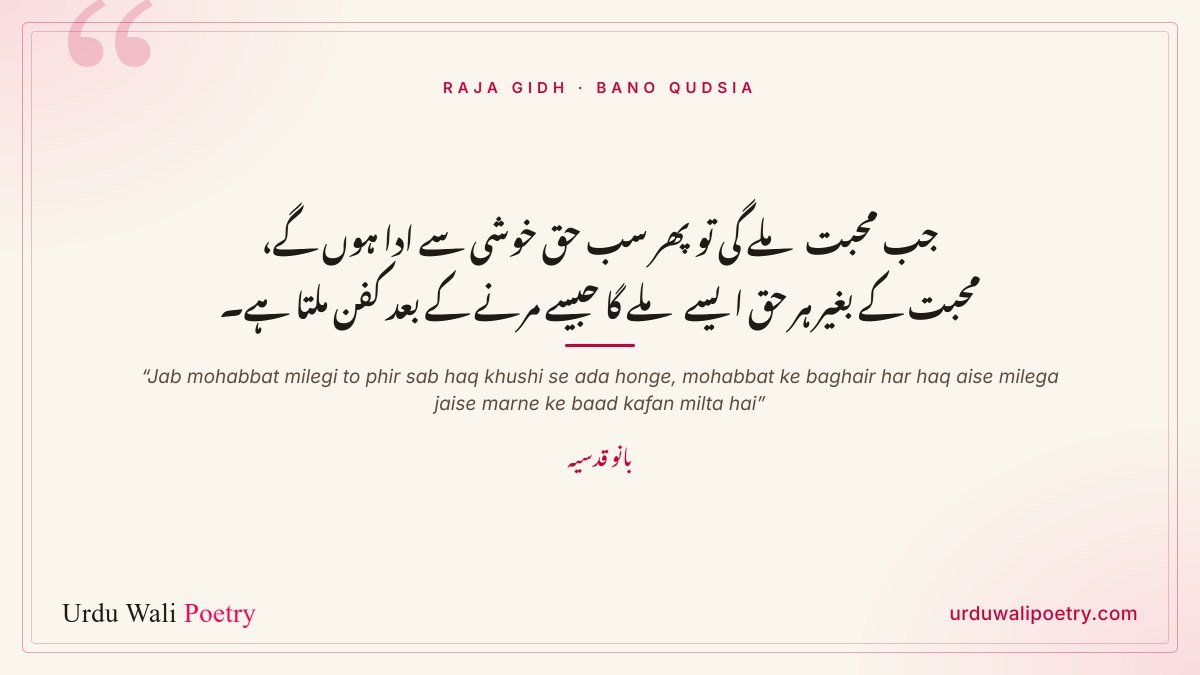
Table of Contents
Who Was Bano Qudsia?
Bano Qudsia was one of the most respected Urdu writers of Pakistan, best known for her novel Raja Gidh. Readers loved her for writing about faith, love and human weakness in simple, honest Urdu.
She was born Qudsia Chattha on 28 November 1928 in Firozpur, in British India. After Partition her family moved to Lahore, and she completed her master’s degree in 1950.
At Government College Lahore she met the writer Ashfaq Ahmed (1925-2004), whom she later married. The couple became one of the best-known literary pairs in Urdu, and both wrote widely for Pakistani television.
Her novel Raja Gidh was published in 1981 and is counted among the greatest Urdu novels. Her play Aadhi Baat is called a classic. She also wrote Mard-e-Abresham, a book about the writer Qudratullah Shahab, and Rah-e-Rawaan, a book about Ashfaq Ahmed.
She received the Sitara-i-Imtiaz in 1983 and the Hilal-i-Imtiaz in 2010. Bano Qudsia died in Lahore on 4 February 2017, at the age of 88.
Did Bano Qudsia Write Poetry?
No. Bano Qudsia wrote novels, short stories, plays and non-fiction, not poetry. The lines shared online as “Bano Qudsia poetry” are almost always sentences from her prose, cut short and set out in two lines so they look like a sher.
That is not a problem in itself: many of her sentences are as sharp as a sher. The problem is that many lines with her name on them are not hers at all. A good rule is simple: if a quote does not name the book it came from, treat it with doubt.
The 8 lines on this page are short quotations taken from two of her books, shared here with commentary so readers can understand her ideas. If your copy of the book is a different edition, the wording can differ slightly.
Bano Qudsia Reflections on Life and Self
Raja Gidh (The Vulture King) is Bano Qudsia’s best-known novel. It is built around the idea of halal and haram, and around a kind of madness (deewangi) that comes from wanting what is not yours. These four lines from it are about love, memory and choices.
جب محبت ملے گی تو پھر سب حق خوشی سے ادا ہوں گے، محبت کے بغیر ہر حق ایسے ملے گا جیسے مرنے کے بعد کفن ملتا ہے۔
Jab mohabbat milegi to phir sab haq khushi se ada honge, mohabbat ke baghair har haq aise milega jaise marne ke baad kafan milta hai.
Bano Qudsia, Raja Gidh
Explanation: Rights (haq) can be given out of duty or out of love. Bano Qudsia says that without love, even what is owed to you arrives cold and late, like a shroud that is only given after death. It is a hard line, and it is aimed at every home where duties are done but no one feels cared for.
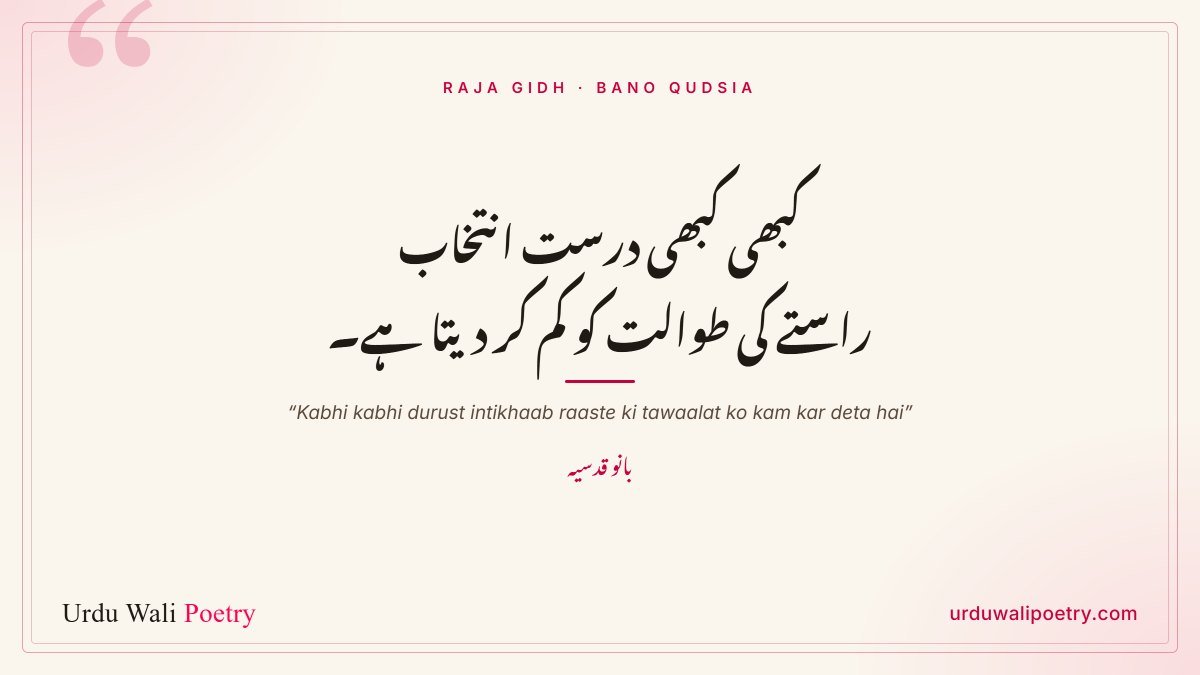
کبھی کبھی درست انتخاب راستے کی طوالت کو کم کر دیتا ہے۔
Kabhi kabhi durust intikhaab raaste ki tawaalat ko kam kar deta hai.
Bano Qudsia, Raja Gidh
Explanation: Sometimes the right choice makes the road shorter. It sounds like simple advice, but in a novel full of wrong choices it carries weight. One honest decision at the start can save years of wandering later.
آگے جانے والے لوگ پیچھے رہے ہوئے لوگوں کی طرح یاد نہیں کرتے۔
Aage jaane wale log peechhe rahe hue logon ki tarah yaad nahin karte.
Bano Qudsia, Raja Gidh
Explanation: The one who leaves and the one who is left behind do not remember each other in the same way. The one who moved on has new days to fill; the one who stayed lives with the memory. Anyone who has watched a friend or a sibling move abroad will feel this line.
پرانے وقتوں کو یاد نہیں کرتے زیادہ، نئے دنوں میں گھن لگ جاتا ہے
Puraane waqton ko yaad nahin karte zyada, naye dinon mein ghun lag jaata hai.
Bano Qudsia, Raja Gidh
Explanation: Do not remember the old days too much, or the new days will rot. “Ghun” is the small insect that eats grain from inside, and Bano Qudsia uses it well: too much nostalgia quietly eats the present, even when everything looks fine from outside.
Bano Qudsia’s Wisdom on Life
Hasil Ghat is a book by Bano Qudsia full of her thoughts on desire, love and freedom. The title roughly means “the shore of what is gained”. These four lines from it are some of her most shared words online.
اِنسان حاصل کی تمنا میں لاحاصل کے پیچھے دوڑتا ہے، اُس بچے کی طرح جو تتلیاں پکڑنے کے مشغلے میں گھر سے بہت دور نکل جاتا ہے، نہ تتلیاں ملتی ہیں نہ واپسی کا راستہ۔
Insaan haasil ki tamanna mein la-haasil ke peechhe daudta hai, us bachche ki tarah jo titliyan pakadne ke mashghale mein ghar se bahut door nikal jaata hai, na titliyan milti hain na wapsi ka raasta.
Bano Qudsia, Hasil Ghat
Explanation: This is the heart of her book’s title: haasil (what we can have) and la-haasil (what we can never have). The picture of a child chasing butterflies far from home is gentle, but the ending is not: no butterflies, and no way back either.
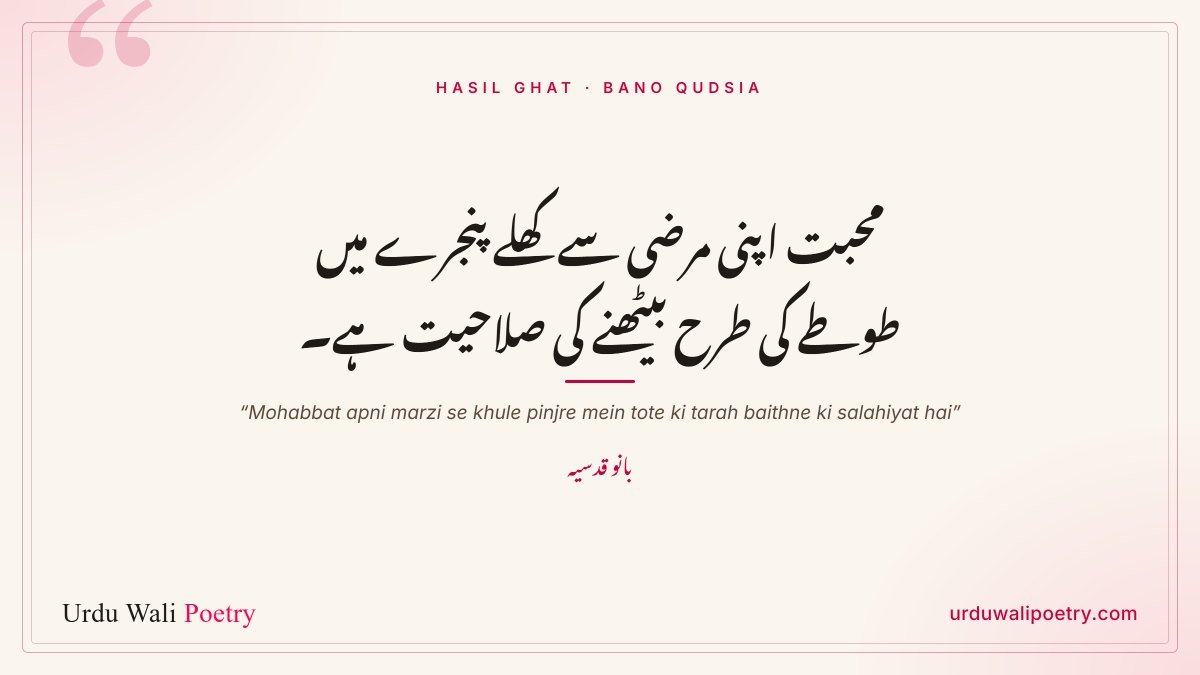
محبت اپنی مرضی سے کھلے پنجرے میں طوطے کی طرح بیٹھنے کی صلاحیت ہے۔
Mohabbat apni marzi se khule pinjre mein tote ki tarah baithne ki salahiyat hai.
Bano Qudsia, Hasil Ghat
Explanation: Love, she says, is the ability to sit like a parrot in an open cage, by choice. The door is open and the bird could fly away, but it stays. For Bano Qudsia, real love is not a locked cage; it is staying when you are free to leave.
جب انسان محدود خواہشوں اور ضرورتوں کا پابند ہوتا ہے، تو اُسے زیادہ جھوٹ بولنے کی ضرورت بھی پیش نہیں آتی۔
Jab insaan mehdood khwahishon aur zarooraton ka paaband hota hai, to use zyada jhoot bolne ki zaroorat bhi pesh nahin aati.
Bano Qudsia, Hasil Ghat
Explanation: When a person keeps their wishes and needs limited, they do not need to lie much either. It is a practical link between qana’at (contentment) and honesty: most lies are told to get more, or to hide that we wanted more.
محبت میں ذاتی آزادی کو طلب کرنا شرک ہے
Mohabbat mein zaati azaadi ko talab karna shirk hai.
Bano Qudsia, Hasil Ghat
Explanation: Bano Qudsia uses a strong word, shirk, to make her point: in love, asking for personal freedom is like setting up a rival to the one you love. Read it next to the parrot line above and you see her full idea: love is freely chosen, and once chosen, it asks for everything.
Bano Qudsia’s Famous Books
If you want to read Bano Qudsia beyond short quotes, these are the books and plays readers most often recommend. Raja Gidh is the usual starting point.
- Raja Gidh (1981): her most famous novel, about halal, haram and the madness of wanting the forbidden.
- Hasil Ghat: reflections on desire, love and freedom.
- Aadhi Baat: a stage play widely called a classic of Pakistani theatre.
- Amar Bail: another of her well-known works.
- Mard-e-Abresham: her book about the writer and civil servant Qudratullah Shahab.
- Rah-e-Rawaan: her book about Ashfaq Ahmed.
Share Your Own Poetry
Do Bano Qudsia’s words inspire you to write? Urdu Wali Poetry is a community for readers and writers. You can post your own poetry or short reflections on our site and let other readers give you daad.
Conclusion
Bano Qudsia did not write poetry, but her best sentences work like poetry: short, clear and hard to forget. Lines from Raja Gidh and Hasil Ghat about love, memory and desire are still shared every day, more than eight years after her death.
The best way to honour her is to share her words with the book’s name and, if you can, to read the books themselves. To read more from her circle of writers, see our page on Ashfaq Ahmed, her husband and fellow writer, and our collection of Wasif Ali Wasif’s sayings. You can also browse more life quotes in Urdu.
FAQs
Did Bano Qudsia write poetry?
No. Bano Qudsia was a novelist, short story writer and playwright. The lines shared as “Bano Qudsia poetry” are usually sentences from her prose books, such as Raja Gidh and Hasil Ghat.
What is Bano Qudsia’s most famous book?
Her most famous book is the novel Raja Gidh, published in 1981. It is counted among the greatest Urdu novels and is still widely read in Pakistan.
Who was Bano Qudsia’s husband?
Bano Qudsia was married to the writer Ashfaq Ahmed (1925-2004). They met at Government College Lahore and became one of the best-known literary couples in Urdu.
When did Bano Qudsia die?
Bano Qudsia died in Lahore on 4 February 2017, at the age of 88. She was born on 28 November 1928 in Firozpur.
What is the meaning of Raja Gidh?
Raja Gidh means “the vulture king”. Gidh is the Urdu word for vulture, and in the novel the vulture stands for a person who feeds on what is haram.
How can I check if a Bano Qudsia quote is real?
Look for the name of the book it comes from. A real quote usually names a book like Raja Gidh, Hasil Ghat or Amar Bail. If a line has no source, share it as a good thought without writing her name under it.
Comments0
No comments yet. Be the first to share your thoughts.