


Every year on 20 November, readers in Pakistan remember Faiz Ahmad Faiz, the poet who died in Lahore on this date in 1984. This Faiz Ahmad Faiz biography covers his whole life in simple words: his childhood in Sialkot, his college years in Lahore, the army, the newspaper, the jail years, his books and his death.
Every fact here is checked against more than one reliable source. Where sources give different years, we say so plainly instead of picking one silently.
Quick answer: Faiz Ahmad Faiz (1911-1984) was a Pakistani Urdu poet, born on 13 February 1911 in Kala Qader near Sialkot and died on 20 November 1984 in Lahore. He is famous for joining romance and revolution in the ghazal and nazm, for poems written in jail, and for books like Naqsh-e-Faryadi and Dast-e-Saba.
Table of Contents
- Who Was Faiz Ahmad Faiz? Quick Facts
- Early Life and Education in Sialkot and Lahore
- How Faiz Began His Poetic Career
- Marriage to Alys and the Army Years
- Pakistan Times and the Poem Subh-e-Azadi
- Faiz Ahmad Faiz in Jail: The Rawalpindi Conspiracy Case
- When Faiz Wrote His Books: From Naqsh-e-Faryadi to Ghubar-e-Ayyam
- Faiz Ahmad Faiz Poetry Style: Romance and Revolution
- Later Life: Lenin Peace Prize, Exile and Return
- Faiz Ahmad Faiz Death Anniversary: 20 November
- Faiz Ahmad Faiz Timeline: Key Years
- Written a Nazm of Your Own After Reading Faiz?
- Conclusion
- Frequently Asked Questions
Who Was Faiz Ahmad Faiz? Quick Facts
Faiz Ahmad Faiz was a poet, teacher, army officer, journalist and editor, and one of the most loved Urdu poets of the twentieth century. Here are the basic facts in one place.
- Real name: Faiz Ahmad
- Takhallus (pen name): Faiz
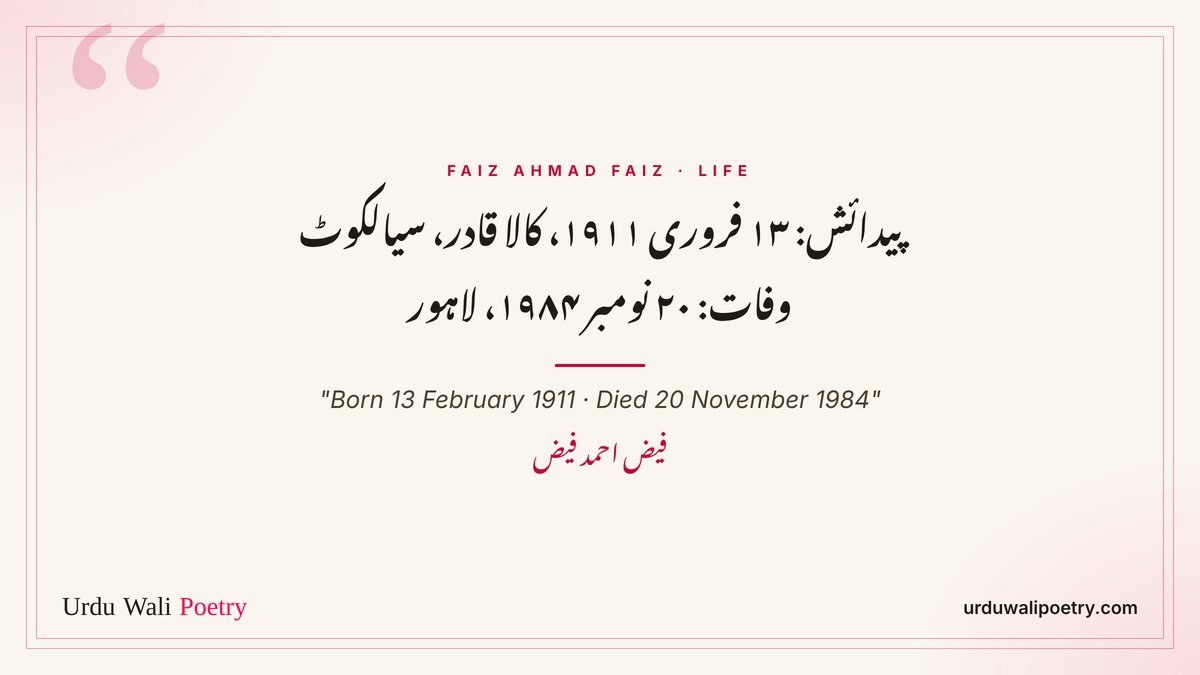
- Born: 13 February 1911, Kala Qader, Sialkot district (today Faiz Nagar, Narowal district, Punjab)
- Died: 20 November 1984, Lahore
- Buried: Model Town graveyard, Lahore
- Father: Sultan Muhammad Khan, a barrister
- Wife: Alys Faiz (married 1941)
- Daughters: Salima Hashmi and Moneeza Hashmi
- First book: Naqsh-e-Faryadi
- Complete poetry: Nuskha-ha-e-Wafa
- Major honours: Lenin Peace Prize, Nishan-e-Imtiaz (1990, after his death)
Early Life and Education in Sialkot and Lahore
Faiz grew up in the Sialkot area and studied in Sialkot first, then in Lahore. His father, Sultan Muhammad Khan, was a barrister, and the house had a strong interest in reading and languages.
As a boy, Faiz took his first lessons in religion at the local mosque, as most children of his time did. He then went to a mission school in Sialkot and did his intermediate at Murray College, Sialkot.
In 1926 he joined Government College, Lahore. He earned a BA in Arabic, then an MA in English literature in 1932, and later a second MA in Arabic from Oriental College, Lahore. That mix of Arabic, Persian and English reading shows clearly in his poetry later.
It is a small but lovely fact that Allama Iqbal also came from Sialkot and also built his life in Lahore. Two of the biggest names in Urdu poetry walked a similar road, one generation apart.
How Faiz Began His Poetic Career
Faiz’s career as a poet took shape in the 1930s, when he started teaching and joined the Progressive Writers’ Movement. These two steps shaped everything he wrote after that.
In 1935 he became a lecturer in English at M.A.O. College, Amritsar (one source gives 1936). There he met writers who believed literature should speak about ordinary people, hunger and freedom. In 1936 he joined the Progressive Writers’ Movement, the group of writers who wanted Urdu literature to deal with real life.
In 1937 he moved to Lahore to teach at Hailey College of Commerce. From 1938 he also edited the Urdu literary monthly Adab-e-Latif.
His first collection, Naqsh-e-Faryadi, came out in the early 1940s. Most sources give 1941, while some give 1943, so the exact year depends on the edition a writer looked at.
The title itself is a tribute. Faiz took the words “Naqsh-e-Faryadi” from the very first misra of Mirza Ghalib’s Diwan:
نقش فریادی ہے کس کی شوخیِ تحریر کا
کاغذی ہے پیرہن ہر پیکرِ تصویر کا
Naqsh faryadi hai kis ki shokhi-e-tahrir ka
Kaghazi hai pairahan har paikar-e-tasvir ka
Mirza Ghalib
Explanation: Every picture is complaining against its maker, says Ghalib. “Kaghazi pairahan” is a paper robe, which in old Persian custom was worn by someone seeking justice. By naming his first book after this line, Faiz placed himself in Ghalib’s tradition, with a complaint of his own about the world.
Marriage to Alys and the Army Years
Faiz married Alys George, a British woman, in 1941, and the next year he joined the British Indian Army. Both events changed his life in the 1940s.
Alys, later known as Alys Faiz, stayed with him through jail, exile and illness. Faiz’s mother gave her the name Kulsoom, and when Faiz dedicated his second book, Dast-e-Saba, “to Kulsoom”, many readers did not know who she was. The couple had two daughters, Salima Hashmi, an artist, and Moneeza Hashmi, who worked in television.
Faiz was commissioned in the army in 1942 during the Second World War and rose to the rank of lieutenant colonel. He left the army in 1947.
Pakistan Times and the Poem Subh-e-Azadi
After 1947, Faiz became the first editor-in-chief of the Pakistan Times, an English daily from Lahore. In the same year he wrote Subh-e-Azadi, one of the most quoted poems about the Partition.
Subh-e-Azadi means “the dawn of freedom”. It was written in August 1947, and it did not celebrate the way people expected. It asked whether this bloody morning was really the dawn everyone had waited for.
یہ داغ داغ اجالا یہ شب گزیدہ سحر
Ye daagh daagh ujala, ye shab-gazida sahar
Faiz Ahmad Faiz, Subh-e-Azadi (August 1947)
Explanation: “Daagh daagh ujala” is stained light, and “shab-gazida sahar” is a morning bitten by the night, the way a snake bites. One misra shows a freedom that arrived with blood on it. That is why the line still returns every 14 August, quoted by admirers and argued over by critics.
Faiz Ahmad Faiz in Jail: The Rawalpindi Conspiracy Case
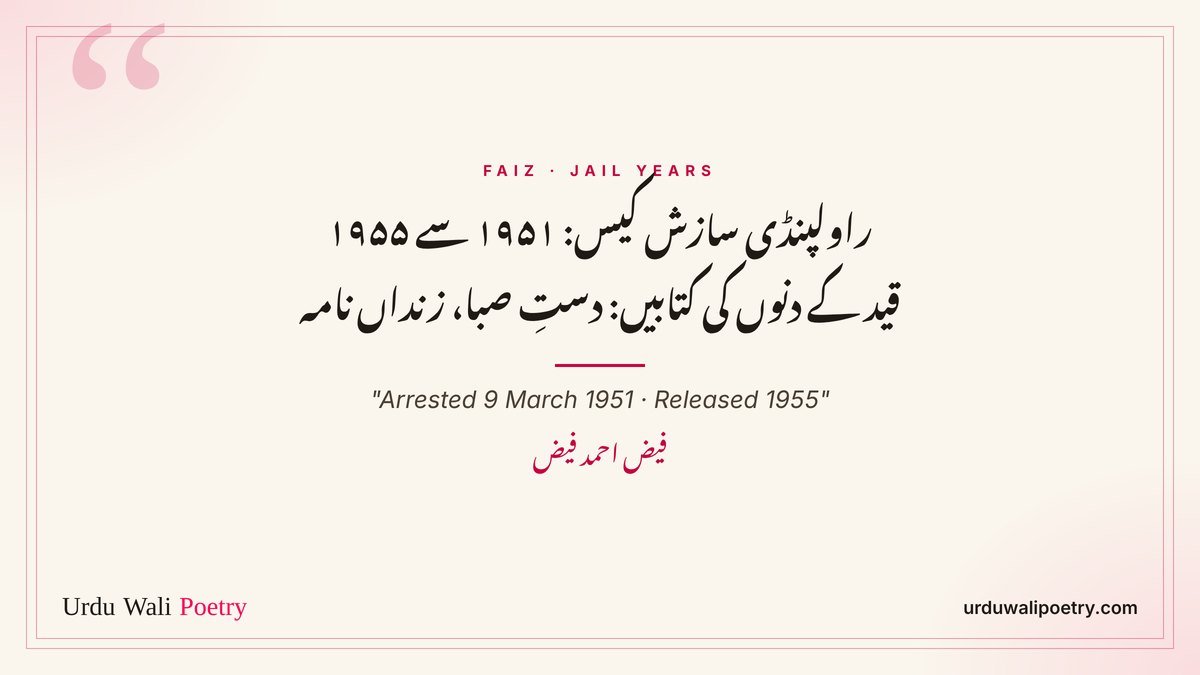
On 9 March 1951, Faiz was arrested in the Rawalpindi Conspiracy Case, an alleged plan to overthrow the government of Prime Minister Liaquat Ali Khan. He spent about four years in different jails and was released in 1955.
Most sources say four years; a few count it as five, because the case began in early 1951 and ended in 1955. The jail years were the hardest of his life, and also the years that gave Urdu some of its finest poems.
Dast-e-Saba was published while he was still in prison, and Zindan Nama (zindan means prison) gathered the poems he wrote behind bars. At times he was not even given pen and paper, and his poems were carried out of jail with the help of sympathetic jail staff.
متاعِ لوح و قلم چھن گئی تو کیا غم ہے
Mata-e-lauh-o-qalam chhin gayi to kya gham hai
Faiz Ahmad Faiz, Dast-e-Saba
Explanation: “Lauh-o-qalam” is the tablet and pen, and “mata” means wealth. So what if they took my pen and paper, asks Faiz; the next misra says he has dipped his fingers in his heart’s blood instead. For a poet in a cell, this was not a metaphor but his daily life.
After Ayub Khan’s martial law in 1958, Faiz was detained again for a short time. He was a poet whom every government of his era watched closely.
When Faiz Wrote His Books: From Naqsh-e-Faryadi to Ghubar-e-Ayyam
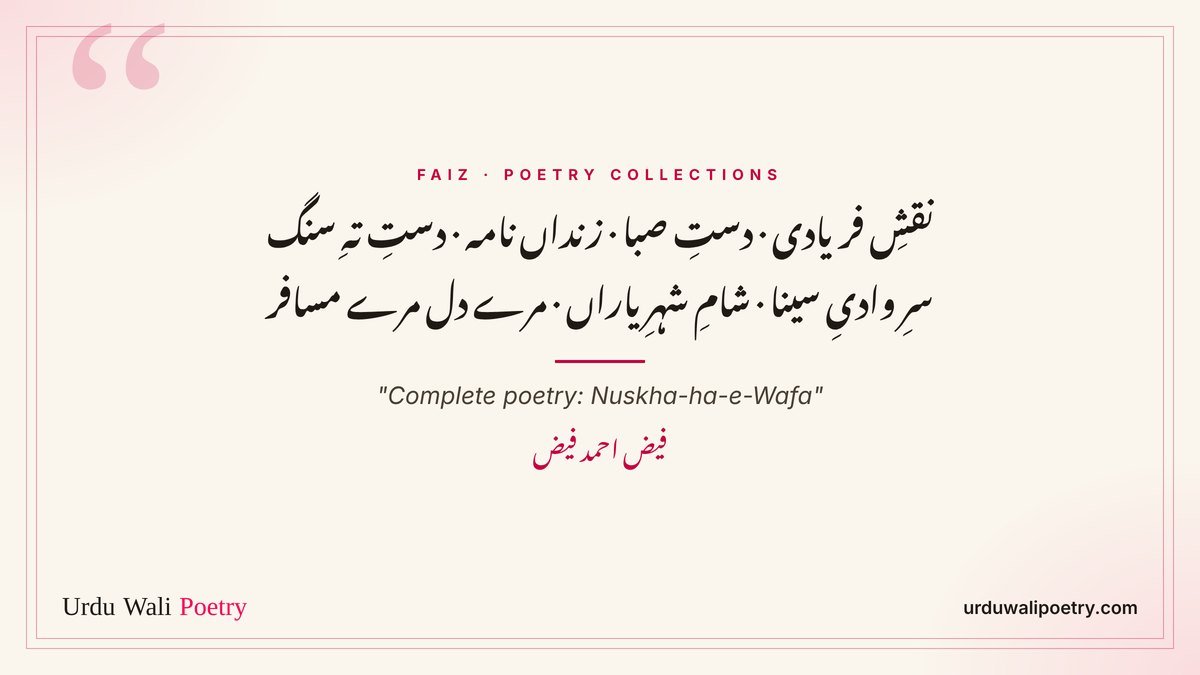
Faiz published eight main poetry collections, and all his poetry is now collected in one volume called Nuskha-ha-e-Wafa. Here they are in their usual order.
- Naqsh-e-Faryadi (first published in the early 1940s, mostly dated 1941)
- Dast-e-Saba (1952; some sources say 1953)
- Zindan Nama (1956; some sources say 1955)
- Dast-e-Tah-e-Sang
- Sar-e-Wadi-e-Sina
- Sham-e-Shehr-e-Yaran
- Mere Dil Mere Musafir
- Ghubar-e-Ayyam
Publication years differ from one source and edition to another, so we give years only where most sources agree. He also wrote prose, including essays and letters, and some poems in Punjabi.
Faiz Ahmad Faiz Poetry Style: Romance and Revolution
Faiz’s style joins two things that were usually kept apart: the soft language of love and the hard language of politics. He used the classical words of the ghazal, like saqi, mehboob, sahar and qafas, but filled them with new meanings about freedom and injustice.
He wrote both ghazal (a poem of independent couplets with one rhyme pattern) and nazm (a poem on one theme from start to end). His music came from the old masters; his subjects came from the street, the prison and the newspaper.
The clearest example is his nazm “Mujh se pehli si mohabbat meri mehboob na maang” from Naqsh-e-Faryadi. The lover tells his beloved not to ask for the old kind of love, because he has now seen hunger and injustice, and the world has sorrows other than love.
His nazm “Bol” from the same book does the same thing with politics: speak, because your lips are still free. Both poems, with other famous Faiz sher, are explained line by line in our Faiz Ahmad Faiz poetry collection, so here we only show where they sit in his life.
Later Life: Lenin Peace Prize, Exile and Return
In his later years Faiz became known around the world, but he spent part of that time away from Pakistan. He received the Lenin Peace Prize and was the first Asian poet to be given it.
Most sources give the year of the prize as 1962, while some reports say 1963. It was a rare honour for an Urdu poet and made his name known far beyond South Asia.
After the political changes of the late 1970s, Faiz left Pakistan and lived for several years mostly in Beirut. He came back to Lahore in 1982, already in poor health. His later nazm “Hum Dekhenge” is still one of the most recited poems of resistance in the region.
Faiz Ahmad Faiz Death Anniversary: 20 November
Faiz Ahmad Faiz died in Lahore on 20 November 1984, at the age of 73, after a long illness of the lungs and heart. He was buried the next day, 21 November, in the Model Town graveyard in Lahore.
A little before his death, he had been nominated for the Nobel Prize in Literature. In 1990 the Government of Pakistan honoured him after his death with the Nishan-e-Imtiaz, the country’s highest civil award.
Every 20 November, newspapers, radio and poetry lovers remember him by sharing his lines. The Faiz Foundation also keeps his memory alive with a yearly Faiz Mela in Lahore.
His real legacy is simpler: Faiz made it normal for an Urdu poet to write about love and justice in the same breath. Almost every protest poem and every modern love nazm in Urdu owes something to him.
Faiz Ahmad Faiz Timeline: Key Years
- 1911: Born on 13 February in Kala Qader, Sialkot district
- 1926: Joins Government College, Lahore
- 1932: MA in English from Government College, Lahore
- 1935: Lecturer in English at M.A.O. College, Amritsar
- 1936: Joins the Progressive Writers’ Movement
- 1941: Marries Alys George; Naqsh-e-Faryadi published (year most sources give)
- 1942: Joins the British Indian Army
- 1947: Leaves the army; becomes editor of the Pakistan Times; writes Subh-e-Azadi
- 1951: Arrested on 9 March in the Rawalpindi Conspiracy Case
- 1955: Released from jail
- 1962: Lenin Peace Prize (some reports say 1963)
- 1982: Returns to Lahore after years abroad
- 1984: Dies in Lahore on 20 November
- 1990: Nishan-e-Imtiaz awarded after his death
Written a Nazm of Your Own After Reading Faiz?
Faiz showed that a poem can carry your heart and your country’s pain together. If his lines have pushed you to write something of your own, a nazm, a ghazal or even a single sher, share it with other readers on Urdu Wali Poetry. Post it in Urdu or Roman Urdu under your own name, and every post is checked before it goes live: Post your own shayari here.
Conclusion
Faiz Ahmad Faiz lived 73 years and spent many of them in jail, in exile or under watch, yet his poems stayed gentle, musical and full of hope. From the Ghalib-inspired title of his first book to the last poems of his life, he kept the classical beauty of Urdu while changing what it could talk about.
If you came here on his death anniversary, a good way to remember him is to read his poems slowly and share one line that speaks to you. You can also read Iqbal’s poetry, the work of his fellow son of Sialkot, or explore more poetry by mood on our site.
Frequently Asked Questions (FAQs)
What was Faiz Ahmad Faiz’s real name?
His real name was Faiz Ahmad, and “Faiz” was his takhallus (pen name). In Urdu poetry the takhallus usually appears in the last sher of a ghazal, called the maqta.
When did Faiz Ahmad Faiz die?
Faiz Ahmad Faiz died on 20 November 1984 in Lahore, at the age of 73. His death anniversary is remembered every year on 20 November.
Where is Faiz Ahmad Faiz buried?
He is buried in the Model Town graveyard in Lahore. He was buried on 21 November 1984, a day after his death.
Why was Faiz Ahmad Faiz sent to jail?
He was arrested on 9 March 1951 in the Rawalpindi Conspiracy Case, an alleged plan to overthrow the government of Liaquat Ali Khan. He spent about four years in jail and was released in 1955.
What was Faiz Ahmad Faiz’s first book?
His first poetry collection was Naqsh-e-Faryadi, published in the early 1940s (most sources say 1941). Its title comes from the first misra of Mirza Ghalib’s Diwan.
Which awards did Faiz Ahmad Faiz receive?
He received the Lenin Peace Prize (dated 1962 in most sources) and was nominated for the Nobel Prize in Literature shortly before his death. Pakistan awarded him the Nishan-e-Imtiaz in 1990, after his death.
Comments0
No comments yet. Be the first to share your thoughts.